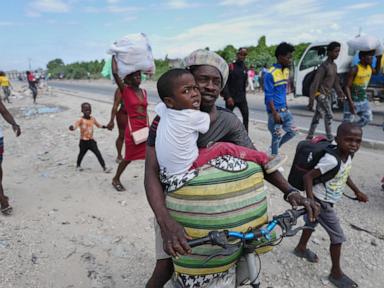
In the hills above Port-au-Prince, the sunrise no longer signals a new day of commerce, but a fresh assessment of loss. Since May 2026 began, the Viv Ansanm gang coalition has executed a series of surgical strikes across the Kenscoff commune and the southern fringes of the capital, displacing thousands of civilians who thought they were out of reach. This is not random chaos. It is a systematic clearing of the board. By forcing over 1.43 million people into internal displacement, Haiti’s armed groups have successfully replaced a failing democracy with a lucrative, parallel state built on the ruins of the neighborhoods they once claimed to protect.
While international headlines focus on the "spasm of violence," the reality is a cold, calculated consolidation of power. The displacement is the objective.
The Geography of Erasure
For the veteran observer, the current exodus is distinct from the uncoordinated skirmishes of 2021. Under the leadership of Jimmy "Barbecue" Chérizier, the Viv Ansanm alliance has moved past mere turf wars. They are now practicing territorial engineering. By depopulating strategically significant zones like the Artibonite valley—Haiti's breadbasket—and the corridors leading to the southern peninsula, gangs achieve two goals. First, they create "no-man's lands" that act as defensive buffers against the newly arriving United Nations-authorized Gang Suppression Force (GSF). Second, they seize abandoned assets, from warehouses to private estates, to house their own supply chains.
The numbers are staggering. Over 90% of Port-au-Prince is now under gang administration. This is not "control" in the sense of a temporary occupation; it is a total capture of the micro-economy. In the displacement camps—often nothing more than overcrowded schoolyards or public squares—the state is entirely absent. There is no police presence, no municipal water, and no judicial recourse. When the state retreats, the gang becomes the only provider, albeit a predatory one.
The Collapse of the Multinational Security Support Mission
The departure of the Kenyan police contingent in late April 2026 marked the end of a flawed experiment. Underfunded and tactically mismatched for the urban labyrinths of Cité Soleil and Delmas, the Kenyan-led mission struggled to hold territory. Their exit left a vacuum that Viv Ansanm was prepared to fill within hours.
The transition to the GSF, a force theoretically comprised of 5,500 personnel, has so far been a trickle rather than a flood. As of mid-May, only a few hundred Chadian officers have hit the ground. They face a battlefield where the enemy is not just armed with rifles, but with kamikaze drones and an intelligence network that spans every street corner. The gangs have had years to fortify; the peacekeepers are learning the map from scratch.
The Child Soldier Industrial Complex
One of the most harrowing shifts in the 2026 landscape is the demographic of the gunmen. United Nations assessments now suggest that half of all gang members are children. This is not an accidental byproduct of poverty; it is a recruitment strategy. As schools close—with 93% of assessed facilities now serving as makeshift shelters for the displaced—an entire generation has been severed from the formal economy.
For a twelve-year-old in a displacement camp, the gang offers the only visible path to survival. They are used as "claireurs" (scouts), spies, and increasingly, as front-line combatants. The psychological toll of this mass conscription ensures that even if the gang leaders are neutralized, the social fabric remains poisoned. The "why" of the current displacement is linked directly to this: by destroying the home and the school, the gang ensures its future labor pool.
A Political Vacuum at the Peak
While the streets burn, the political transition remains in a state of suspended animation. The Transitional Presidential Council (TPC) saw its mandate expire in February, handing over a fragile executive power to Prime Minister Alix Didier Fils-Aimé. The promise of elections in August 2026 feels like a fever dream to the thousands currently sleeping on cardboard in the Nazon district.
How can a country vote when:
- The National Palace has been attacked ten times in the last year.
- The main airport and seaports are frequently paralyzed by sniper fire.
- Over 10% of the population is in flight.
The gangs know this. They are intentionally maintaining a "controlled instability" to prevent any legitimate authority from taking root. By keeping the population in a state of permanent transit, they ensure that a census is impossible and an election is a farce.
The Humanitarian Blind Spot
International aid is failing. Funding for the 2026 Humanitarian Needs and Response Plan remains a fraction of what is required. With the United States pulling back significant aid budgets and the Dominican Republic aggressively deporting hundreds of thousands of Haitians back into this war zone, the pressure cooker has no vent.
We are witnessing the birth of a captured state. It is a territory where the "gang" is the government, the tax collector, and the executioner. The displacement of hundreds this week is simply another line item in a long-term ledger of state erasure. Unless the GSF can do more than just guard government buildings—unless they can actually provide the security necessary for people to return to their homes and for schools to reopen—the displacement will not be a temporary crisis. It will be the permanent condition of Haiti.
The intervention must be as sophisticated as the insurgency it faces. If the focus remains solely on "suppression" without a corresponding plan for radical social reintegration and the rebuilding of the domestic judicial system, the gangs will simply wait out the foreigners. They have nowhere else to go. The people of Haiti do, but they are running out of places to hide.