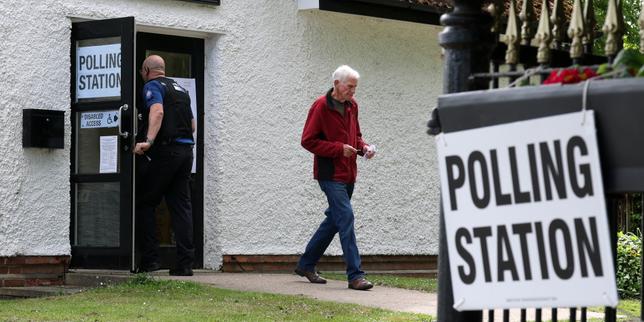
The British electorate is currently engaged in an act of mass eviction rather than a celebration of new management. While the polls suggest a historic landslide for Keir Starmer’s Labour Party, the atmosphere on the ground is not one of 1997-style euphoria. It is one of exhaustion. Voters are heading to the booths with a singular, grim determination to punish a Conservative government that has overseen a decade and a half of stagnation, internal warfare, and public service decay. Starmer stands on the threshold of power not because he has captured the national imagination, but because he is the only person left standing in the room after the ceiling fell in.
This is a mandate built on a void. The "change" Starmer promises is more a pledge of administrative competence than a radical reimagining of the British state. For a country grappling with the highest tax burden in seventy years and a National Health Service (NHS) that functions as a national trauma ward, the lack of a clear, funded roadmap for recovery is the silent crisis of this election.
The Strategy of Strategic Silence
Starmer’s path to Number 10 has been paved with "Ming vase" politics—carrying a fragile lead across a polished floor, terrified of a single slip. His team has systematically stripped away any policy that could be framed as a fiscal target by the right-wing press. The most notable casualty was the £28 billion green investment pledge, once the centerpiece of Labour’s economic identity. By ditching it, Starmer successfully neutralized the "tax and spend" attacks that sank his predecessors, but he also left a gaping hole where an industrial strategy used to be.
The result is a campaign of managed expectations. Labour’s "First Steps" are intentionally modest: recruitment of more teachers, cutting NHS waiting lists by using overtime, and creating a new border security command. These are surgical interventions, not systemic overhauls. The gamble is that the British public is so desperate for stability that they will accept a leader who promises very little, as long as he delivers it reliably.
The Conservative Collapse and the Rise of the Right Flank
The incumbent Conservative Party is not merely losing; it is decomposing in real-time. The campaign led by Rishi Sunak has been a masterclass in political malpractice, from the early D-Day departure to the betting scandals that have made the party look more like a gambling syndicate than a government. However, the true threat to the future of British conservatism—and the stability of a Starmer government—lies in the resurgence of Nigel Farage and Reform UK.
Farage has weaponized the "broken promises" narrative regarding immigration and Brexit. By siphoning off millions of disgruntled Tory voters, Reform is essentially acting as a wrecking ball for the center-right. Even if they only win a handful of seats, their influence on the national conversation will be disproportionate. They will spend the next five years shouting from the sidelines that Starmer is a "metropolitan elite" who refuses to stop the boats or fix the economy, putting immense pressure on Labour’s right flank in former industrial heartlands.
The Fiscal Trap Waiting in Downing Street
Whoever wins the keys to the Treasury on July 5th will inherit an economic nightmare. The "black hole" in public finances is not a partisan talking point; it is a mathematical reality. Current spending plans for both major parties imply a return to austerity for "unprotected" departments—local government, courts, and prisons—which are already at a breaking point.
The Productivity Problem
Britain’s fundamental issue is a lack of growth. Since the 2008 financial crisis, productivity has flatlined. Business investment has been paralyzed by the uncertainty of the Brexit years and the revolving door of Prime Ministers. Starmer’s plan for growth relies heavily on planning reform—changing the rules to make it easier to build houses and infrastructure. It is a sensible policy, but it is a slow-burn solution. It will take years to see the effects on the GDP, while the demands for public sector pay rises and infrastructure repair are immediate.
The NHS Elephant in the Room
The NHS is the secular religion of the UK, and it is currently failing its parishioners. Wait times for elective surgeries are at record highs, and the social care system is effectively non-existent, forcing elderly patients to remain in hospital beds they don't need. Labour has promised to tackle this by ending the non-dom tax status and taxing private school fees, but these are small pots of money compared to the billions required to modernize the service. Without a massive injection of capital or a fundamental redesign of how healthcare is delivered, Starmer risks becoming the steward of a slow-motion collapse.
A Mandate Without a Honeymoon
In the 1990s, Tony Blair enjoyed a period of immense public goodwill. He had a booming economy and a country that felt cool, modern, and optimistic. Starmer will have none of that. He is inheriting a country that is poorer, older, and more cynical. The "Starmer in sursis" (Starmer on borrowed time) sentiment isn't just a French observation; it is a domestic reality.
The moment the results are in, the clock starts. The British public has shown that it has zero patience for failure. If the queues at the GP surgeries don't get shorter and the cost-of-living crisis doesn't ease within the first eighteen months, the "anyone but the Tories" sentiment will quickly turn into "everyone is the same."
The Ghost of Brexit Past
Noticeably absent from the campaign trail has been any serious discussion of the UK’s relationship with the European Union. Both parties have treated Brexit like a family secret that everyone knows but nobody wants to discuss at dinner. Starmer has ruled out a return to the Single Market or the Customs Union, fearing he will alienate "Red Wall" voters who backed Leave in 2016.
Yet, the economic friction caused by the current deal is a major drag on growth. Small businesses are drowning in paperwork, and the service sector—the backbone of the UK economy—has been largely sidelined. By refusing to reopen the Brexit settlement, Starmer is essentially fighting with one hand tied behind his back. At some point, the cold logic of economics will have to override the hot emotion of the 2016 referendum, but that is a battle Labour is currently too terrified to fight.
The Broken Social Contract
For the first time in generations, young people in Britain expect to be worse off than their parents. Homeownership is a distant dream for many, and university debt is a lifelong burden. This intergenerational unfairness is a ticking time bomb. If a Labour government cannot find a way to build homes at scale and lower the cost of living, they will lose the only demographic that currently supports them with any enthusiasm.
The election is a foregone conclusion, but the governance that follows is anything but certain. Starmer is not walking into a coronation; he is walking into a burning building with a bucket of water. He has played a brilliant game of "not being the other guy." Starting tomorrow, "not being the other guy" will no longer be a policy. It will be a memory. He will have to prove that he can lead a nation that has forgotten what it feels like to be led well.
The tragedy of the 2024 election is that it is being fought over the crumbs of a shrinking pie. The winner gets the right to manage the decline unless they find the courage to be far more radical than their campaign suggests. If the incoming government remains wedded to the fiscal rules of the past, they will simply be the latest occupants of a failing system, waiting for the next populist wave to wash them away.


