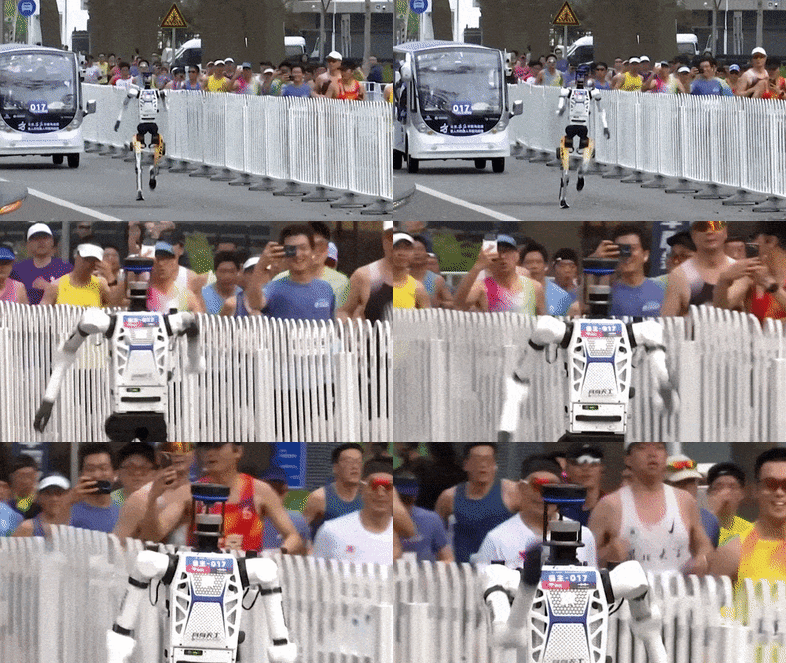
The sight of Tiangong, a humanoid robot developed in China, trotting across the finish line at the Beijing Half Marathon should have felt like a sci-fi dream. It didn't. Instead, it felt like a carefully choreographed PR stunt that says more about marketing budgets than the actual state of robotics. Don't get me wrong. Seeing a 163-centimeter-tall machine maintain a steady pace alongside human runners is technically impressive. But if you think we're at the point where robots are ready to outrun humanity in any meaningful way, you've been sold a narrative that skips over the messy reality of mechanical engineering.
Beijing's sports scene recently hosted this metallic guest, and the footage went viral for all the expected reasons. Tiangong, which means "Heavenly Palace," was built by the Beijing Humanoid Robot Innovation Center. It looks the part. It's got the sleek limbs, the articulated joints, and that eerie, purposeful gait. During the race, it maintained a speed of roughly 6 kilometers per hour. For context, that's a brisk walk for most adults. It didn't win the race. It didn't even come close to the elite runners who finish 21 kilometers in just over an hour. It just... finished.
Why the Beijing half marathon was a controlled experiment
We need to stop treating these public demonstrations as organic events. The Beijing event wasn't a "race" for the robot. It was a live stress test in a highly curated environment. Most humanoid robots struggle with uneven terrain, unpredictable crowds, and the simple physics of staying upright for two hours straight. Tiangong's appearance was meant to prove stability, not speed.
The Beijing Humanoid Robot Innovation Center claims Tiangong is the world's first full-sized humanoid powered purely by electric drives that can run at 6 meters per second. That’s about 21 kilometers per hour. If it actually ran at that speed during the marathon, it would have been a different story. It didn't. It stayed at a safe, plodding pace to ensure it didn't face-plant in front of thousands of spectators and international cameras. This is the gap between lab specs and real-world performance that nobody wants to talk about.
The hardware hurdle that keeps robots slow
Building a robot that can run is relatively easy. Building one that doesn't explode its own battery or strip its gears after ten miles is incredibly hard. Humans are remarkably efficient. We dissipate heat through sweat and our tendons act like natural springs, recycling energy with every stride. Robots are the opposite. They're heavy, they're rigid, and they're constantly fighting friction.
Tiangong uses high-torque density motors. These are great for short bursts of power, but they generate massive amounts of heat. In a half marathon, that heat builds up. If the cooling systems can't keep up, the sensors start to drift, the joints tighten, and the whole thing becomes a very expensive paperweight. I've seen plenty of prototypes that look amazing for five minutes then need a two-hour nap to cool down. The fact that Tiangong finished the distance at all is the real "win" here, even if it moved like a tourist looking for a coffee shop.
Sensors and the chaos of a public race
Running in a lab is boring. The floor is level. The lighting is perfect. Running in Beijing with thousands of humans is chaos. You've got people cutting in front of you, discarded water bottles on the asphalt, and the constant vibration of footsteps all around.
Tiangong relies on a suite of 3D vision sensors and high-precision IMUs (Inertial Measurement Units). These sensors have to process thousands of data points per second just to keep the robot from falling over. Every time the robot's foot hits the ground, it sends a shockwave through the frame that can mess with the logic boards. To survive the Beijing half marathon, the software had to filter out all that noise while making micro-adjustments to the ankle and knee actuators. It's a miracle of control theory, but it's still light years away from the fluid, reactive movement of a biological runner.
China is betting big on the humanoid market
You can't look at Tiangong without looking at the broader economic picture. China is currently the world's largest market for industrial robots, and they're pivoting hard toward humanoids. The government has released guidelines aiming to mass-produce humanoid robots by 2025. They aren't doing this because they want robot marathoners. They're doing it because they have a shrinking workforce and an aging population.
Tiangong is a "general-purpose" platform. That means the Beijing Humanoid Robot Innovation Center wants other companies to buy the hardware and write their own software for it. Whether it's working in a warehouse or assisting in a hospital, the goal is versatility. The marathon was just a flashy way to show off the platform's reliability. It’s the robot equivalent of a car company putting their new SUV on a racetrack. It doesn't belong there, but it proves the engine won't fall out.
The competition is getting crowded
While Tiangong was making headlines in Beijing, other players aren't sitting still. Boston Dynamics recently retired their hydraulic Atlas in favor of an all-electric version that looks like it crawled out of a horror movie with its 360-degree joint mobility. Tesla is still Refining Optimus, though it seems more focused on folding laundry and walking through factories than running marathons.
The difference with the Chinese approach is the speed of iteration. They're willing to put their robots in public early. It's a "move fast and break things" mentality applied to heavy machinery. Tiangong’s run was arguably more about national pride and signaling tech dominance than it was about a breakthrough in bipedal locomotion.
What happens when the PR dust settles
We're currently in the "dancing robot" phase of the industry. We see them do backflips, we see them play the piano, and now we see them run half marathons. It's entertaining. It's great for social media. But it's also a distraction. The real test isn't whether a robot can complete 21 kilometers on a flat road in a straight line.
The real test is whether that robot can navigate a cluttered construction site, pick up a fragile object without crushing it, and operate for eight hours without a recharge. We aren't there yet. Not by a long shot. The power-to-weight ratio of current batteries is the ultimate bottleneck. Until we have a massive shift in energy storage, these robots will always be tethered to short durations or slow speeds.
Don't throw away your running shoes just yet
If you're worried about a robot taking your spot on the podium, relax. The fastest human marathoners run at about 20 kilometers per hour. Tiangong's "running" in the Beijing event was barely a jog. We are still the masters of long-distance endurance.
Instead of watching the finish line, watch the feet. Look at how stiff the movements are. Notice the lack of lateral agility. A human runner can hop a curb, dodge a puddle, and adjust their stride length in a heartbeat. A robot like Tiangong is still largely stuck in a pre-programmed loop, reacting to its environment with a slight delay that would be disastrous in a real-world scramble.
How to track the actual progress of humanoids
Stop looking at viral videos and start looking at the specs. If you want to know if a robot is actually getting better, check three things. First, check the "Degrees of Freedom" (DoF) in the hands and ankles. More DoF means better balance and utility. Second, look at the battery life under load. If it can't go four hours, it's a toy. Third, look at the latency of the vision system.
Beijing's half marathon was a great show. It proved that China has the manufacturing muscle to build a stable, full-sized humanoid. But don't confuse a parade with a revolution. The revolution happens in the quiet corners of logistics hubs and assembly lines, not on the pavement of a marathon course.
Keep an eye on the Beijing Humanoid Robot Innovation Center’s open-source releases. They're planning to share more of Tiangong’s architecture with the dev community. That's where the real growth will happen—when thousands of engineers start poking holes in the software and finding ways to make these machines move more like us and less like a PowerPoint presentation. Until then, keep running. You’re still faster than the machines.