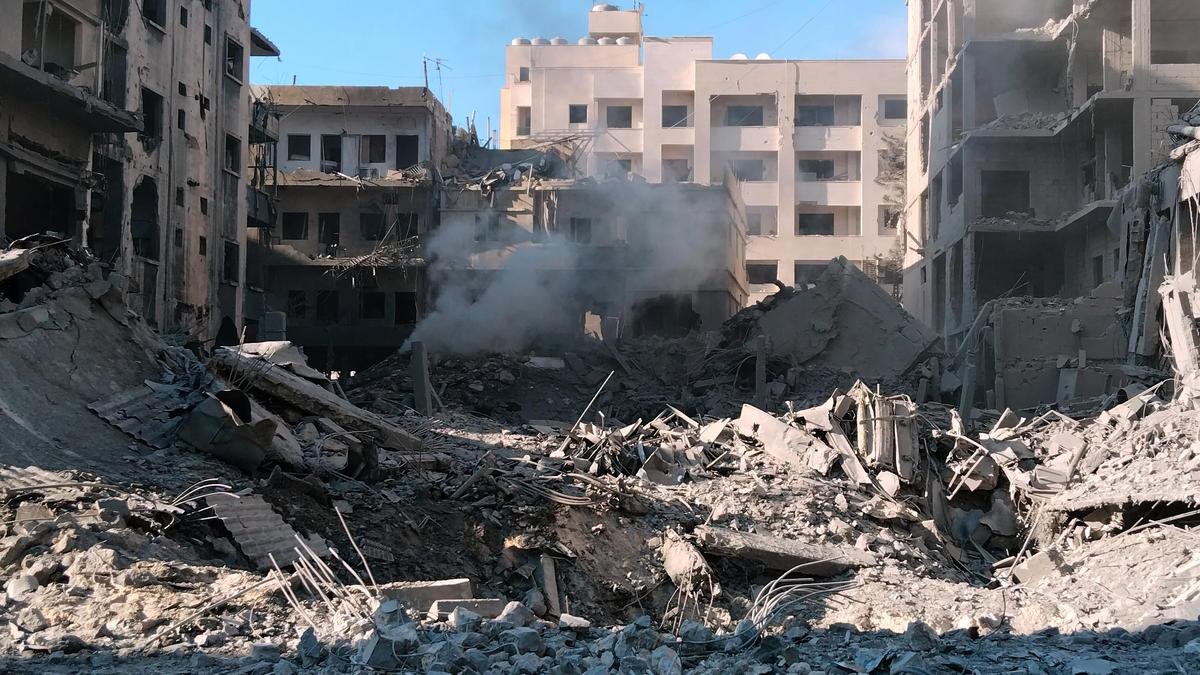
An Israeli dawn airstrike killed eight people, including three women, in the southern Lebanese town of Deir Zahrani on May 31, 2026. The strike, which also wounded 19 others including five children, underscores a brutal reality that diplomatic statements continue to ignore. The April 17 ceasefire between Israel and Hezbollah has collapsed in everything but name, replaced by a devastating war of attrition that is systematically clearing a permanent buffer zone north of the border.
While the official narrative from Jerusalem frames these operations as precise counter-terrorism measures designed to secure northern Israel, the ground reality in the Nabatieh district reveals a different strategy. Israel is expanding its territory of control through intense bombardment and rapid ground maneuvers. The capture of the medieval Beaufort Castle on the same day as the Deir Zahrani strike signals a dramatic shift. This is no longer a temporary cross-border skirmish. It is a calculated push to reshape the map of southern Lebanon.
The Strategy Behind the Attrition
The destruction of residential buildings in Deir Zahrani fits into a broader, highly deliberate military pattern. By targeting towns located five to ten kilometers north of the border, the Israeli military is enforcing an unproclaimed exclusion zone. This strategy relies on absolute displacement. Over one million Lebanese citizens have already fled their homes, driven out by a relentless cycle of evacuation orders followed by immediate bombardment.
For Israel, the math is simple. A buffer zone cannot function if it remains populated. Therefore, towns like Deir Zahrani, Burj al-Shamali, and Mashghara are subjected to regular strikes under the premise of targeting Hezbollah infrastructure, command centers, and weapon storage units.
Southern Lebanon Conflict Metrics (As of May 2026)
+-----------------------------------+------------------------+
| Metric                            | Estimated Figure       |
+-----------------------------------+------------------------+
| Displaced Lebanese Civilians      | Over 1,000,000         |
| Lebanese Death Toll (Total)       | 3,213+                 |
| Israeli Soldiers Killed (Lebanon) | 23                     |
+-----------------------------------+------------------------+
This structural clearance creates an empty terrain where any remaining movement is treated as hostile. It provides a defensive layer for Israeli border towns, but it comes at the expense of permanently erasing the socioeconomic fabric of southern Lebanon. The diplomatic framework brokered in mid-April has failed to halt this progression because both sides utilize a self-serving definition of defensive action. Israel justifies its daily raids as preemptive defense against Hezbollah’s advanced drone arsenal, while Hezbollah views its rocket fire as a legitimate response to ongoing territorial violations.
Technological Evolution Changing the Battlefield
The current campaign looks vastly different from previous conflicts in the region due to a major shift in tactical technology. The traditional reliance on heavy artillery and unguided rockets has been replaced by a quiet, highly lethal drone war.
Hezbollah has introduced new fiber-optic guided drones into the conflict. These devices pose a severe challenge to Israeli air defense networks. Because these drones do not rely on traditional radio frequencies for pilot communication, they are completely immune to standard electronic warfare and jamming equipment. They fly low, navigate complex terrain, and hit Israeli troop concentrations and northern villages with high precision.
"Now my directive is to deepen and expand our hold in places that were under Hezbollah's control."
— Israeli Prime Minister Benjamin Netanyahu, May 31, 2026
To counter this threat, Israel has turned to maximum firepower, utilizing heavy aerial bombardment to eliminate potential launch sites before drones can get airborne. The strike on Deir Zahrani is a direct result of this doctrine. When intelligence suggests a drone storage site or command post is located within a civilian apartment complex, the military prioritizes target destruction over the risk of collateral damage.
The Political Deadlock in Beirut
While the south burns, the political establishment in Beirut remains completely paralyzed. The current Lebanese government stepped into power on a platform of reform and a promise to disarm independent militias, including Hezbollah. However, executing that mandate has proven impossible.
The state has entered direct talks with Israel in Washington, hoping to secure a permanent Israeli withdrawal. Yet, these negotiations are happening in a vacuum. Hezbollah completely opposes these direct diplomatic channels, viewing them as a capitulation to foreign pressure. The Lebanese army lacks the firepower, the political backing, and the institutional willpower to enforce state sovereignty in the south or to push Hezbollah out of its strongholds.
This leaves the civilian population caught in a destructive trap. If they stay in their homes, they face the constant threat of dawn airstrikes. If they flee north to Beirut or the Bekaa Valley, they join an impoverished mass of internally displaced persons in a country already suffering from a historic economic collapse.
The international community has offered little more than symbolic gestures. France has requested an emergency United Nations Security Council meeting to address the expansion of the offensive, but these diplomatic efforts rarely translate into changes on the ground. Western powers remain hamstrung by the broader geopolitical dynamics of the Middle East war, which began in earnest on March 2. With billions of dollars in military aid flowing into the theater and regional powers deeply committed to their respective proxies, a diplomatic solution is a distant prospect.
The Reality of the Permanent Buffer
The capture of Beaufort Castle marks a highly symbolic return to the status quo of the late 20th century. Israeli forces previously used this historic fortress as a strategic vantage point during their two-decade occupation of southern Lebanon, which ended in 2000. Returning to this position indicates that the current military leadership is prepared for a long-term presence.
The illusion of the April 17 ceasefire has been completely shattered by the reality of the daily casualty reports coming out of Nabatieh and Tyre. Israel will not withdraw its forces until it believes Hezbollah's cross-border capability is permanently broken. Conversely, Hezbollah will not cease its drone and rocket attacks as long as foreign troops occupy Lebanese soil.
This gridlock guarantees that the border region will remain a active combat zone. The primary casualty of this strategy is the concept of civilian sanctuary. As long as tactical advantages are prioritized over diplomatic agreements, the dawn strikes will continue, and the border will be drawn not by international law, but by the destructive reach of heavy artillery and guided munitions.