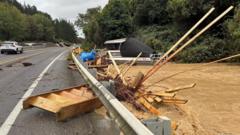
The declaration of a state of emergency in Wellington signifies a fundamental breach in the city's built-environment tolerances. When precipitation rates exceed the drainage capacity of a metropolitan area, the resulting crisis is rarely a "natural" disaster in isolation; it is a systemic failure of the Integrated Catchment Management system. This emergency serves as a case study in the diminishing returns of aging infrastructure when faced with atmospheric patterns that deviate from historical 1-in-100-year flood models.
The Mechanics of Urban Inundation
Wellington’s topography creates a high-velocity runoff environment. The city’s steep hillsides, characterized by low-permeability soils and increasing "grey" infrastructure (concrete and asphalt), transform rainfall into immediate kinetic energy. The failure sequence follows a predictable three-stage progression:
- Saturation of Pervious Surfaces: Once the initial absorption capacity of green spaces is met, 100% of subsequent rainfall converts to surface runoff.
- Hydraulic Overload: The subterranean pipe network, designed for mid-20th-century peak flows, encounters a volume of water that exceeds its internal diameter capacity.
- Backflow and Surging: When the exit points (outfalls) are submerged by rising sea levels or high tides, the water has nowhere to go. It reverses through the system, erupting from manholes and residential drains.
The Triple Constraint of Wellington’s Infrastructure
To quantify the risk currently facing the capital, we must examine the intersection of three specific stressors. Each variable compounds the others, creating a feedback loop that necessitates emergency intervention.
Structural Obsolescence
A significant portion of Wellington’s water and wastewater network is reaching the end of its theoretical service life. Materials like earthenware and unreinforced concrete are prone to calcification and root intrusion, which reduce the effective diameter of the pipes. When a high-volume event occurs, these internal obstructions cause localized pressure spikes, leading to "blowouts" that destroy the surrounding roading substrate.
Topographic Funneling
Unlike flat urban centers (e.g., Christchurch), Wellington forces water into narrow "pinch points." The flow rate $Q$ can be modeled using the Manning Formula:
$$V = \frac{1}{n} R_h^{2/3} S^{1/2}$$
Where:
- $V$ is the velocity.
- $n$ is the Gauckler–Manning coefficient (surface roughness).
- $R_h$ is the hydraulic radius.
- $S$ is the slope.
In Wellington, $S$ is high. This increases velocity exponentially. High-velocity water carries a higher sediment load, which acts as an abrasive, further damaging infrastructure and clogging filtration grates at the base of the hills.
The Seismic-Hydraulic Correlation
Wellington’s location on the fault line means its soil is frequently disturbed. Small, often imperceptible seismic shifts create micro-fractures in the pipe network. During a flood, water enters these fractures (infiltration), washing away the supporting soil and creating "voids." This is why flooding in Wellington is almost always accompanied by significant subsidence and "sinkholes" that remain hidden under the water surface until a vehicle applies weight.
The Economic Cost Function of Emergency Declarations
A state of emergency is an administrative lever used to bypass standard procurement and labor laws. From a consultant's perspective, this is a transition from Planned Maintenance (PM) to Reactive Remediation (RR). The cost function of this transition is brutal.
- Labor Premiums: Emergency response requires 24/7 staffing at overtime rates.
- Supply Chain Friction: Immediate demand for aggregate, pipe sections, and heavy machinery drives up short-term costs.
- Indirect Economic Attrition: The closure of the Golden Mile and the suspension of the rail network halts the flow of human capital. For every hour the Wellington CBD is inaccessible, the regional GDP takes a measurable hit in productivity that is rarely recovered.
Defining the Vulnerability Gap
The "State of Emergency" is triggered when the Residual Risk—the risk that remains after all safety measures are in place—exceeds the capacity of local emergency services. Wellington’s vulnerability gap is widening because the "design storm" parameters are changing.
Older systems were built for a climate that no longer exists. If a system was built to handle 50mm of rain over 24 hours, and the new baseline is 80mm, the system is technically "bankrupt." It cannot fulfill its primary function. This necessitates a shift toward Water Sensitive Urban Design (WSUD).
Strategic Remediation Frameworks
Addressing the Wellington flood crisis requires more than just clearing drains. It requires a fundamental re-engineering of the city's relationship with water.
The Sponge City Pivot
The most effective way to protect aging pipes is to ensure the water never reaches them. This involves:
- Permeable Pavement Implementation: Replacing standard asphalt in low-traffic areas to allow ground infiltration.
- Bioretention Cells: Utilizing specialized plant life and soil layers to slow the transit of water from hill to sea.
Real-Time Sensor Integration
The current response is reactive because the city lacks a "digital twin" of its hydraulic state. Deploying IoT sensors within the pipe network would allow the council to monitor flow rates and pressure in real-time. By identifying a "clog" before the water breaches the surface, maintenance crews can be deployed surgically, preventing a localized issue from becoming a city-wide emergency.
Managed Retreat vs. Hard Engineering
There is a point where the cost of protecting a specific asset (a road, a building, a pipe) exceeds its lifetime value. Wellington faces a hard choice: continue building higher sea walls and larger pipes, or begin the process of "Managed Retreat"—decommissioning high-risk infrastructure and moving populations to higher, more stable ground.
The Bottleneck of Governance
The primary obstacle is not engineering; it is the fragmentation of authority. Currently, the responsibility for Wellington’s water is split between various local and regional entities. This creates a "Tragedy of the Commons" where no single body is incentivized to invest in the multi-decade infrastructure projects required to mitigate these floods.
Until the governance structure is streamlined to align with the physical reality of the catchment area, "States of Emergency" will become a recurring operational expense rather than an occasional anomaly.
The strategic play for Wellington is to transition from a "fail-safe" mentality—where we assume infrastructure will never break—to a "safe-to-fail" mentality. This means designing the city so that when the pipes inevitably overflow, the water is directed into controlled "sacrificial" zones (like parks or designated flood plains) rather than into the electrical substations or the ground floors of commercial buildings.
The focus must shift from Resistance to Redundancy.