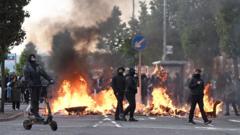
The immediate breakdown of order on the streets of Belfast following a brutal knife attack on Monday evening highlights a dangerous structural failure in Northern Ireland security that authorities have long ignored. When a Sudanese national was charged after a horrific stabbing in north Belfast, the ensuing street violence, arson, and targeted intimidation of ethnic minorities were treated by officialdom as sudden, unpredictable flare-ups. Security advisers quickly labeled the disorder as destabilising. This assessment misses the point. The reality is that the infrastructure of paramilitarism has simply been repurposed by anti-immigrant networks, creating a permanent state of volatility that the Police Service of Northern Ireland (PSNI) is fundamentally unequipped to contain.
For decades, the state operated under the assumption that managing Northern Ireland meant policing a binary sectarian divide. That calculation is now obsolete. The street violence that saw a bus set ablaze in east Belfast, homes attacked, and vigilante groups conducting identity checks on minority residents is not an isolated outburst of racial prejudice. It is the consequence of a security vacuum where legacy paramilitary structures and globalized, online far-right agitation have fused together.
The Repurposing of Paramilitary Infrastructure
The response to Monday's stabbing followed a script written over the course of two years of escalating racial tensions. Minutes after graphic footage of the attack began circulating on social media, the mobilization did not rely on spontaneous local anger alone. It utilized established command structures.
In working-class loyalist areas like Sandy Row and parts of east Belfast, the neighborhood networks that once managed sectarian turf have found a new focus in anti-immigrant agitation. Security analysts who focus exclusively on traditional dissident republican or loyalist threats overlook how easily these legacy structures lend themselves to modern vigilantism.
The mechanics of the disorder reveal an organized underbelly.
- Pre-staged logistics: The swift appearance of masked youths at specific, high-leverage transit points across the city.
- Coordinated intimidation: Systematic door-kicking and arson targeting specific streets known to house asylum seekers and ethnic minority shopkeepers.
- Command and control: The deployment of lookouts and the strategic movement of agitators to stretch PSNI resources across multiple districts simultaneously.
This is not the chaotic rioting of angry individuals. It is an operational methodology borrowed directly from the paramilitary playbook, executed by a younger generation that lacks historical memory of the Troubles but possesses an acute understanding of how to hold territory against the state.
The Illusion of the Borderless Far Right
A common misdiagnosis among political leaders in London and Belfast is that this unrest is merely an extension of English far-right politics crossing the Irish Sea. While it is true that modern agitation relies heavily on algorithms that spread disinformation globally, the violence in Belfast operates on a completely different set of physical rules than the riots seen in Southport or London.
In England, far-right rioting tends to be transient, moving from town square to town square based on weekend organizing. In Belfast, the threat is localized, permanent, and deeply spatial.
| Region | Modern Extremist Flashpoints | Operational Mechanism | State Vulnerability |
|---|---|---|---|
| England | High streets, hotels, migrant centers | Digital mobilization, weekend rallies | Rapid response, policing by consent |
| Northern Ireland | Specific interfaces, residential enclaves | Embedded neighborhood networks, localized vigilantism | Historical distrust, over-reliance on armored physical containment |
When a crowd of a hundred men systematically kicks in doors in east Belfast, they are doing so with local knowledge that cannot be replicated by an online influencer sitting in England. They know which houses belong to families who have lived there for generations and which ones have been leased to newer arrivals. The state’s failure to recognize this localized intelligence network is why its intelligence-gathering apparatus consistently fails to predict the scale of these flashpoints.
The Failure of the Political Response
The joint statement issued by Northern Ireland’s political leaders calling for calm was entirely predictable. It was also entirely ineffective. For years, the political establishment has relied on a policy of containment, hoping that economic development and vague appeals to community cohesion would gradually erode the power of local gatekeepers.
Instead, a hands-off approach to community policing has allowed shadow authorities to solidify their grip. By refusing to confront the remaining elements of illegal organizations that continue to operate under various flags, the state has effectively outsourced local order. When a trigger event occurs, such as Monday's stabbing, the state suddenly realizes it does not hold the monopoly on force in these neighborhoods.
"The assumption that Northern Ireland could transition to a normal civic society without directly dismantling the informal power structures in working-class areas has proven to be a catastrophic error."
💡 You might also like: The American Pipeline Arming Brazil’s Cartels
The PSNI deployed armored vehicles to respond to the burning of a bus in east Belfast, but physical containment is a temporary fix. It does nothing to address the reality that within hours of a crime, non-state actors can clear the streets, set up checkpoints, and demand identity papers from black and minority ethnic residents without immediate police intervention.
The Policing Dilemma
The PSNI finds itself in an impossible position, paralyzed by its own institutional history. To mount an aggressive, intelligence-led crackdown on the networks organizing this violence risks provoking a wider confrontation with communities that are already deeply alienated from the state. Yet, a passive approach allows vigilante groups to grow bolder.
The statistics tell a stark story. Despite years of strategy documents aimed at ending paramilitarism, the street-level authority of these groups has mutated rather than diminished. The shift from sectarian enforcement to anti-immigrant enforcement provides these elements with something they have lacked for a generation: a sense of broader political relevance and a connection to a wider, international movement.
This is the real reason the situation is destabilising. It is not because a single knife attack has fractured community relations, but because the machinery required to turn an isolated crime into a city-wide security crisis is already built, oiled, and waiting for a reason to run. Until the strategy shifts from managing the symptoms of these flare-ups to systematically dismantling the neighborhood structures that facilitate them, the streets of Belfast will remain entirely at the mercy of the next algorithmically generated trigger.