The military confrontation involving Iran has laid bare the fragile architecture of an expanded BRICS bloc, shattering the illusion that shared grievances against Western financial hegemony can substitute for a unified foreign policy. When the drums of war sounded across the Middle East, drawing in Tehran alongside regional rivals like the United Arab Emirates, the coalition of emerging economies did not act as a cohesive geopolitical titan. Instead, it devolved into a fractured assembly of states pursuing competing national interests. Beneath the diplomatic choreography of summit declarations and de-dollarization pledges lies a harsher reality. An enlarged membership has not empowered the bloc to project global power; it has merely imported the volatile sectarian and territorial rivalries of the Global South directly into its boardroom.
For years, proponents of multipolarity portrayed BRICS as an inevitable counterweight to Washington and its allies. The enlargement initiative brought in energy powerhouses and regional heavyweights, swelling its ranks to eleven full members and multiplying its economic footprint. Analysts cheered the addition of petroleum-rich states as a masterstroke that would secure energy dominance and accelerate local-currency trade settlements. Yet, architectural flaws were baked into the expansion from day one. Bringing together nations with diametrically opposed security architectures and regional ambitions is a recipe for paralysis when actual bullets fly.
Consider the fundamental divergence in how member states view the global security order. Russia and China, locked in direct strategic competition with the United States, viewed the Western-backed military campaign against Iran through the lens of unipolar aggression. Beijing and Moscow issued sharp criticisms of the initial strikes, decrying violations of state sovereignty. Yet, when diplomatic rubber met the road at the United Nations Security Council, both powers retreated from confrontation, abstaining on critical resolutions rather than throwing their full weight behind Tehran. That calculated retreat exposed the limits of rhetoric. Great powers protect their core commercial and geopolitical ledgers first, ideological solidarity second.
The friction within BRICS reached a breaking point due to the direct entanglement of its own members in the theater of war. The admission of Iran and the United Arab Emirates placed two sworn adversaries under the same diplomatic tent. When the conflict escalated, Iranian strikes targeted military installations on Emirati soil, transforming a remote geopolitical theory into an immediate domestic security crisis for the Gulf monarchies.
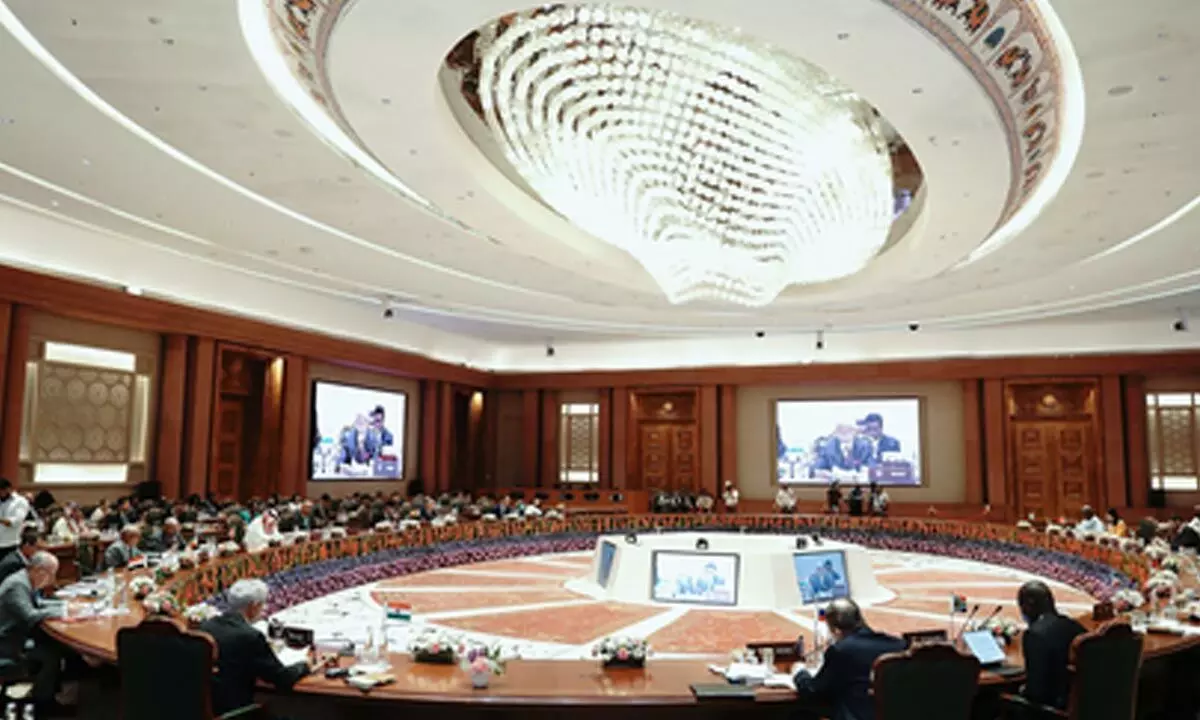
This direct clash rendered standard diplomatic ambiguity impossible. Abu Dhabi demanded accountability and vocal condemnation of attacks on its sovereign territory, while Tehran expected unconditional solidarity from a bloc ostensibly united against Western imperialism. Instead, the consensus fractured. The New Delhi summit declaration managed to avoid a complete institutional collapse only by practicing the art of strategic omission. Leaders adopted text urging maximum restraint and condemning attacks on civilian infrastructure without assigning blame to any specific actor. It was a masterpiece of bureaucratic survival, designed to prevent a walkout rather than forge a meaningful consensus. By sidestepping the crisis, the bloc avoided immediate fracture, but it sacrificed its credibility as a serious security actor. Multipolarity cannot function when members are actively shooting at each other's security infrastructure.
No country illustrates the agonizing compromises of this new era more vividly than India. New Delhi holds a precarious position, attempting to maintain strategic autonomy while navigating deep partnerships with Washington, Tel Aviv, and Tehran simultaneously. Prime Minister Narendra Modi's government found itself caught in an untenable diplomatic squeeze. Days before the military conflagration erupted in the Middle East, India was deepening its strategic and economic embrace of Israel.
When the crisis broke, India refused to condemn the United States or Israel, choosing instead to emphasize dialogue and stability. For Tehran, this diplomatic tightrope walking felt like a betrayal. Iran had long counted India as a historic friend and an essential partner for regional trade connectivity through the Chabahar port corridor. Yet New Delhi's economic survival depends heavily on Gulf stability, secure energy supplies, and migrant remittances from Arab monarchies. Fence-sitting became an expensive luxury. By trying to please everyone in an increasingly polarized international environment, India discovered that middle powers lose the luxury of ambiguity when a shooting war forces regional choices.
While public statements from Moscow and Beijing expressed rhetorical outrage over the assault on Iran, intelligence assessments and diplomatic maneuvers reveal a much more calculating approach. China remains acutely aware of its dependence on Middle Eastern crude oil shipments passing through vulnerable maritime choke points like the Strait of Hormuz. Beijing's primary objective is economic preservation and securing uninterrupted supply chains, not fighting Washington's proxy wars in the Persian Gulf.
Russia, meanwhile, stands on shifting sands. Moscow benefits tangentially from higher global energy prices driven by supply disruptions, which pad its war chest for the ongoing conflict in Ukraine. Reports of backdoor intelligence sharing and drone warfare expertise flowing from Moscow to Tehran indicate a transactional relationship rather than an ironclad mutual defense pact. Neither Russia nor China is willing to risk a direct military confrontation with the United States over Iranian security. The structural asymmetry within the coalition ensures that Beijing and Moscow call the strategic shots, while newer members like Iran and Ethiopia are left to absorb the localized shocks of great power competition.
The economic fallout of the conflict has further scrambled internal alignments. Rising oil prices act as a severe regressive tax on energy-importing economies within the bloc, disproportionately straining growth in India and China while providing a fiscal cushion to state treasuries in Moscow. For developing member states battling domestic inflation and currency depreciation, high crude prices undermine the very premise of economic resilience that BRICS promises to deliver. The bloc's New Development Bank, framed as an alternative to Washington-based lending institutions, has found itself structurally unequipped to manage the macroeconomic shockwaves of a major Middle Eastern war.
Beyond immediate fiscal pressures, the crisis has exposed a fundamental ideological fault line regarding relations with the West. Countries like Brazil approach the global order from a strict anti-interventionist framework, using international forums to denounce military adventurism while advocating for multilateral dialogue untainted by arms trade interests. Conversely, nations like the UAE and Saudi Arabia operate through pragmatic transactionalism, balancing security arrangements with Western powers against commercial integration with Asian giants. This creates a dizzying polycentric puzzle where no single strategy commands universal adherence.
The structural constraints facing BRICS point to a deeper truth about international relations in the twenty-first century. Economic dissatisfaction with the dollar-dominated global financial architecture is a powerful glue, but it lacks the binding strength of a shared security umbrella. NATO operates with brutal clarity because its members share a unified threat perception. BRICS, by contrast, operates on the assumption that economic convenience can override fundamental geopolitical contradictions.
That assumption has now collided with the harsh reality of kinetic conflict. When a member state faces existential military pressure, the rest of the coalition retreats into national self-interest. Brazil calls for immediate ceasefires grounded in legalistic doctrines, South Africa condemns the madness of the escalation while nervously managing domestic political fallout, and the Gulf monarchies prioritize their own physical and economic security above bloc solidarity.
The expansion of the coalition was meant to project unstoppable momentum. Instead, it built a glass house in a hurricane zone. The bloc will undoubtedly continue to facilitate trade settlements in local currencies, coordinate development bank lending, and provide a diplomatic platform for nations seeking alternatives to Western financial sanctions. But transforming that economic cooperative into an anti-imperialist military alliance or a cohesive geopolitical actor remains an unattainable fantasy. The smoke clearing over the Persian Gulf has stripped away the diplomatic veneer, leaving behind a collection of pragmatic states calculating their own survival in a ruthless, unsparing world.