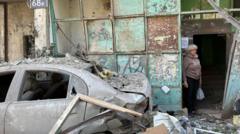
The physical wreckage of a Russian missile strike can be cleared in a week, but the psychological and economic infrastructure of Ukraine is fracturing under a strategy designed to hollow out civilian resilience. When a high-rise in Kyiv's Darnytskyi or Podil district is hit, municipal crews arrive with astonishing speed, sweeping shattered glass and assessing structural integrity within hours. Yet beneath this surface efficiency lies a compounding crisis of displacement, underfunded municipal budgets, and a population enduring what local psychologists call "cumulative trauma."
While international headlines focus on air defense intercept rates and the immediate death toll, the long-term reality for survivors involves navigating a broken housing market and a municipal recovery fund that cannot keep pace with the destruction.
The Mirage of Swift Recovery
To walk through a targeted Kyiv neighborhood forty-eight hours after an attack is to witness a bizarre contrast. Heavy machinery removes concrete slabs, utility workers patch severed gas lines, and local volunteers sweep the sidewalks clean. It creates an illusion of rapid normalization.
The structural reality is far bleaker. Since the intensification of the air campaign, municipal authorities have allocated roughly $56 million toward housing recovery. It sounds substantial until you calculate the cost of rebuilding a single twenty-four-story apartment block, let alone forty distinct locations damaged in a single night.
The city maintains a mere handful of temporary apartments for displaced families. When hundreds of residents are de-housed in a single morning, the state cannot simply hand them new keys. Instead, citizens are absorbed into an strained rental market or forced to rely on the charity of relatives, creating a secondary wave of internal displacement that numbers never fully capture.
The Mathematics of Attrition
The strategic logic behind Moscow’s bombardment of residential areas has shifted from terror to economic exhaustion. A single ballistic missile or drone swarm requires millions of dollars in Western-supplied air defense interceptors to stop. When those interceptors fail, or when falling debris shears through a residential roof, the financial burden shifts directly to the Ukrainian state and its citizenry.
Consider the economic trajectory of an affected family:
- The Loss of Equity: For most middle-class Ukrainians, their apartment was their sole financial asset.
- The Insufficiency of Diia: The government’s digital compensation portal, eRecovery, tracks damage efficiently, but payouts are capped and heavily delayed by budgetary shortfalls.
- The Insurance Void: Private property insurance for war damage is virtually non-existent in a combat zone.
This creates an environment where municipal workers can stabilize a building’s exterior walls, but the interior remains an unlivable shell. The phrase "they'll fix the building, but not our souls" is less a poetic lament and more a precise description of institutional limits. The state can replace concrete, but it cannot replace a family’s eradicated financial security.
The Invisible Casualty of Cumulative Trauma
Mental health infrastructure in Ukraine is facing a demand shock for which no modern society has a blueprint. Unlike the acute shock experienced during the initial 2022 invasion, the current psychological state of Kyiv’s population is defined by weariness.
When over forty thousand residents cram into underground metro stations during a single dawn raid, the immediate threat is physical. The enduring threat is the neurological toll of chronic sleep deprivation combined with unpredictable, lethal violence. Local clinical networks report a surge in complex post-traumatic stress disorders that manifest not as panic, but as profound apathy.
Kyiv Metro Shelling Sheltering Peaks (Recent Campaigns)
[██████████████████████████████] 41,000+ Residents (Peak Single Night)
This apathy poses a direct threat to the wartime economy. Workers operating under sustained cognitive exhaustion are less productive, small business owners are less willing to invest in new ventures, and the baseline human capital required to sustain a long-term war of attrition begins to erode.
The Limits of Voluntarism
For years, the gaps in state capacity have been filled by an aggressive network of domestic NGOs and neighborhood mutual-aid groups. If an elderly woman's windows were blown out, volunteers showed up with plywood and plastic sheeting within hours.
This decentralized network is hitting a wall of volunteer burnout and funding dry spells. International donations have plateaued, and local capital is dried up. The assumption that civic solidarity can indefinitely substitute for a robust social safety net is a dangerous miscalculation. Mutual aid can board up a window; it cannot bankroll the structural underpinning of a collapsed nine-story building.
The current strategy of rapid cosmetic cleanup hides a structural deficit. By focusing aid metrics entirely on military hardware and immediate humanitarian food supplies, international partners overlook the creeping insolvency of the municipal structures required to keep Ukraine’s cities viable. Without targeted financial underwriting specifically earmarked for urban stabilization and long-term housing capital, the physical reconstruction of Kyiv will remain an incomplete facade.
The true frontline of this war is no longer just the trenches of the east, but the structural integrity of the high-rises in the west and the endurance of the people inside them.


