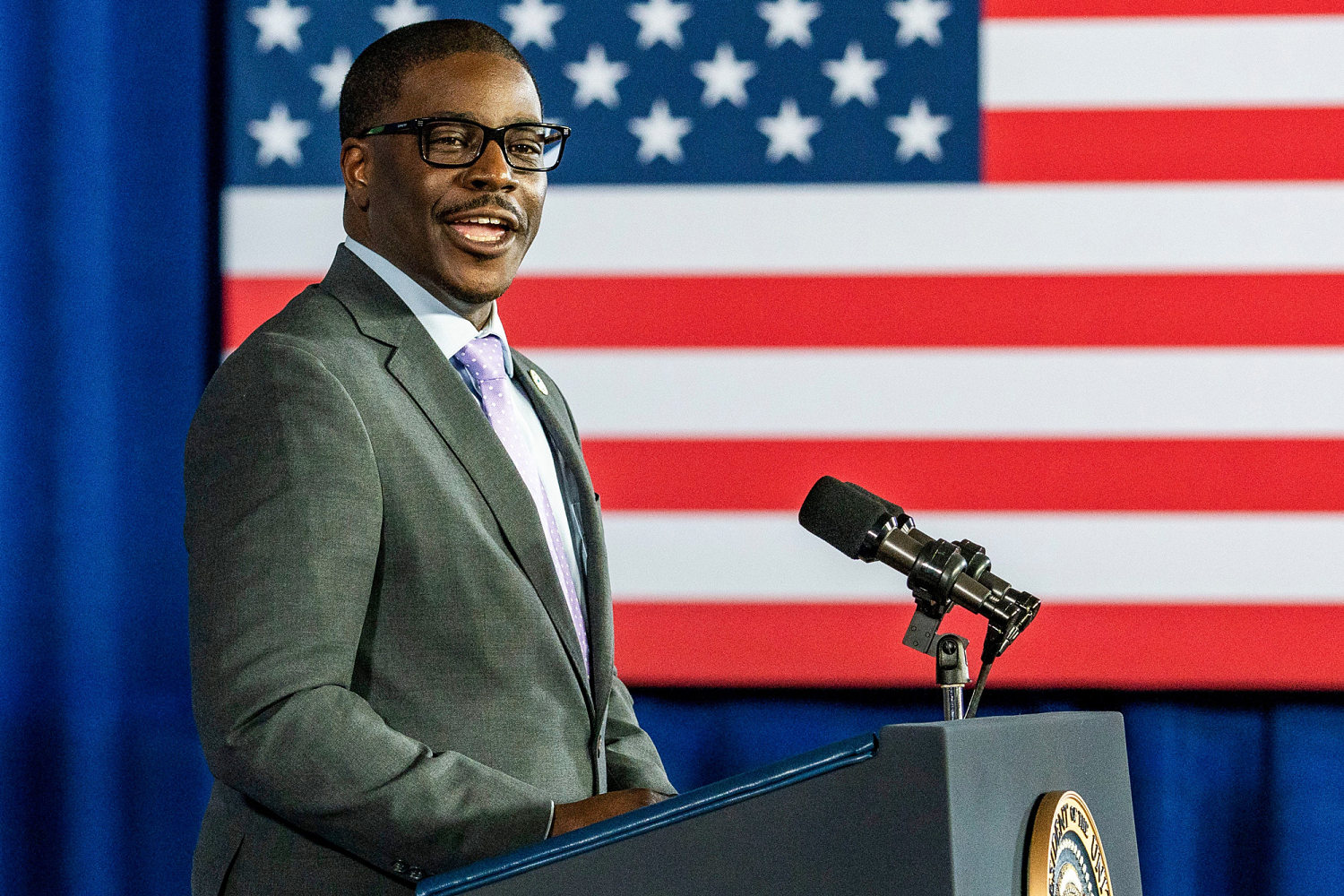
Milwaukee County Executive David Crowley secured the Democratic nomination for governor of Wisconsin after a chaotic primary that featured a temporary suspension of his campaign, a late intervention by outgoing Governor Tony Evers, and a razor-thin margin over progressive state Representative Francesca Hong. This unexpected turnaround resets the political math in America's perennial swing state, paving the way for a fierce autumn showdown against Republican U.S. Representative Tom Tiffany.
The Anatomy of an Exit and Return
Elections rarely follow a linear script. Campaigns live and die by momentum, internal polling data, and donor confidence. When Crowley announced his departure from the gubernatorial race on July 8, conventional political analysts wrote off his ambitions as another casualty of a fractured primary field. His polling numbers hovered in single digits, trailing far behind the ascendant energy of the progressive wing. If you enjoyed this article, you should look at: this related article.
He pointed to internal metrics at the time. Those metrics proved faulty.
The primary landscape shifted beneath the candidates' feet almost immediately after Crowley stepped aside. Lt. Governor Sara Rodriguez suspended her campaign amid financial reporting irregularities and campaign management turmoil. At the same time, establishment Democrats grew increasingly alarmed by the trajectory of the primary. Francesca Hong held a commanding lead, backed by enthusiastic grassroots mobilization and significant progressive traction. Yet party elders feared her past public positions on policing and institutional reform would provide a vulnerable target for Republican attacks in a general electorate. For another angle on this event, see the latest update from The Washington Post.
Governor Tony Evers stepped into the vacuum.
Recognizing the urgent need to consolidate the moderate base, Evers recruited Crowley to jump back into the contest. On July 18, just weeks before voters headed to the polls, Crowley re-entered the fray. Backed by the institutional muscle of the governor's office and a grueling state-wide barnstorming tour, Crowley positioned himself as the pragmatic alternative.
Decoding the Numbers Behind the Upset
The final tally exposed deep ideological divisions within the state party. Crowley edged out Hong by less than half a percentage point, translating to a margin of roughly 4,000 votes out of hundreds of thousands cast. State Senator Kelda Roys and former Department of Administration Secretary Joel Brennan finished far behind, confirming that the electorate had condensed into a binary choice between two distinct visions for the state's future.
How did a candidate who abandoned the race manage to eclipse the definitive front-runner in less than thirty days?
Undecided voters broke heavily toward the center in the final stretch. Polling data from the Marquette University Law School indicated a massive pool of uncommitted voters lingering just weeks before election day. As major secondary campaigns collapsed—including the late-July exit of former Lieutenant Governor Mandela Barnes amid damaging personal scrutiny—those uncommitted ballots consolidated around Crowley.
Furthermore, structural advantages in Milwaukee County served as the final firewall. Crowley outpaced Hong on absentee ballots within his home base, securing a critical advantage that held up through the early morning hours as results trickled in from municipal clerks.
The Intersection of Executive Experience and Retail Politics
Crowley built his winning argument around the concept of executive competency. Throughout the campaign trail, he emphasized his track record managing Wisconsin's most populous county through turbulent fiscal and social terrain. He repeatedly pointed to the 200-million-dollar shared revenue agreement struck in 2023, which allowed Milwaukee County to resolve long-standing pension obligations through bipartisan compromise with the Republican-controlled Legislature.
This background offered a direct counter-narrative to opponents who labeled him a standard party insider. Growing up in the most economically distressed ZIP code in the state, Crowley framed his biography not merely as an inspirational talking point, but as proof of his capacity to deliver tangible structural solutions for working families.
Conversely, Hong's campaign exposed vulnerabilities when scrutinized under a statewide microscope. Resurfaced social media statements from previous years became central talking points for conservative opposition researchers and nervous moderate Democrats alike. While Hong attempted to contextualize those statements as past rhetorical positions, the media cycle consumed valuable campaign bandwidth during the critical closing fortnight.
The General Election Realities
With the primary dust settled, the primary victor immediately shifted focus toward a general election that promises unprecedented national attention. U.S. Representative Tom Tiffany secured the Republican nomination with the explicit backing of Donald Trump. Tiffany enters the autumn contest with a voting record closely aligned with the national conservative platform.
The strategic battle lines are already drawn. Democrats view Crowley as an ideal vessel to challenge a deeply conservative opponent in a state where presidential approval metrics fluctuate constantly. By highlighting Crowley's history of working alongside political adversaries in county government, his campaign hopes to appeal directly to independent suburban voters and disaffected moderates.
At the same time, unifying the progressive wing remains an immediate priority. At a post-primary unity event, party leaders emphasized that defeating Tiffany requires an intact coalition. If Crowley can successfully bridge the gap between the moderate establishment that resurrected his candidacy and the passionate progressive base that propelled Hong to the brink of victory, the November ballot could deliver a historic outcome.
The machinery of the state party is now geared toward a singular objective. Wisconsin voters have chosen their path through the primary wreckage, setting up a clash that will test the limits of partisan polarization in the heart of the Midwest.