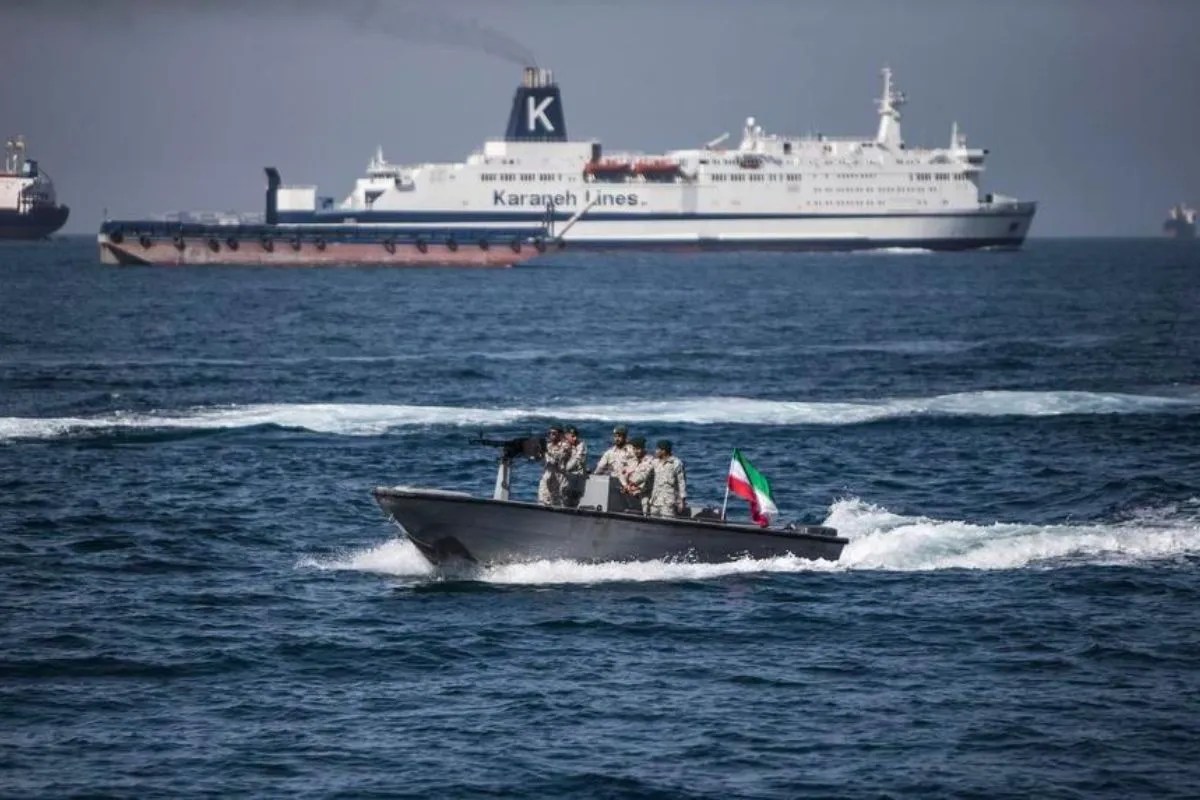
The recent interception of ten vessels departing Iranian ports marks a shift from passive observation to active strangulation in the world's most volatile maritime chokepoint. While headlines focus on the immediate seizure, the real story lies in the sophisticated digital and physical architecture the U.S. and its allies have quietly deployed across the Persian Gulf. This is no longer a game of cat and mouse played with binoculars and radio hails. It is a data-driven blockade that uses satellite telemetry, artificial intelligence, and automated drone swarms to predict a ship's intent before it even clears the breakwater.
For decades, the Strait of Hormuz has been a theater of "shadow wars." Iran uses it as a pressure valve, threatening to choke off 20% of the world's petroleum liquids consumption whenever international sanctions bite too hard. However, the latest mass seizure indicates that the "shadow" is disappearing. Washington has stopped waiting for overt provocations. By integrating Task Force 59’s unmanned systems with traditional carrier strike group power, the U.S. Navy has effectively mapped every rhythmic vibration and thermal signature of the Iranian "ghost fleet."
The Mechanics of the Modern Maritime Trap
The ten ships captured were not random targets. They were identified through a process of behavioral pattern analysis. In the past, a vessel could "go dark" by turning off its Automatic Identification System (AIS) transponder. This was the primary trick for smuggling oil or weapons. Today, turning off an AIS transponder is the equivalent of screaming in a library. It draws immediate attention.
Modern surveillance utilizes Synthetic Aperture Radar (SAR) satellites that see through clouds and darkness. When a ship disappears from the digital grid, SAR imagery picks it up instantly. Analysts compare the vessel's displacement—how low it sits in the water—against its reported cargo manifest. If a tanker claims to be empty but sits deep in the brine, the system flags it. The "trap" mentioned in recent reports is actually a multi-layered sensor web that feeds into a centralized command hub in Bahrain.
This hub doesn't just watch; it predicts. By analyzing years of data on Iranian smuggling routes, the system can forecast which secondary channels a vessel will take to avoid standard patrol zones. The ten ships in question were intercepted because they followed "irregular" paths that the AI had already categorized as highly probable escape routes.
Why the Sudden Escalation
To understand why this is happening now, look at the shifting geopolitical tectonic plates. Iran has become a central node in a new triad involving Russia and China. Iranian drones are hitting Ukrainian cities, and Iranian oil is fueling the Russian war machine. The U.S. strategy has moved from containment to disruption.
By seizing ten ships simultaneously, the U.S. is sending a message to the private insurers and shipping conglomerates that facilitate these trades. It is a demonstration of absolute maritime domain awareness. If you can catch ten ships at once in the narrowest part of the Gulf, you can catch a hundred. This creates an uninsurable risk for the "dark fleet" operators.
The Role of Task Force 59
The backbone of this operation is Task Force 59. This unit doesn't rely on massive, expensive destroyers for every task. Instead, they use unmanned surface vessels (USVs) like the Saildrone Explorer. These are small, solar-powered boats packed with sensors that can stay at sea for months.
- They operate silently.
- They are difficult to detect on radar.
- They provide 360-degree high-definition video feeds.
When the Iranian ships moved, they were likely tracked by these "floating eyes" long before a manned U.S. Navy vessel appeared on the horizon. This reduces the cost of the blockade and minimizes the risk to American sailors, making the enforcement of sanctions more sustainable over the long term.
The Countermove and the Risk of Miscalculation
Tehran is not standing still. The Islamic Revolutionary Guard Corps (IRGC) Navy has its own doctrine of "asymmetric swarm warfare." They know they cannot win a conventional blue-water engagement. Their response to this new electronic net is to increase the noise.
Iran has started using spoofing technology to broadcast fake AIS coordinates, making one ship look like a dozen, or making a civilian freighter look like a military target. They are trying to overwhelm the sensor web with "false positives." This creates a dangerous environment where a split-second decision by a drone operator or a fleet commander could lead to a kinetic exchange involving innocent third parties.
The tension in the Strait of Hormuz is no longer about just oil. It is about the control of the maritime information environment. Whoever owns the clearest picture of the water wins without firing a shot.
Economic Fallout and the Global Energy Supply
Every time a seizure occurs, the price of Brent crude reflects the anxiety of the market. But there is a secondary economic impact that few talk about: the cost of maritime security premiums.
Shipping companies are now paying exorbitant rates for "war risk" insurance to traverse the Gulf. Even if a ship isn't seized, the mere presence of this "trap" drives up the cost of every gallon of gas in Europe and Asia. The U.S. is betting that the economic pain caused to Iran by seizing their exports outweighs the collateral damage to global shipping prices. It is a high-stakes gamble with the world economy as the chips.
The Iranian Ghost Fleet Vulnerability
The ships being caught are often aging hulls, poorly maintained and flying flags of convenience from countries like Panama or Liberia. These vessels are the weak link. They lack the sophisticated electronic warfare suites necessary to jam U.S. sensors. When the U.S. Navy "lays a net," these rusted tankers are the first to get tangled.
The seizure of ten ships suggests that the U.S. has cracked the code of the ghost fleet’s middle-men. They aren't just tracking the boats; they are tracking the financial transactions and shell companies that keep them moving. This is a synchronized attack on the logistics of evasion.
The Strategy of Permanent Friction
We are entering an era of permanent friction in the Strait. The U.S. has built a digital wall that Iran cannot easily climb over. This isn't a one-time operation. It is the new baseline for maritime operations in the region.
The sophistication of the "trap" means that the era of easy smuggling is over. However, as the net tightens, the cornered party becomes more unpredictable. The IRGC’s past behavior suggests they will respond with "tit-for-tat" seizures of Western-linked tankers in the coming weeks.
The focus shouldn't be on the ten ships that were caught, but on the thousands of sensors left behind in the water. The Strait of Hormuz is now the world’s largest laboratory for automated warfare. The "trap" isn't just a physical barrier of warships; it is a permanent state of surveillance that makes the very concept of a "secret" voyage obsolete.
Navigation in these waters now requires more than a compass and a map. It requires the ability to disappear in a world where every heat signature and radar pulse is logged, analyzed, and weaponized in real-time. The net is closed.