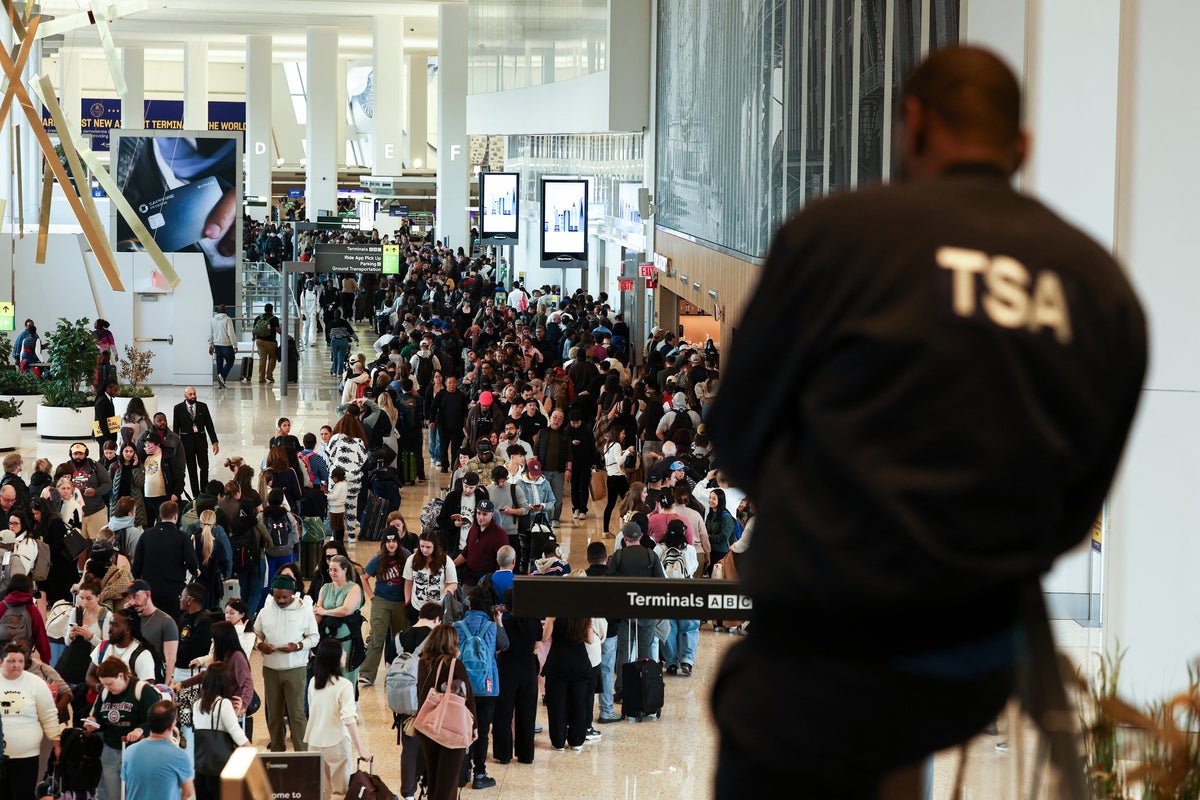
Maria doesn’t look like a national security asset. She looks like a grandmother who hasn't slept in thirty-six hours, standing under the oppressive hum of industrial fluorescent lights at O’Hare. Her blue uniform, once crisp, is starting to show the strain of a double shift. Behind her, the line of travelers stretches toward the horizon of the terminal—a restless, sweating sea of humanity clutching passports and carry-ons.
She is one of the thousands. Or, more accurately, she is one of the few who stayed.
While the rest of the country looks toward the World Cup with the giddy anticipation of a summer long-delayed, the machinery that makes that dream possible is grinding to a halt. The Department of Homeland Security is bleeding. Since the funding lapse began, more than 1,000 Transportation Security Administration officers have handed in their badges. They didn't leave because they stopped caring about the flight paths or the forbidden items; they left because passion doesn't pay the electric bill.
The Quiet Exodus
Security isn't a wall. It’s a pulse. When that pulse slows, the entire body of global transit begins to fail.
We often treat the TSA as a nuisance, a hurdle of plastic bins and removed shoes that stands between us and our vacation. But imagine the mental overhead required to scan ten thousand bags a day, looking for the one item that shouldn't be there, while your own bank account sits at zero. This isn't a hypothetical struggle. For the officers currently working without a definitive payday, the pressure is a physical weight.
One thousand officers.
That number sounds like a statistic until you distribute it across the busiest hubs in the nation. It means the "Pre-Check" lane is closed. It means the person checking your ID has been standing there for ten hours because their relief never showed up. It means the thin margin for error that keeps the skies safe is being stretched until the fibers snap.
The timing is a masterpiece of misfortune. The World Cup is descending upon us—a logistical behemoth that requires every gear in the security machine to turn with precision. Add to that the standard "summer crush," where millions of families pack into pressurized aluminum tubes to cross the globe, and you have a recipe for a systemic heart attack.
The Cost of Staying
Consider a hypothetical officer named David. David has five years on the job. He knows the difference between a dense block of cheese and something more sinister on an X-ray screen in half a second. He is an expert. But David’s landlord doesn't accept "patriotism" as a valid form of currency.
When the DHS funding evaporated, David’s life became a series of impossible choices. Does he spend his last twenty dollars on gas to get to the airport for a shift he isn't being paid for, or does he buy milk for his daughter?
He chose the milk. He called out. Then, he went to work for a local delivery service that pays every Friday, no matter what is happening in Washington.
David is part of the 1,000. He didn't quit because he was lazy. He quit because the contract was broken. When the government stops paying the people who protect the gates, the gates eventually swing open. This isn't just about longer lines at the airport; it’s about the erosion of institutional knowledge. You cannot replace five years of "security intuition" with a three-week crash course for a new hire.
The Physics of a Bottleneck
There is a grim mathematical reality to an airport. If you have 20,000 passengers and five functioning lanes, the wait is thirty minutes. If two of those lanes close because the officers quit, the wait doesn't just double. It compounds.
The air in the terminal thickens. Tempers flare. A missed connection in Atlanta ripples into a canceled flight in London. By the time the World Cup kicks off, these ripples will be tsunamis. We are looking at a summer where the journey might actually become impossible for many.
The funding lapse is often discussed in the halls of power as a "leverage point" or a "negotiating chip." To the traveler trying to get home for a wedding, or the officer wondering if they can afford their insulin, it is an act of structural negligence.
We rely on the invisibility of security. We want it to be a background process, like the software updates on our phones. But people aren't code. They are biological entities with bills, anxieties, and breaking points.
The Breaking Point
The departure of 1,000 officers is a warning shot. It is the sound of the foundation cracking before the house shifts.
If the funding isn't restored—and restored with a sense of permanence—the exodus will accelerate. People are watching their colleagues leave for better-paying, more stable jobs at big-box retailers and warehouses. They see the lack of urgency from the people who hold the purse strings, and they draw the only logical conclusion: their sacrifice is not valued.
The irony is that the cost of fixing the lapse is a pittance compared to the economic damage of a paralyzed national travel infrastructure. A stalled World Cup isn't just a PR nightmare; it’s billions of dollars in lost revenue, broken contracts, and shattered consumer confidence.
Maria is still there at O’Hare, for now. She stays because she feels a sense of duty to the people in her line. She sees the tired parents and the nervous first-time flyers, and she wants them to be safe. But even Maria has a limit.
Everyone has a limit.
The lights in the terminal flickered briefly an hour ago. Maria didn't even flinch. She just reached for the next grey bin, her movements mechanical, her eyes scanning the screen for threats, while the world she protects remains blissfully unaware of how close the whole system is to simply stopping.
The line is getting longer. The clock is ticking toward the first kickoff. And the blue uniforms are disappearing, one by one, into the shadows of the exit.



