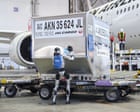
The press releases are coming in thick, glowing with the sort of unearned optimism that precedes every major capital expenditure disaster in the automation sector. Japan is putting humanoid robots into their airports. The images circulating on social media show polished, metallic figures standing near arrival gates, ready to tackle the physical grind of baggage handling. It looks clean. It looks futuristic. It is entirely, aggressively wrong.
I have spent the better part of two decades auditing logistics facilities, from the automated nightmares of the Midwest to the high-throughput hubs in Southeast Asia. I have watched companies pour millions into "innovative" hardware, only to see those investments rust in corners within eighteen months. The push for humanoids in airports is not a technological evolution. It is a fundamental misunderstanding of physics, economics, and basic industrial engineering. You might also find this connected story interesting: Bukele Turns El Salvador Into a Living Lab for Google Health AI.
The Physics of Failure
The primary issue with the humanoid form factor is not the software. It is not the battery life. It is the simple, stubborn reality of center of gravity. Humans have evolved over millions of years to stabilize a top-heavy, bipedal frame. It is an expensive biological trade-off that allows for incredible versatility. In a baggage handling environment, versatility is a liability.
A humanoid robot needs to balance itself while lifting a thirty-kilogram suitcase. Think about the mechanical complexity required to keep that robot upright while it shifts a heavy, awkward load. You are adding servos, actuators, and gyroscopes just to fight gravity. Every gram of weight in the robot’s torso is weight it must lift before it even touches a bag. It is a zero-sum game played against the laws of motion. As extensively documented in detailed coverage by MIT Technology Review, the results are worth noting.
Compare that to a gantry robot or a simple, rail-mounted articulated arm. An industrial arm fixed to a floor or a ceiling has zero concern for balance. It doesn't need to waste energy standing up. It utilizes that energy to move payload. When you see a humanoid struggling to lift a suitcase, you are watching a machine spend 80 percent of its power just to keep from falling over. That is not progress. That is a thermal management nightmare waiting to happen.
The MTBF Trap
Let’s talk about Mean Time Between Failures, or MTBF. If you want to understand why your factory or airport will eventually hate your new robot, look at the number of joints.
A human arm has seven degrees of freedom. To replicate that, a humanoid robot requires at least seven high-torque actuators per arm, plus the neck, the waist, and the legs. Now, consider the airport environment. It is dusty. It is loud. It is chaotic. Vibrations from moving belts and conveyor rollers create a constant stress environment for sensitive electronics.
Every additional joint is a point of failure. Every gear, every sensor, every wire routed through an elbow is a potential catastrophic stop. In a logistics hub, a machine that goes down for an hour is a headache. A machine that goes down for a day because a wrist actuator needs a proprietary replacement part is a disaster. I have seen facilities where the "highly intelligent" humanoid fleet spent more time tethered to charging stations and diagnostic ports than they did moving cargo. They become mobile monuments to expensive downtime.
The Economics of Vanity
Why, then, is this happening? Why invest in a platform that is demonstrably less efficient than a stationary arm or an autonomous mobile platform (AMP) designed specifically for transport?
The answer is rarely operational efficiency. It is almost always marketing.
Japan has a cultural fascination with the humanoid aesthetic. It is a source of national pride, a vision of the future that has been projected in anime and pop culture for decades. There is a desire to see that vision materialize, regardless of whether the engineering makes sense. When a company decides to put a humanoid in an airport, they aren't trying to lower the cost-per-package handling rate. They are trying to create a viral moment. They are selling an image of tech-forwardness to investors and the public.
I have walked through boardrooms where the decision to buy humanoid units was made because the CEO wanted a "cool" photo op. When I pointed out that a specialized belt-feeder could do the job with 99.9 percent uptime for a fraction of the cost, I was told that the board didn't want "boring machinery." They wanted a brand ambassador that could walk.
This is the vanity of engineering. It happens when the ego of the design team outweighs the bottom line of the operations department. If you are a facility manager looking to improve throughput, you do not need a robot with a face. You need a machine that can do one task, ten thousand times a day, without fatigue, without needing a recharge for four hours, and without requiring a robotics degree to troubleshoot.
The Better Way
If you want to automate baggage handling, the solution is already here, and it is boring. It is ugly. It is effective.
Stationary automation is the backbone of global trade for a reason. Fixed-position industrial arms are the kings of logistics. They don’t walk; they work. They are bolted down. They have high-duty cycles. They are serviced by technicians who know how to change a motor without recalibrating a neural network.
Instead of humanoids, we should be looking at swarm-capable, wheeled platforms. These are machines designed to carry weight horizontally, which is the only way that makes sense in a transport hub. A base on wheels doesn't fight gravity. It lets the floor do the work. By distributing the load across a fleet of small, dumb, highly efficient units, you create a system that is infinitely more resilient than one humanoid robot that acts as a single point of failure.
Imagine a scenario where one of these humanoid units trips on a piece of plastic wrap or a misplaced bag. The entire line stops. The sensor suite recalibrates. A support team is dispatched. With a decentralized swarm of simple, low-cost transport bots, if one unit fails, the rest move around it. The throughput continues. That is the definition of operational continuity.
The Hidden Cost of Complexity
There is a fetishization of AI in robotics that further complicates the humanoid problem. People assume that because these robots look like humans, they should "think" like humans—interpreting the environment, making decisions, improvising.
In an airport, you don't want improvisation. You want predictability.
You want a system that interacts with a database, reads a barcode, and places a bag in a bin. If the bag is slightly crooked, you don't need a robot to adjust its posture and "analyze" the situation. You need a simple mechanical stop that aligns the bag before the arm even touches it. If you have to write complex computer vision algorithms just to help a robot pick up a suitcase, you have already failed the engineering challenge. You are spending massive compute power to solve a problem that should have been solved by a simple gravity chute or a guide rail.
The obsession with complex AI-driven humanoid navigation is a distraction. It lures companies into building software-heavy solutions for problems that require hardware-simple solutions. I have seen firms burn through millions in venture capital trying to train a humanoid to walk through a crowd when a simple designated path or a floor-embedded guide wire would have achieved the same result for the price of a few cans of paint.
The Maintenance Mirage
Talk to any maintenance supervisor at a high-volume logistics hub. They don't care about "future-proofing." They care about parts availability. They care about how quickly they can get a machine back online at 3:00 AM on a Tuesday.
When you buy a humanoid robot, you are signing a contract for specialized, bespoke maintenance. You are locked into the vendor’s ecosystem. If the wrist joint fails, you cannot buy a generic replacement from a catalog. You are waiting for a shipment from the manufacturer. You are at the mercy of their support queue.
Contrast this with standard industrial equipment. If a motor burns out on a standard conveyor-loading arm, there are hundreds of suppliers who can ship a compatible part overnight. There is a secondary market for components. There is a standardized interface for control logic. When you deviate from that, you are trading efficiency for proprietary lock-in.
The Human Element
The argument that humanoid robots provide a "better experience" for passengers is equally hollow. Passengers do not care if their luggage is handled by a humanoid, a claw, or a conveyor belt. They care that their luggage arrives at the carousel in one piece and that it doesn't take an hour to get there.
The uncanny valley effect is real. Seeing a humanoid robot clumsily attempt to mimic human movement in a public space often elicits more anxiety than delight. It feels erratic. It feels unnatural. When a machine tries to act like a person but fails to perform the task with the grace of a specialized tool, it just looks like a broken toy.
Instead of spending capital on these displays, companies should be pouring that money into the backend infrastructure that people never see. Improve the sorting speed. Reduce the number of jams in the baggage room. Upgrade the RFID tracking. These are the things that actually matter. They don't make for good press releases, but they keep a logistics operation alive.
The Reckoning
There will come a day when these humanoid experiments are quietly pulled from the floor. The cost of maintenance will skyrocket, the uptime metrics will lag behind traditional automation, and the investors will stop seeing the "innovation" they were promised.
When that happens, the industry will have to reckon with the wasted years spent chasing a fantasy. We will look back at this period of humanoid obsession as a cautionary tale about what happens when design is divorced from function.
Stop building robots that look like people. Build machines that solve problems. Stop prioritizing the optics of the future and start obsessing over the mechanics of the present. The baggage handling room is a harsh, unforgiving environment that punishes complexity and rewards simplicity. Anyone who thinks they can beat those odds with a pair of artificial legs is going to learn a very expensive lesson.
The next time you see a robot with arms, legs, and a face attempting to lift a suitcase, do not applaud. Count the seconds until it breaks. Then check the balance sheet of the company that bought it. You will find that the real cost of this experiment is being hidden in the maintenance budget, the downtime reports, and the bottom line. It is a slow-motion wreck in a very high-tech skin. The sooner we admit that humanoids have no business in a logistics hub, the sooner we can get back to building things that actually work.