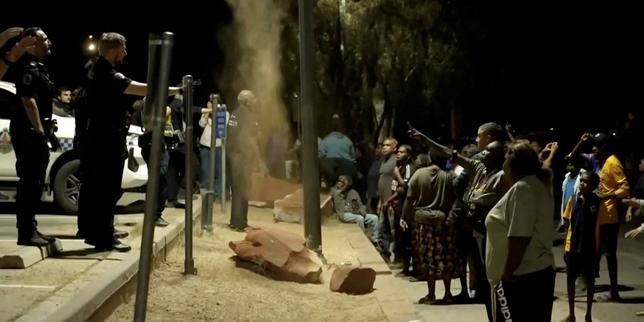
The collision between Western statutory law and Indigenous customary law in Australia creates a recurring cycle of institutional paralysis and communal trauma. When a violent crime occurs within an Aboriginal community—specifically the recent case involving the sexual assault and murder of a five-year-old girl—the immediate public discourse focuses on the horror of the act. However, the deeper strategic failure lies in the incompatible legal frameworks governing these territories. The demand from the community to "use our own laws to make him pay" is not merely an emotional outcry; it is a request for the re-establishment of a social equilibrium that the Australian state legal system is structurally incapable of providing.
The Dual Sovereignty Bottleneck
The Australian legal landscape operates under the doctrine of terra nullius—now legally overturned but administratively persistent—which prioritizes a centralized, punitive justice model. Aboriginal customary law, conversely, is restorative and localized. The friction between these two systems manifests in three distinct pressure points:
- The Legitimacy Gap: State law focuses on the individual offender and the state. Customary law focuses on the relationship between the offender, the victim’s kin, and the land. When the state removes an offender to a distant urban prison, the local community experiences a lack of closure. The "debt" remains unpaid in the eyes of the elders, leading to a permanent state of social agitation.
- The Deterrence Deficit: Statutory sentencing often fails to register as a meaningful deterrent within remote communities where Western incarceration is viewed as an external, arbitrary imposition rather than a moral reckoning.
- The Protection Paradox: By asserting exclusive jurisdiction over violent crimes, the state effectively disarms the traditional authority structures (the Elders) that previously regulated behavior. This creates a power vacuum where neither the state police (often hours away) nor the community leaders can effectively intervene to prevent recidivism or escalating violence.
Structural Decomposition of Customary Law Demands
The call for "own laws" typically refers to the implementation of "payback," a term frequently misunderstood by external observers as mere vigilantism. In a clinical sense, payback functions as a regulated, transparent physical or social sanction designed to end a feud. Without this mechanism, the trauma of a crime like the murder of a child does not dissipate; it metastasizes into intergenerational violence between family groups.
The Mechanics of Social Equilibrium
Within Aboriginal legal frameworks, justice is a communal asset. The loss of a child is a depletion of the community’s future human capital and spiritual continuity. The Western model's focus on "rehabilitation" or "timed incarceration" fails to account for this specific loss.
- Symmetry of Sanction: Traditional law seeks a physical or spiritual equivalence to the crime.
- Kinship Responsibility: In many customary systems, the family of the offender shares the burden of the crime. This creates a high-pressure social environment that discourages deviance.
- Public Resolution: Unlike the closed doors of a state courtroom, traditional sanctions are often public, providing immediate psychological catharsis for the grieving party.
The state’s refusal to recognize these mechanisms forces the community into a state of perpetual victimhood. They are prohibited from applying their own logic of justice but find the state’s logic insufficient to heal the communal rift.
The Cost of Centralized Justice in Remote Geographies
Logistical constraints exacerbate the failure of the Australian justice system in the Northern Territory and Western Australia. The cost of policing remote regions is disproportionately high, yet the efficacy is statistically low.
The primary inefficiency is the Response Time Lag. In cases of immediate threat or discovery of a crime, the hours or days required for state intervention allow for the contamination of evidence and the escalation of communal tensions. By the time the state arrives, it is no longer managing a crime; it is managing a riot.
Furthermore, the Cultural Translation Loss during legal proceedings ensures that the victim's family rarely understands the nuances of sentencing, parole, or legal defense. This lack of transparency erodes trust in the state, leading to the "scandalized" atmosphere currently observed in the wake of the five-year-old’s death. The community perceives the legal system not as a tool for justice, but as an alien bureaucracy designed to protect the rights of the offender over the survival of the collective.
The Infrastructure of Violence
Violence in these regions is not an isolated event but a symptom of a collapsing social architecture. The interaction between systemic poverty, historical displacement, and the erosion of traditional law creates a high-risk environment for the most vulnerable.
The Vulnerability Matrix in these communities includes:
- Overcrowded housing that eliminates private safety zones.
- The breakdown of the "Skin System" (traditional kinship rules) which previously governed social interactions and marriage/unions.
- The introduction of external stressors—substance abuse and unemployment—without the corresponding reinforcement of local authority.
When a crime of this magnitude occurs, it serves as a "stress test" that the current legal framework fails every time. The outcry for traditional law is a demand for the return of a system that possesses the cultural nuance to address these specific environmental variables.
Jurisdictional Integration as a Mitigation Strategy
To resolve the impasse, the strategy must shift from total jurisdictional dominance to a tiered legal integration. This is not a suggestion for "lawlessness," but for a more sophisticated application of authority.
The first level of this integration involves Circle Sentencing. This allows Elders to participate in the sentencing process, ensuring the punishment carries the weight of the community’s moral authority. This bridges the legitimacy gap by making the community an active participant rather than a passive observer.
The second level requires the Recognition of Physical Redress. While Western human rights frameworks often clash with traditional physical sanctions, the absence of any culturally relevant sanction leads to higher rates of extralegal violence. A mediated form of traditional punishment, conducted under the oversight of both state and traditional leaders, would provide the "payback" necessary for social stabilization while maintaining a ceiling on the severity of the sanction to meet international standards.
The third level is the Devolution of Policing. Empowering local "Night Patrols" with actual legal standing and communication links to state police turns a reactive system into a proactive one.
The current impasse ensures that the death of a child becomes a catalyst for broader social disintegration. The Australian state must acknowledge that its monopoly on violence is currently failing to produce a monopoly on order. Until customary law is integrated into the statutory framework with precise, functional boundaries, the "scandal" of Indigenous justice will remain a permanent feature of the Australian social fabric. The strategic move is not more police, but the formalization of the law that the community already recognizes as legitimate.
The immediate requirement is the establishment of a Joint Jurisdictional Commission in the affected region, tasked with drafting a pilot framework where traditional Elders hold veto power over the parole and local management of violent offenders. This shifts the offender’s accountability from a faceless state to a visible community, re-establishing the deterrent effect that the current prison system has lost.