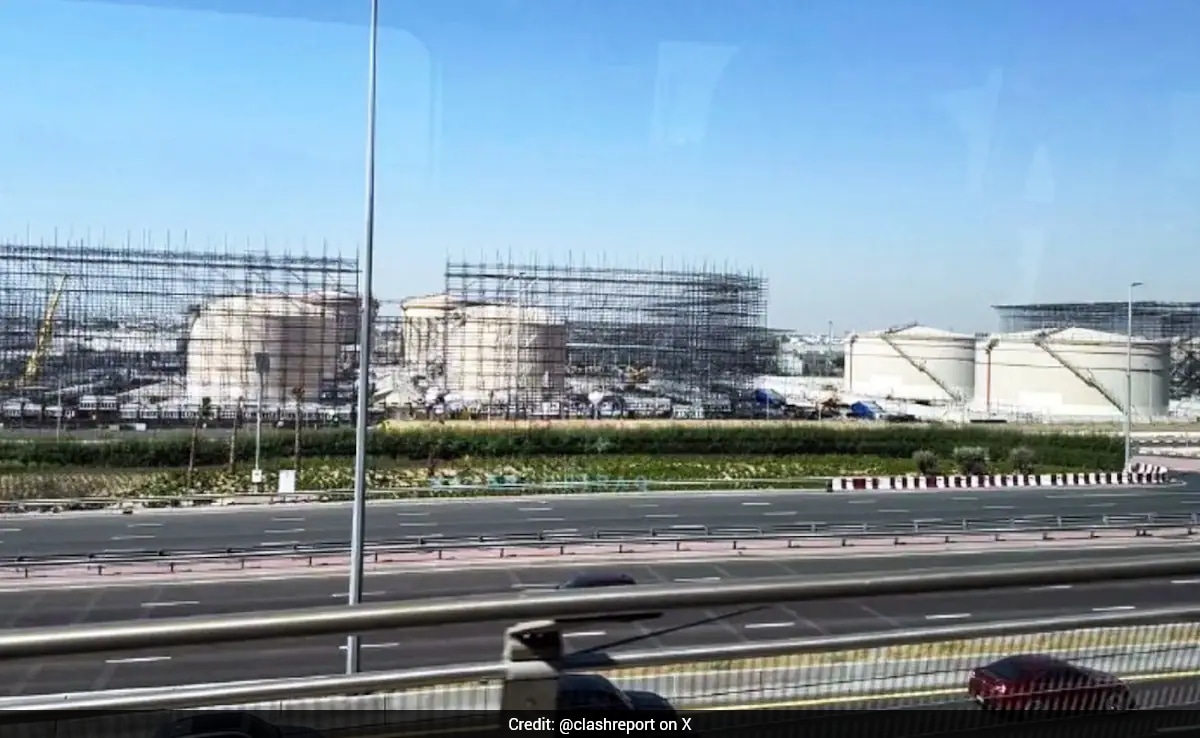
The physical fortification of critical energy infrastructure across the United Arab Emirates signals a structural shift in modern defensive doctrine, migrating from exclusive reliance on active multi-layered air defense systems to localized, passive physical mitigation frameworks. Confronted by sustained asymmetric salvos comprising 2,265 unmanned aerial vehicles (UAVs), 551 ballistic missiles, and 29 cruise missiles fired by Iran and its regional proxies, the Emirati Defense Ministry has confronted a fundamental mathematical bottleneck in active interception: the profound economic and operational asymmetry of modern air defense.
The deployment of large-scale structural steel enclosures—frequently termed "cope cages" or protective metal grills—around fuel storage tanks at high-value nodes like the Dubai International Airport fuel depots and the Port of Fujairah represents a calculated response to this cost-exchange imbalance. Rather than serving as a superficial improvisational measure, these physical barriers introduce a permanent, low-cost layer designed to disrupt the final terminal guidance vector of one-way attack (OWA) munitions, minimizing capital asset destruction and macroeconomic volatility.
The Cost Exchange Disparity in Active Air Defense
The foundational vulnerability of defending sprawling industrial footprints from asymmetric saturation attacks resides in the cost-exchange ratio ($R_c$), defined as:
$$R_c = \frac{C_{\text{interceptor}}}{C_{\text{effector}}}$$
Where $C_{\text{interceptor}}}$ is the marginal cost of the surface-to-air missile (SAM) or active counter-UAV countermeasure, and $C_{\text{effector}}}$ is the production cost of the incoming OWA munition.
When defending against low-cost loitering munitions such as the Shahed-136, which features an estimated production cost between $20,000 and $40,000, active interception via Western or regional air defense platforms introduces an unsustainable economic drain. Interception options display an order-of-magnitude cost disparity:
- Patriot PAC-3 MSE: $3,000,000 – $5,000,000 per interceptor.
- MIM-23 Hawk (Upgraded): $250,000 – $500,000 per interceptor.
- NASAMS (AMRAAM): $1,000,000 per interceptor.
This creates an economic exhaustion vector. An adversary can theoretically exhaust a state's strategic interceptor inventory by launching massed, low-cost drone swarms, leaving high-value assets exposed to subsequent high-velocity ballistic or cruise missile strikes.
Active air defense platforms face a secondary constraint: radar channel saturation. Every engagement radar possesses a finite tracking capacity ($T_{\text{max}}$). When the volume of concurrent incoming threats ($V$) exceeds $T_{\text{max}}$, the system undergoes a localized failure state, permitting a percentage of effectors to bypass the screen. Passive infrastructure shielding addresses this vulnerability by operating independently of electronic tracking limits or inventory constraints.
The Mechanics of Structural Impact Mitigation
The implementation of metal frameworks detached from the primary hulls of petroleum, oil, and lubricant (POL) tanks alters the terminal mechanics of an OWA drone strike. These structures are engineered based on specific kinetic and explosive variables designed to isolate the primary container from three distinct destructive forces.
Terminal Vector Disruption
Loitering munitions utilize contact fuze mechanisms situated at the nose cone or along the forward belly of the fuselage. When an incoming drone impacts a rigid, elevated steel grid positioned several meters from the tank wall, the primary impact occurs on the sacrificial barrier. The structural steel absorbs the initial kinetic energy ($E_k = \frac{1}{2}mv^2$), shearing the drone’s fuselage, deforming its aerodynamic profile, and preventing the contact fuze from directly striking the volatile tank skin.
Stand-Off Detonation and Blast Overpressure Reduction
If the impact triggers detonation upon contact with the metal mesh, the grid enforces an artificial stand-off distance ($d$). The peak overpressure ($P_{\text{so}}$) generated by a high-explosive warhead decreases exponentially as a function of distance from the explosion center, governed by the scaling law:
$$P_{\text{so}} \propto \frac{1}{d^3}$$
By maintaining a structural gap between the caging and the tank hull, the blast overpressure experienced by the tank’s welded steel plates falls below the threshold required for catastrophic structural failure or tearing.
Fragment and Shrapnel Deflection
Detonating warheads project high-velocity shrapnel designed to puncture industrial steel and ignite pressurized hydrocarbons. The heavy gauge steel mesh acts as a physical shield, deflecting or capturing fragment matrices. By arresting these fragments prior to hull penetration, the passive shield blocks the oxygen-fuel interface required to trigger cascading thermal runaway events across an entire tank farm.
Vulnerability Mapping and Strategic Structural Boundaries
Passive physical defense systems do not present a universal solution for critical infrastructure security. They operate within explicit mechanical limits and are highly specialized according to threat profiles.
| Variable | OWA Munitions (e.g., Shahed-136) | Cruise Missiles | Ballistic Missiles |
|---|---|---|---|
| Kinetic Energy Profile | Low to Moderate (~200 km/h) | High Subsonic/Supersonic | Hypersonic Terminal Velocity |
| Warhead Mass | 30 – 50 kg | 300 – 500 kg | 500 – 1,000 kg |
| Grid Mitigation Efficacy | High (Structure absorbs impact) | Negligible (Kinetic energy shears grid) | Zero (Total structural bypass) |
| Primary Failure Mechanism | Mesh deformation / Localized tearing | Full structural collapse | Total obliteration of asset and shield |
The structural caging deployed near Dubai International Airport is functionally incapable of mitigating a direct strike from a liquid- or solid-fueled ballistic missile. The mass and terminal velocity of such threats deliver kinetic forces that instantaneously shear structural steel grids, executing detonation directly inside the asset footprint.
The primary utility of these grids is instead to segregate threat vectors. By delegating the defense against low-tier, high-volume OWA drones to passive physical structures, UAE defense planners can reserve highly sophisticated, finite active interceptors—such as the Patriot and Terminal High Altitude Area Defense (THAAD) systems—exclusively for high-velocity, high-consequence cruise and ballistic missile threats.
Operational Realities and Downstream Vulnerabilities
The implementation of comprehensive physical shielding across vast industrial complexes introduces severe long-term engineering and operational trade-offs that complicate facility management.
The first limitation is the restriction of routine operational access. Enclosing massive vertical cylindrical storage tanks inside a structural steel exoskeleton impedes standard inspection protocols. Acoustic emissions testing, non-destructive ultrasonic hull thickness gauging, and automated robotic weld inspections become structurally constrained. Maintenance personnel face physical logjams, delaying the detection of localized corrosion, stress cracking, and bladder leaks.
The second limitation involves the altering of thermal profiles and fire suppression mechanics. Should a localized breach occur—as observed during the May 4 drone strikes on the Fujairah Oil Industry Zone—the surrounding metal cages can hinder emergency response efforts. The overhead and lateral steel frameworks create a physical barrier for high-volume foam monitors and automated fire suppression deluge systems, potentially redirecting or breaking up the dense foam blankets required to smother hydrocarbon fires.
Furthermore, the structural steel itself absorbs radiant heat during a fire, retaining thermal energy and increasing the cooling time required to prevent adjacent tanks from reaching auto-ignition thresholds.
The Macroeconomic Mandate of Energy Infrastructure Hardening
The strategic imperative to fortify these sites is dictated by the systemic economic vulnerabilities of the Gulf's energy export infrastructure. The UAE has positioned itself as a primary global logistics and energy node, leveraging assets designed to bypass volatile choke points like the Strait of Hormuz.
The Abu Dhabi Crude Oil Pipeline, terminating at the Port of Fujairah, is engineered to transport up to 1.5 million barrels per day of Murban crude directly to the Gulf of Oman. The systemic impact of even minor disruptions to this architecture is disproportionately high:
- Supply Elasticity Bottlenecks: Hydrocarbon infrastructure possesses a highly inelastic supply curve. The temporary closure of processing units, such as the Habshan natural gas processing facility following recent drone damage, removes significant volume from regional grids. Habshan's prolonged timeline to achieve full capacity restoration demonstrates that sophisticated, customized industrial components require extended lead times for procurement, manufacturing, and recalibration.
- The Premium Risk Multiplier: Modern energy security is as much a function of maritime insurance and logistics stability as it is of physical volume. Recurrent kinetic impacts trigger immediate escalation in War Risk Insurance premiums for tankers loading at regional terminals. These compounded insurance premiums act as an artificial tariff on exported crude, reducing the price competitiveness of Emirati barrels in East Asian markets.
- Localized Grid Destabilization: The drone strike hitting an electrical generator outside the inner perimeter of the Barakah nuclear power plant highlights an expanding threat envelope. While the reactor containment structures are hardened against direct impacts, the auxiliary infrastructure—substations, cooling water intake systems, and external distribution lines—remains highly vulnerable. Disrupting these secondary nodes can force an unscheduled automated reactor trip, removing gigawatts of baseload capacity from the national grid and triggering wide-scale industrial power shedding.
Systemic Integration and Future Engineering Directives
To maximize the efficacy of passive defenses while minimizing operational friction, future infrastructure deployments must transition from retrofitted "cope cages" toward highly integrated, modular defense architectures.
Industrial operators should implement dual-layered, high-tensile steel wire netting tensioned by remote anchor pillars, rather than relying on heavy rigid frames welded directly adjacent to volatile assets. These tensioned cable systems can be positioned at a significantly expanded stand-off radius, utilizing energy-dissipating friction clutches to absorb drone impacts without collapsing inward onto the storage vessels.
Additionally, these structures must incorporate quick-release modular segments aligned with automated fire monitor paths, ensuring that emergency crews can rapidly disengage sections of the barrier during a thermal event to facilitate direct firefighting access. By combining passive terminal deflection with optimized active intercept deployment, critical infrastructure can withstand prolonged asymmetric attrition campaigns without causing wider macroeconomic destabilization.
For a deeper understanding of how these passive systems operate under real-world conditions, this detailed analysis of structural defenses against drone strikes provides on-scene footage and technical evaluations of the recent kinetic impacts on Gulf energy infrastructure.