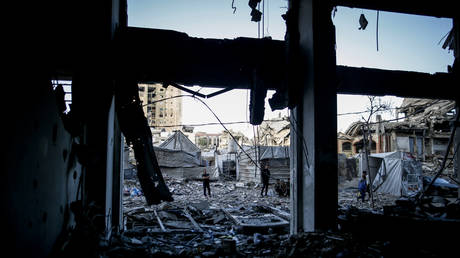
The targeted strike by the Israeli Air Force against Izz al-Din al-Haddad in Gaza City’s Rimal neighborhood exposes a fundamental flaw in contemporary counterterrorism doctrine: the conflation of tactical attrition with strategic victory. While the execution of a high-value targeting operation yields immediate political and psychological utility, its long-term strategic efficacy remains bounded by the structural resilience of the targeted organization. Decapitation strikes do not systematically dismantle deeply institutionalized asymmetric groups; instead, they trigger predictable cycles of structural adaptation, operational transformation, and political re-alignment.
To evaluate the systemic impact of this operation, the situation must be processed through three rigorous analytical lenses: the organizational replacement rate, the geopolitical escalation mechanics under a fragile ceasefire, and the friction between kinetic actions and long-term demilitarization frameworks.
The Organizational Replacement Rate: Mechanized Succession and the Ghost of al-Qassam
Asymmetric networks operating under prolonged high-attrition conditions develop highly institutionalized, decoupled organizational architectures. Haddad, colloquially dubbed the "Ghost of al-Qassam," ascended to lead the military wing of Hamas only after his predecessor, Mohammed Sinwar, was eliminated. This transition demonstrates an organizational design tailored for leadership continuity.
The resilience of an insurgent or terrorist command structure can be modeled as an operational balance sheet where stability depends on the relationship between two primary variables:
- The Decapitation Rate ($R_D$): The frequency and velocity at which a state actor can identify, track, and neutralize senior leadership nodes.
- The Institutional Regeneration Velocity ($V_R$): The speed at which the organization's bureaucratic and military hierarchy promotes qualified personnel to fill vacant nodes, maintaining command and control continuity.
When $V_R \ge R_D$, the targeted organization experiences localized tactical disruption but avoids systemic operational collapse.
Haddad’s trajectory through the al-Majd internal security apparatus highlights how Hamas uses internal security to insulate its leadership from espionage. The primary vulnerability of a high-value target is information leakage. By embedding veteran internal security personnel at the apex of its military hierarchy, the group minimizes intelligence penetration, thereby lowering $R_D$ and buying the time needed for institutional regeneration.
While the strike used high kinetic force—three fighter jets deploying 13 munitions to simultaneously eliminate a hideout apartment and an adjacent getaway vehicle—the underlying operational structure remains. High-value targeting alters the identity of the commander, but it rarely deletes the function of the command node.
Geopolitical Escalation Mechanics: The Fragile Ceasefire Paradox
The timing of the Rimal neighborhood strike reveals a stark trade-off between immediate kinetic opportunities and broader geopolitical stabilization strategies. Executing a major decapitation strike during a highly sensitive diplomatic window introduces profound instability into negotiated frameworks.
This dynamic operates within a specific strategic friction zone:
[Kinetic Opportunity: High-Probability Target Identified]
                         │
                         ▼
             [Executive Authorization]
                         │
                         ▼
        [Tactical Strike Executed Mid-Ceasefire]
                         │
                         ▼
       ┌─────────────────┴─────────────────┐
       ▼                                   ▼
[Diplomatic Attrition:              [Asymmetric Calibration:
Collapsing Trust & Mediation]        Rockets / Guerrilla Attrition]
State actors often operate under a "preemptive neutralization" doctrine, which dictates that any actionable intelligence on a high-value target must be exploited immediately, regardless of political timing. The justification rests on the assumption that a top-tier commander poses a continuous, non-containable threat to state forces.
However, this kinetic opportunism directly undermines diplomatic initiatives, such as those aimed at regional demilitarization. In an asymmetric conflict, the state's use of precision airpower during a ceasefire is interpreted by the adversary as a systemic breach. This perception alters the adversary's cost-benefit calculus, shifting their strategy away from compliance toward asymmetric retaliation.
Because an insurgent force cannot match a state's conventional airpower, its response typically bypasses symmetric escalation. Instead, it relies on low-cost, high-impact methods: localized guerrilla ambushes, improvised explosive devices (IEDs), or rocket fire designed to inflict political and economic costs on the state. Consequently, a single tactical success can collapse a broader diplomatic architecture, trading long-term stabilization for a short-term degradation of enemy personnel.
The Demilitarization Bottleneck: Why Kinetic Force Fails to Disarm
The joint statement by Israeli leadership framed the strike on Haddad not merely as retribution for the October 7 attacks, but as a direct consequence of his refusal to comply with international demilitarization plans. This rationale highlights a recurring structural bottleneck in conflict resolution: the belief that kinetic coercion can force disarmament without addressing underlying structural incentives.
Disarmament, Demobilization, and Reintegration (DDR) frameworks fail when applied to ideological, non-state armed groups through purely kinetic pressure. The resistance to disarmament is driven by three distinct structural factors.
The Survival Asymmetry
For a state, disarmament is a policy objective. For an asymmetric armed group, its weapons cache is its sole guarantee of survival and political relevance. Absent an existential alternative or a total administrative replacement on the ground, an organization will view disarmament as a demand for unconditional surrender, choosing instead to sustain high casualty rates.
The Decentralization of Material
Modern asymmetric warfare relies heavily on low-technology, distributed manufacturing capabilities. Even if the senior leadership tier is neutralized, the technical knowledge, underground infrastructure, and distributed supply lines required to manufacture or deploy basic weaponry remain distributed among lower-level operational cells. Decapitation strikes remove the orchestrators, but they do not eliminate the inventory.
Leverage in Negotiations
Weapons systems serve as the primary leverage mechanism for non-state actors in international mediation. Surrendering these assets prior to achieving core political objectives eliminates their bargaining power. Therefore, targeting a commander for resisting disarmament often hardens the resolve of the remaining hierarchy, transforming weapons retention into a symbol of institutional defiance.
Defying the Metric of Attrition
The reliance on high-value targeting as a primary metric of success creates an analytical illusion. State intelligence services frequently present the elimination of "the last remaining architect" or the "most senior commander" as a definitive turning point. This presentation relies on a linear model of warfare, assuming that removing key inputs (leadership) will proportionally decrease operational outputs (insurgent activity).
Historical and structural data from contemporary asymmetric conflicts suggest otherwise. Highly institutionalized groups respond to decapitation by decentralizing authority, granting autonomous operational mandates to regional brigades. The elimination of a centralized commander like Haddad often accelerates this shift, transforming a unified military wing into a network of highly localized, independent cells. These decentralized fragments are frequently more volatile, less predictable, and significantly harder to engage via diplomatic mediation.
The strategic play moving forward requires moving past the illusion of the kinetic quick-fix. State actors must expect that this strike will trigger an immediate, decentralized restructuring within the insurgent command framework. Operational focus must pivot away from body counts and toward the systematic disruption of the financial, logistical, and internal security mechanisms that enable the organizational replacement rate to function. Until a state can consistently drive the institutional regeneration velocity below the decapitation rate, high-value targeting will remain an expensive exercise in managing an status quo of conflict, rather than resolving it.