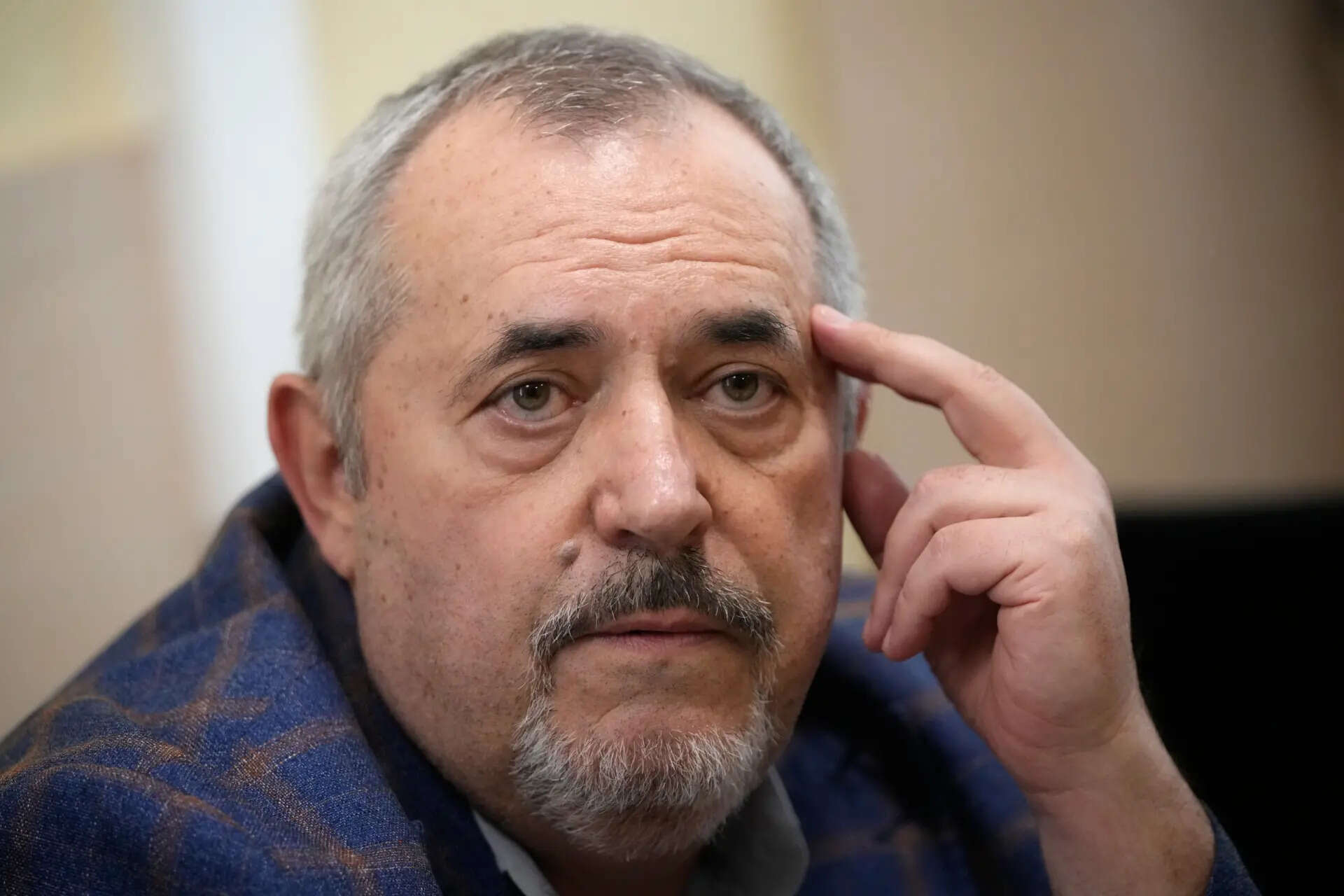
A Russian judge just fined anti-war politician Boris Nadezhdin 1,000 rubles. That is roughly thirteen American dollars. It sounds like a joke, a minor traffic ticket or a penalty for littering in a municipal park. But it isn't a joke. It's a calculated legal strike meant to wipe out the last visible anti-war campaign heading into the September parliamentary elections.
The Dolgoprudny City Court found the 63-year-old veteran politician guilty of publicly displaying "extremist symbols". His crime? Sharing a link to a 2023 online interview that briefly showed a portrait of the late opposition leader Alexei Navalny. The image stayed on screen for a mere ten seconds. In today's Russia, those ten seconds are enough to completely disqualify a challenger from the ballot. Meanwhile, you can read other stories here: The Anatomy of Supply Chain Friction: Labor Deficits and Safety Hazards in Long Haul Logistics.
This is how modern candidate filtering works under Vladimir Putin. The Kremlin doesn't always need to hand down a 19-year penal colony sentence to stop an opponent. Sometimes, a thirteen-dollar administrative fine does the job with surgical precision.
The Mathematical Trap of Russian Election Law
To understand why this tiny fine matters, you have to understand the mechanics of the Russian electoral system. Nadezhdin was actively preparing to collect signatures to get on the ballot for the State Duma, Russia's lower house of parliament. He was doing this despite the Justice Ministry branding him a "foreign agent" just one week earlier. To explore the full picture, we recommend the detailed report by The Washington Post.
The foreign agent tag already made running for office legally impossible, but Nadezhdin kept pushing forward with a symbolic signature-collecting campaign anyway. He wanted to show the world, and the Russian public, that anti-war sentiment still exists. He called it his plan to keep standing his ground.
The Kremlin deployed "Plan B". Under Russian administrative law, a conviction for displaying extremist symbols triggers an automatic one-year ban on participating in elections or even collecting signatures for a campaign. The law strips away the legal right to organize a campaign structure entirely.
Nadezhdin saw it coming. He noted that when the foreign agent label failed to scare his team into halting their signature drives, the state shifted instantly to an offense that legally paralyzes his operations. The goal wasn't to lock him away forever; the real goal was to shut his mouth and kill the campaign mechanics before September.
Ten Seconds of Navalny
The state constructed its entire case around a livestream announcement posted on Telegram. The video featured Nadezhdin alongside politician Elvira Vikhareva. For a brief moment, a photograph of Alexei Navalny appeared in the frame.
Because Russia officially labeled Navalny’s Anti-Corruption Foundation as an extremist organization back in 2021, the state now treats any public depiction of his face as an illegal broadcast of extremist propaganda. It doesn't matter that the interview took place in 2023. It doesn't matter that Navalny died in an Arctic penal colony in early 2024. The legal machinery moves backward through time to find infractions.
During the court session, the reality of the situation broke through the bureaucratic procedures. Nadezhdin, who suffers from heart disease and diabetes, felt visibly unwell. The judge initially blocked paramedics from entering the courtroom while the trial was active. Medical staff only gained access to check his vitals after the judge retreated to a back room to write the predetermined verdict.
"I'm glad I'm alive and free," Nadezhdin remarked after leaving the courtroom. He knows how easily an administrative offense can morph into a criminal case overnight.
The Shrinking Space for Dissent
The timing of this ruling isn't accidental. The Kremlin is dealing with visible domestic strain. Ukrainian drone strikes have hit oil facilities deep within Russian territory, sparking localized fuel shortages and raising uncomfortable economic anxieties. Inflation is accelerating, growth is flatlining, and stagflation fears are creeping into state economic discussions.
In a volatile economic environment, the authorities lose all tolerance for political wildcards. They need a controlled, entirely predictable ballot. The official system parties—like the Communists—will run, but they consistently vote in lockstep with United Russia on every critical war policy and budget issue. Someone like Nadezhdin, who collected over 100,000 signatures during his disqualified 2024 presidential bid while calling for an immediate end to the Ukraine conflict, represents an unpredictable variable.
The crackdown isn't limited to traditional liberal opposition figures either. On the exact same day Nadezhdin was fined outside Moscow, police in St. Petersburg arrested Ilya Remeslo. Remeslo wasn't a lifelong pro-Western liberal; he was a former pro-Kremlin activist and blogger who turned critical of the military campaign and publicly demanded Putin's resignation. The state responded by confining him to a psychiatric clinic for a month before hitting him with formal criminal charges for spreading "false information" about the military.
Whether you come from the liberal intelligentsia or the disillusioned pro-state blogging sphere, the punishment for open critique remains uniform.
A Trapped Politician
Nadezhdin is an insider who knows how the Kremlin functions. In the late 1990s, he served as an advisor to Boris Nemtsov—the opposition leader assassinated near the Kremlin walls in 2015. He also worked directly under Sergei Kiriyenko, who currently serves as Putin's deputy first chief of staff and oversees domestic political control. He spent years navigating the gray zones of Russian politics, serving in the State Duma decades ago and keeping a local council seat until recently.
That insider knowledge makes his current situation even more claustrophobic. Just days before his trial, the Federal Bailiff Service slapped him with an sudden travel ban. The state resurrected a year-old bankruptcy case to legally block him from crossing the border.
Nadezhdin openly admitted that he and his family were discussing whether to leave the country. He stated plainly that at his age, with his failing health and young children to raise, going to a penal colony isn't something he can casually shrug off. "I will just die behind bars," he told the court. By shutting down his exit route and killing his campaign with a minor fine, the state has locked him in a legal cage: unable to run, unable to leave, and entirely neutralized.
If you are tracking international relations or Russian internal policy, do not look past these seemingly minor administrative court filings. They provide the most accurate look at how modern autocracies maintain absolute legislative compliance. You can track his legal team's upcoming appeal through independent Russian media outlets like Mediazona or OVD-Info, though the judicial track record suggests the thirteen-dollar ban will stand exactly as written.