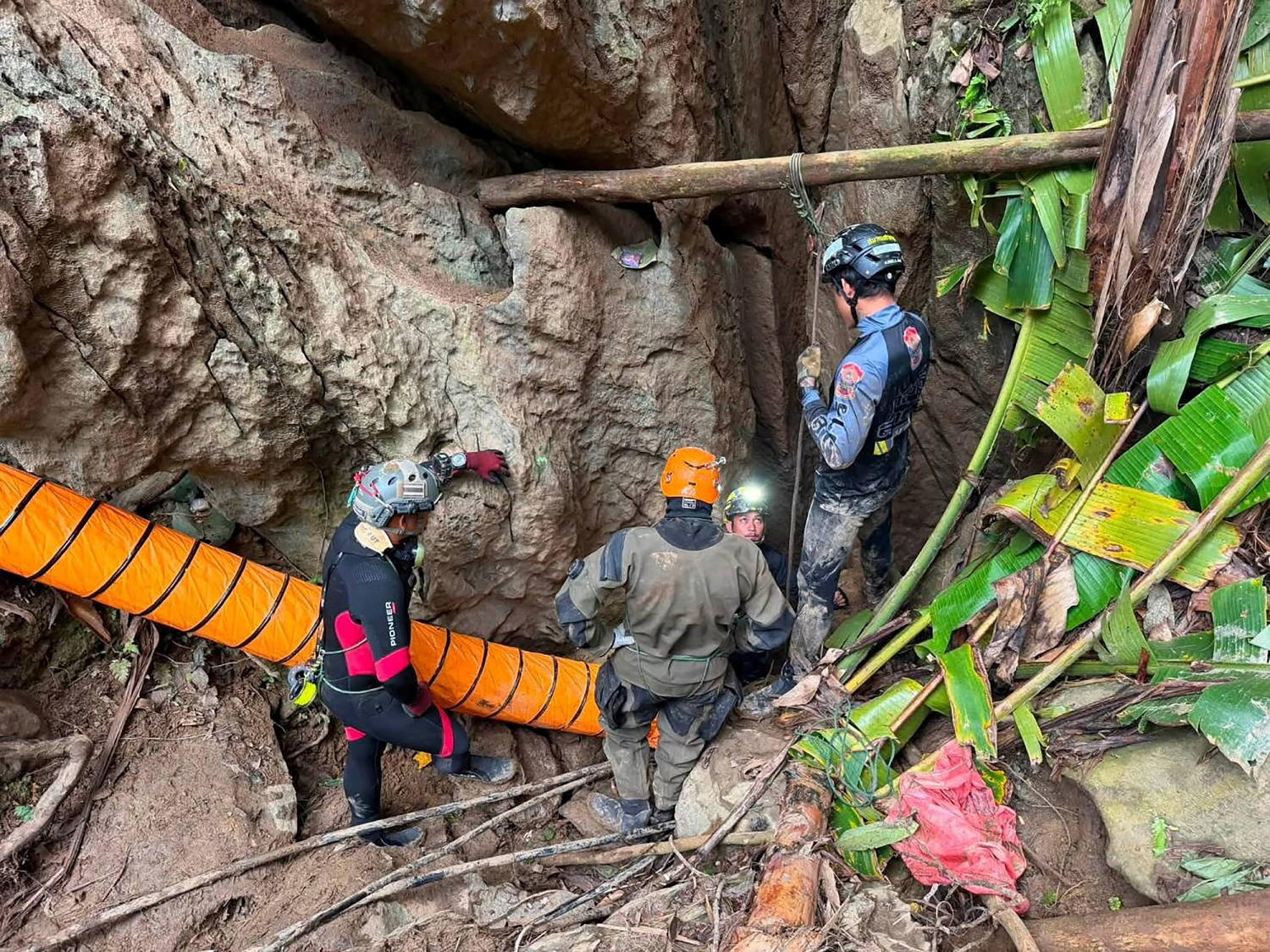
The media loves a ticking clock. As rescuers scramble in northern Laos to extract the final two men trapped in a subterranean choke point, the global news machine is running its favorite script. We see dramatic B-roll of muddy boots, tearful family members, and graphics of rising water levels. The narrative is always the same: human grit versus merciless nature, a race against time, and a triumph of the human spirit waiting just around the corner.
It is a comforting story. It is also entirely wrong. Don't miss our earlier article on this related article.
By framing these cave incidents as unpredictable, sudden acts of God requiring heroic eleventh-hour interventions, the public—and the adventure tourism industry—misses the brutal operational reality. Having spent nearly two decades consulting on remote wilderness logistics and risk mitigation, I can tell you that the "race to save" narrative is a myth designed to mask systemic, predictable failures.
The truth? The rescue isn’t the triumph. The rescue is the receipt for a series of avoidable, institutional blunders. If you want more about the context of this, NPR provides an informative summary.
The Mirage of the Blameless Disaster
When a cave flooding traps individuals, the immediate coverage focuses on the weather. Media outlets point to unseasonal monsoons or sudden, freak downpours. They treat the geology like a trap door that snapped shut without warning.
This is lazy journalism.
In subterranean exploration, there is no such thing as a surprise flood. Hydrogeology dictates that caves are drainage systems. If it rains in a catchment basin, that water is going underground. The time it takes for surface water to penetrate a specific cave system—known as the lag time—is measurable, predictable, and often heavily documented by local geological surveys.
When people get trapped, it is almost never because nature changed the rules. It is because human beings ignored the data.
Imagine a scenario where a commercial aviation company flew a plane directly into a known, tracking supercell storm, and then we spent a week praising the bravery of the paramedics who pulled survivors from the wreckage. We wouldn't call that a miracle rescue. We would call it criminal negligence. Yet, when it comes to extreme environments like the karst topography of Southeast Asia, we suspend our critical faculties and blame the rain.
The Hero Complex is Actively Dangerous
The "race against time" framing does more than just misinform; it kills people.
When the media hypes up a frantic countdown, it creates immense political and social pressure on the ground. Local officials, desperate to avoid international embarrassment, push rescue teams to move faster than the environment allows.
In deep-cave rescue logistics, speed is your enemy. The moment you rush an extraction in a flooded, zero-visibility environment, you multiply the risk exponentially—not just for the victims, but for the divers. Consider the high-profile Tham Luang rescue in 2018. The world cheered the outcome, but the operational reality was a terrifyingly close call that cost the life of Saman Kunan, a retired Thai Navy SEAL, and later, Beirut Pakbara, another rescue diver.
The media treats these tragedies as unavoidable collateral damage in the pursuit of a miracle. The reality is simpler: extreme environments do not care about heroism. They care about physics, gas management, and hyperbaric mechanics.
By demanding a fast, cinematic resolution, the public conversation forces rescuers to accept margins of safety that are unacceptably thin. We are treating a highly technical, cold-blooded engineering problem like a sports movie.
Dismantling the People Also Ask Mythos
Look at the questions people search for during these events. The premises are fundamentally broken.
Can't we just pump the water out?
This is the standard engineering fantasy. People assume that if you bring in enough diesel pumps, you can drain a cave like a swimming pool. It shows a complete ignorance of karst geology. Caves in Laos are carved out of porous limestone. You aren't pumping out a room; you are trying to pump out an entire mountain's watershed while it is actively raining. Pumping can lower water levels by inches in critical bottlenecks, but it is a holding action, not a solution.
Why don't they just swim out with scuba gear?
Putting an untrained, claustrophobic, potentially malnourished person into a cave-diving rig is a death sentence. Cave diving is widely considered the most dangerous technical sport on earth. It requires hundreds of hours of specialized training to manage panic in pitch-black, confined spaces. In high-flow, low-visibility conditions, a panicked victim will thrash, rip out their regulator, stir up silt, and drown both themselves and their handler.
The unconventional truth that nobody wants to admit is that sometimes, the safest operational move is to do absolutely nothing. If the victims have air, fresh water, and high ground, the correct choice is often to leave them there for weeks—or even months—until the dry season naturally drops the water levels. But a headline that reads "Men to Stay in Cave Until October" doesn't generate clicks, so we push for dangerous, immediate interventions instead.
The Real Cost of Cheap Adventure Tourism
If we want to stop writing these rescue stories, we have to talk about the economic forces driving them.
Tourism infrastructure across developing regions has expanded faster than the regulatory oversight required to manage it safely. Local operators, running on razor-thin margins, offer access to high-risk environments without the capital to invest in real-time weather monitoring, redundant communication systems, or proper guide accreditation.
I have stood at the entrance of caves in Southeast Asia where the entire safety protocol consisted of a handwritten sign warning people not to enter during the rainy season. That isn't a safety strategy; it is a legal liability waiver.
When a crisis occurs, these under-regulated operations rely on the global community to bail them out. They rely on volunteer technical divers flying in from the UK, the US, or Australia, using their own money and risking their own lives to clean up the mess left by a lack of institutional oversight.
We are subsidizing high-risk tourism with the lives of volunteer rescuers.
The Cold Reality of Extrication
We need to stop romanticizing the rescue.
The two men still inside that cave in Laos are not waiting for a miracle. They are trapped in a dark, humid, high-stress environment where their bodies are slowly deteriorating. Every hour they spend in there increases the risk of hypothermia, trench foot, and psychological collapse.
The divers trying to reach them are navigating passages where a single displaced rock or a torn drysuit can mean death. They are checking pressure gauges, calculating decompression ceilings, and fighting currents that want to pin them against sharp limestone walls. It is a grim, calculated risk assessment where every variable is weighted against human survival.
If they make it out alive, it won't be because of a collective global wish or a burst of adrenaline. It will be because a team of highly trained individuals executed a cold, methodical plan that managed to cheat the margins of error just enough.
Stop cheering for the race. Start asking why the race was allowed to happen in the first place.