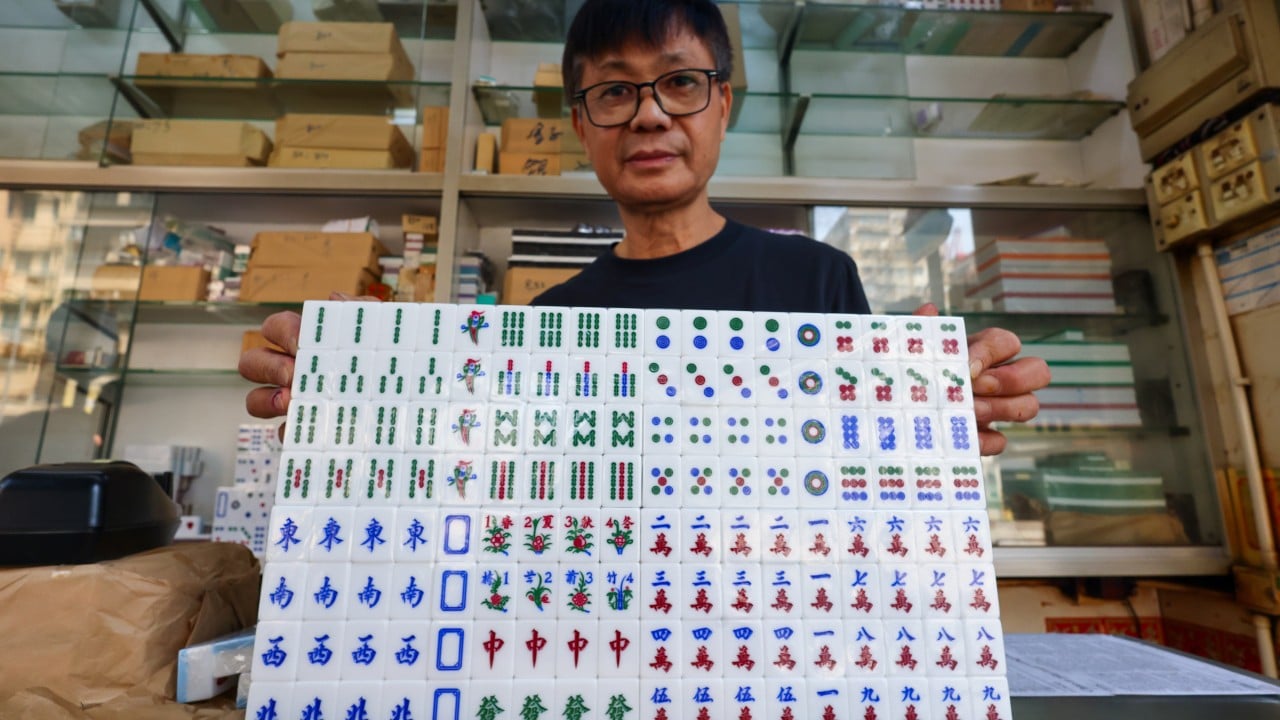
The air inside the tiny shop on Jordan Road doesn't smell like the humid, exhaust-heavy breeze of modern Hong Kong. It smells of bone-dry plastic, sharp metal, and the faint, lingering ghost of whale oil. Here, the city’s frantic neon pulse slows to the rhythmic skrit-skrit-skrit of a tungsten blade meeting a smooth white surface.
Uncle King sits hunched over a workbench that has supported his weight for nearly half a century. His eyes, clouded by decades of focusing on millimetres, are fixed on a single tile. It is the One Bird—the Siu Ma—the most intricate piece in a mahjong set. In his hands, a blank rectangle of urea resin is being coaxed into life. A feather here. A sharp beak there. A tail that curves with the grace of a calligraphy stroke.
But the bird is crying out for a different reason today. After 47 years of defiant existence, the metal shutter is coming down for the last time. Biu Kee Mahjong is closing. When the ink dries on the final set, a specific frequency of Hong Kong’s heartbeat will simply stop.
The Weight of a Hand-Carved Soul
To understand why this matters, you have to feel the difference. Most people today play with factory-pressed sets. They are perfect. They are symmetrical. They are sterile. They are born in a mold, thousands at a time, identical and soulless.
A hand-carved tile is different. Because Uncle King’s blade follows the subtle grain of the material and the even subtler tremors of a human hand, no two "Green Dragons" are ever truly the same. High-stakes players in the 1970s used to say they could "read" the tiles with their fingertips, sensing the depth of the carving without ever looking down. It was a language of tactile intimacy.
Imagine a smoke-filled room in Kowloon City, circa 1982. The clatter of tiles sounds like falling dominoes, but sharper. It is the "clack" of heavy, high-quality resin hitting a wooden table. For the people in that room, mahjong wasn't just a game. It was the social fabric of a displaced generation. It was how you negotiated a business deal, how you vetted a future son-in-law, and how you forgot, for a few hours, that the world was changing too fast.
Uncle King, or Cheung Shun-king, started at the age of 13. He didn't choose it because it was "art." He chose it because it was a trade, a way to put rice in the bowl. He became a master because he stayed. While his peers moved into finance or shipping as Hong Kong transformed into a global titan, he remained in the shadows of the eaves, carving birds.
The Invisible Stakes of a Vanishing Act
The tragedy of Biu Kee isn't just about a shop closing its doors. It’s about the erasure of "the touch."
When we transition everything to digital screens or mass-produced plastic, we lose the human error that makes life textured. Uncle King’s tiles carry his DNA—not literally, perhaps, but through the specific way he curves the "Seven Circles" or the pressure he applies to the "Red Middle."
The problem is one of cold mathematics. A machine can spit out a set of mahjong tiles in minutes. Uncle King takes four or five days. In a city where a square foot of floor space costs more than a lifetime of labor, the math eventually breaks. The landlord needs a higher yield. The younger generation needs a faster career. The tourists want a cheap souvenir, not a HK$5,000 heirloom that took a week of a master’s life to create.
Consider the "Bird" again. In the hand-carving tradition, the bird on the One Bamboo tile is the artist’s signature. Some carvers make them look like plump sparrows; others make them look like predatory hawks. Uncle King’s birds have always looked like they were caught mid-song. When he retires, that specific species of bird goes extinct. You cannot download his muscle memory. You cannot patch his fifty years of experience into an algorithm.
The Silent Shutter
The eviction notice didn't come with a villain’s laugh. It came with the quiet finality of a bureaucratic stamp. Building safety regulations, urban renewal, the relentless march of "improvement." The government sees a fire hazard or an aging structure; the community sees a library of living history being burned to the ground.
People flocked to the shop in the final weeks. They weren't there to buy tiles, mostly. They were there to witness a ghost. They stood in the narrow doorway, snapping photos with iPhones, trying to capture the sight of a man doing something with his hands that didn't involve a touchscreen.
Uncle King remained polite, but he didn't stop working. He couldn't. He had backorders to finish. Even at the end, the work is the point. He doesn't see himself as a "cultural heritage bearer," a title the media loves to throw around. He sees himself as a carver who still has a few sets to go.
There is a profound loneliness in being the last of something. It is the realization that you are speaking a language that no one else is bothering to learn. His children have their own lives, their own modern professions. They respect his work, but they aren't going to spend ten hours a day inhaling resin dust for the sake of a tradition that the market has decided is obsolete.
Beyond the Four Walls
We often talk about the "soul" of a city as if it’s a permanent fixture, like a mountain or a harbor. It isn't. The soul of a city is a collection of small, flickering lights—the noodle maker who knows exactly how much alkali to add, the tailor who remembers the slope of your shoulders, and the mahjong carver who knows the "One Bird" by heart.
Every time one of these shops closes, the city becomes a little more generic. A little more like everywhere else. We trade the jagged, beautiful edges of craftsmanship for the smooth, forgettable surfaces of convenience.
Uncle King is packing his tools now. The tungsten blades, the pots of vibrant red and green paint, the brushes with bristles worn down to nubs. He isn't angry. He has the calm of a man who knows he did his job well. He outlasted the British Empire’s rule of Hong Kong. He outlasted the transition to the mainland. He outlasted the rise of the internet.
But no one outlasts the rent.
The game of mahjong is built on cycles. You build a wall, you tear it down. You discard, you pick up. You wait for the right tile to complete the hand. But sometimes, the tile you need is the one that has been tossed out of the game entirely.
As the sun sets over Jordan, casting long shadows across the empty shelves of Biu Kee, the "clack" of the tiles finally goes silent. The bird has flown. All that is left is the smooth, white blankness of a city that has forgotten how to carve its own name.
The blade sits on the table, cold for the first time in forty-seven years.