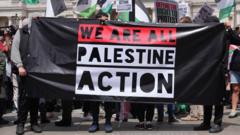
The British government just hit a massive legal wall, but they aren't backing down. After the High Court ruled that the ban on Palestine Action was actually unlawful, the Home Office decided to dig their heels in. It's a messy situation that raises some serious questions about how far the state can go to silence protest groups they don't like. You’ve probably seen the headlines about activists targeting arms factories or splashing red paint on office buildings. Whether you agree with their methods or not, the legal battle happening right now matters for every single person who cares about civil liberties in the UK.
Basically, the High Court found that the previous administration's move to proscribe the group didn't follow the rules. It wasn't just a minor technicality. The judges were clear that the process lacked the necessary legal rigour. Yet, instead of pivoting or re-evaluating, the current government is defending the stance. They're insisting that the threat posed by the group justifies the heavy-handed approach. It's a bold move. It's also one that might backfire if they can't prove their case in a way that satisfies a skeptical judiciary.
Why the High Court Slammed the Original Decision
The court's ruling wasn't a defense of Palestine Action’s tactics. It was a defense of the law itself. When the government decides to ban an organization, they're using one of the most powerful tools in their box. Proscription means it's a criminal offense to belong to the group, support it, or even wear its logo. You’re talking about potential jail time. Because the stakes are so high, the Home Secretary has to meet a very specific legal threshold.
In this case, the court found the government failed to show that Palestine Action met the statutory definition of a group "concerned in terrorism." That's the heart of the issue. You can't just ban a group because they're a nuisance or because they break property laws. Those things are already illegal. You have to prove they're involved in terrorism as defined by the Terrorism Act 2000. The High Court looked at the evidence and said, "This isn't enough." It was an embarrassing defeat for the Home Office.
The Government Strategy to Keep the Ban Alive
Despite that judicial slap on the wrist, the government is trying to salvage the ban. They're arguing that the court didn't see the full picture or that new evidence justifies keeping the group on the list. It feels like a desperate attempt to avoid looking weak on "extremism." I’ve seen this play out before. A department makes a high-profile decision, the courts find it's legally flawed, and the politicians spend months trying to retroactively justify it rather than admitting they overreached.
They're leaning heavily on the idea of "public safety." They claim that the group’s actions go way beyond "normal" protest and enter the territory of serious organized crime that threatens national infrastructure. By framing it this way, they're trying to move the goalposts. They want the public to focus on the smashed windows and the disrupted factory lines rather than the legal standards they failed to meet. It's a classic distraction technique.
What This Means for Future Protests in the UK
If the government succeeds in defending this ban despite the High Court's initial ruling, it sets a scary precedent. It means the "terrorism" label becomes a convenient catch-all for any group that's effective at being annoying. Palestine Action targets companies like Elbit Systems. They've been successful at causing genuine financial headaches for firms involved in the defense industry. That’s why the government wants them gone.
If the bar for proscription stays this low, who's next? Could an environmental group that blocks a motorway be labeled a terrorist organization tomorrow? The law is supposed to be a shield against arbitrary state power, not a weapon for the government to use against its political enemies. When the Home Office ignores a court ruling to push an agenda, the balance of power shifts in a dangerous direction.
The Reality of Palestine Action Tactics
Let’s be honest about what the group actually does. They aren't traditional lobbyists. They use "direct action." This involves breaking into facilities, damaging equipment, and making it impossible for certain businesses to operate. Under current UK law, these people can be arrested for burglary, criminal damage, and aggravated trespass. And they often are. Many members have spent time in cells.
The question isn't whether they should be punished for breaking the law. They are already being punished. The question is whether they should be classified alongside groups like Al-Qaeda or ISIS. That's the leap the government is making. It's a massive leap. Most legal experts will tell you that criminal damage—no matter how politically motivated—doesn't automatically equal terrorism. By trying to force that square peg into a round hole, the government is stretching the law until it snaps.
A Pattern of Legislative Overreach
This isn't an isolated incident. Over the last few years, we’ve seen a string of new laws designed to crack down on dissent. The Police, Crime, Sentencing and Courts Act and the Public Order Act gave the police huge new powers to shut down protests for being "too noisy" or "too disruptive." This ban is just the latest escalation in that trend.
The government keeps saying they want to protect "the British way of life," but they're doing it by chipping away at the right to protest, which is a pretty fundamental part of that life. It’s a messy contradiction. They talk about freedom while they're busy writing new ways to take it away. This legal battle is the frontline of that conflict.
The Cost to the Taxpayer
Every time the Home Office loses one of these cases, it's your money that pays for it. High Court battles aren't cheap. Defending an "unlawful" ban requires expensive KCs and thousands of hours of civil service time. If they lose again, they might have to pay the legal costs of the group they're trying to ban. It's a massive waste of resources.
Instead of fixing the legal process or actually addressing the underlying issues—like the ethics of the arms trade that fuels these protests—the government chooses the most expensive and least effective route. They're playing a game of legal whack-a-mole. Every time they try to suppress a movement with a ban, two more pop up in its place, fueled by the perceived injustice of the state's actions.
Where the Case Goes From Here
The legal fight isn't over. The government’s defense will be scrutinized by judges who don't care about political optics. They only care about the law. If the Home Office can't produce a "smoking gun" that links Palestine Action to actual terrorist activity, the ban will eventually have to be lifted.
If that happens, it'll be a massive victory for the group and a humiliating blow for the government. It would also likely lead to a wave of compensation claims from individuals who were targeted or arrested under the proscription order while it was in place. The government is taking a huge gamble. They're betting that they can bully the legal system into accepting their definition of terrorism.
Keep an eye on the specific evidence the government presents in the coming months. They'll likely try to point to specific incidents of "violence," but pay attention to whether that violence is against property or people. In UK law, that distinction is everything. If they can't prove a threat to human life or a calculated attempt to intimidate the public through terror, their case falls apart.
You should also look at how other activist groups respond. If this ban sticks, expect to see a chilling effect across the entire protest spectrum. Groups will become more secretive, more radicalized, and less willing to engage with the legal system at all. That doesn't make the country safer; it just makes the conflict more underground and harder to manage. The smarter move would be to follow the High Court's lead and use existing criminal laws to deal with property damage, rather than trying to rewrite the definition of terrorism to suit a political agenda.
Stay informed by checking the official court transcripts if you can. Don't just rely on the government's press releases. They have a vested interest in making their actions sound more reasonable than they actually are. The real story is in the legal fine print.