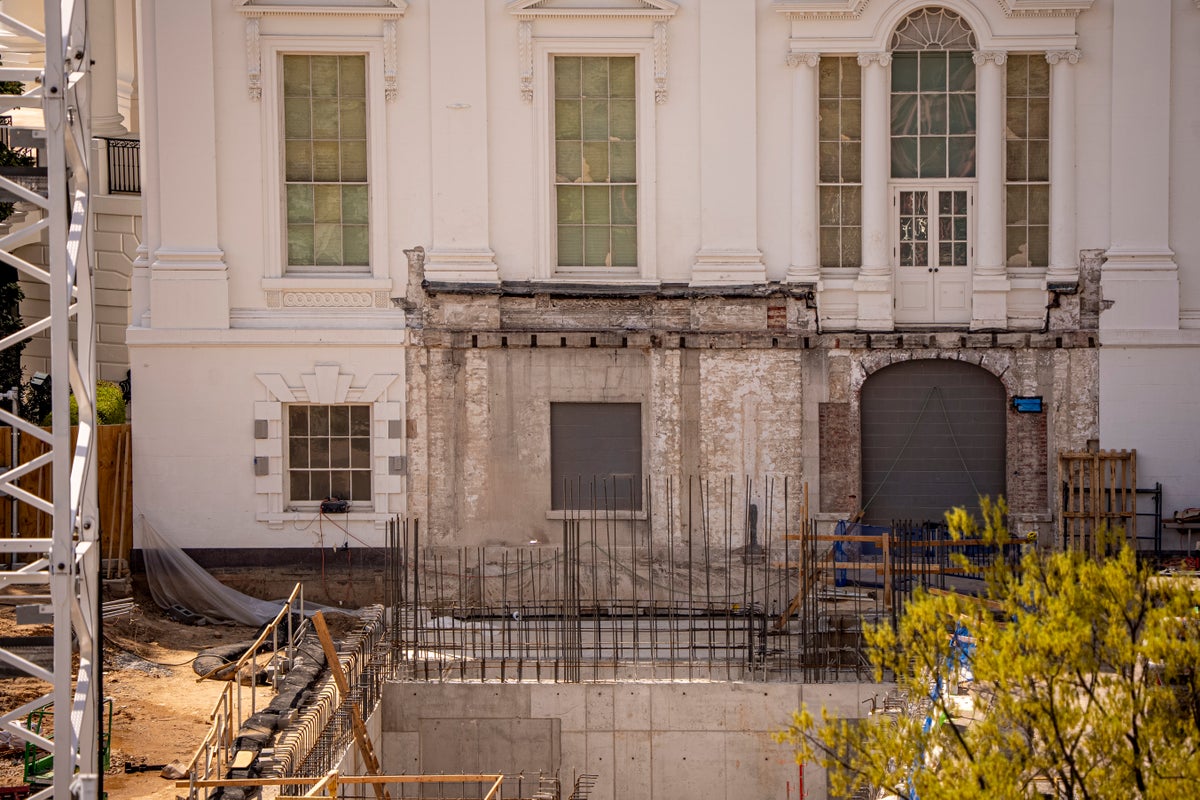
A federal judge has frozen construction on the White House ballroom for a second time, issuing a scathing rebuke of the legal tactics employed by Donald Trump’s defense team. U.S. District Judge Royce Lamberth halted the project after determining that the former president's lawyers provided "disingenuous" arguments regarding the necessity and transparency of the massive renovation project. This ruling does more than just pause a construction crew; it exposes a deep-seated friction between executive ambition and judicial oversight that has come to define the modern American presidency.
The conflict centers on a multi-million-dollar addition to the executive mansion, a project pitched as a necessary upgrade for state functions but criticized by opponents as an ego-driven vanity project that bypasses standard preservation protocols. By freezing the work, Lamberth is signaling that the court will not be sidelined by bureaucratic maneuvers or misleading filings. The hammer has dropped, and the dust is settling on a vacant construction site that serves as a physical manifestation of a constitutional stalemate.
Judicial Patience Runs Dry
Judge Lamberth is not a jurist known for suffering fools. His decision to halt the ballroom project rests on the premise that the defense intentionally obscured the timeline and the environmental impact of the construction. In his written order, Lamberth noted that the representations made by the legal team were inconsistent with the reality of the site’s development. This is a significant escalation from a simple procedural delay. It is a formal accusation of bad faith.
The "disingenuous" label is a heavy one in federal court. It suggests that the lawyers were not merely mistaken, but were actively trying to steer the court away from the truth. When a judge loses trust in the advocates before him, the legal ground shifts. The defense had argued that the construction was already too far along to stop without causing irreparable structural damage to the existing White House foundation. Lamberth found this claim lacked credible engineering support.
The Preservation Battleground
The White House is more than an office; it is a National Historic Landmark. Every brick moved and every trench dug is subject to the National Historic Preservation Act. Critics argue the ballroom project skipped essential review phases. They claim the administration used national security as a blanket excuse to avoid public hearings and environmental impact assessments.
Architectural historians have voiced concerns that the new structure would permanently alter the silhouette of the West Wing. The proposed ballroom is massive. It is designed to host hundreds of guests in a climate-controlled, high-security environment that the current East Room cannot easily accommodate. However, the "how" matters as much as the "what." By fast-tracking the project, the administration effectively told preservationists that their input was a luxury the executive branch could no longer afford.
Money and Mandates
Funding for the ballroom has been a point of contention since its inception. While the administration claims the funds were properly diverted from existing maintenance budgets, Congressional watchdogs are digging into the fine print. There is a specific process for how taxpayer money is allocated for capital improvements at 1600 Pennsylvania Avenue. If the court finds that the funding was redirected without proper authorization, the project could face more than just a pause; it could face a permanent defunding.
The defense maintains that the President has broad authority to manage the executive residence. They view the court’s intervention as an overreach. From their perspective, a judge is micromanaging the physical security and operational capacity of the Commander-in-Chief. This argument relies on the theory of the unitary executive, suggesting that the President's control over his immediate surroundings is near-absolute. Lamberth’s ruling rejects that level of autonomy when it clashes with federal statutes.
The Disconnect in the Courtroom
During the most recent hearings, the tension was palpable. The judge pressed the defense on why certain documents regarding the foundation's stability were withheld during the initial discovery phase. The answers provided were vague. They focused on "evolving assessments" and "operational fluidity." Lamberth saw through the jargon.
Legal analysts watching the case note that this pattern of behavior—obfuscation followed by pleas of "too late to stop now"—is a gamble. It relies on the idea that the court will be intimidated by the scale of the project. That gamble failed. The judge’s willingness to shut down a high-profile project at the heart of American power shows that the bench still values process over prestige.
The Engineering Reality
The defense claimed that stopping mid-pour on the concrete foundation would lead to "catastrophic settling." This was their primary leverage. They wanted to make the judge feel responsible for the White House sinking into the dirt. Independent engineers consulted by the court-appointed special master disagreed. They testified that while a pause is inconvenient and adds cost, it is technically feasible.
The discrepancy between the defense's "catastrophe" narrative and the engineers' "inconvenience" reality is what triggered the "disingenuous" remark. It was a calculated attempt to use fear as a legal strategy. When that fear was debunked by technical data, the defense was left standing with no clothes.
Impact on Future Executive Projects
This ruling sets a precedent that will haunt future administrations. If the White House cannot build a ballroom without meeting every line item of a preservation act, then no federal project is safe from judicial scrutiny. It re-establishes the principle that the executive branch is a tenant of the people, not a landlord with a blank check.
The delay is costing taxpayers roughly $150,000 per week in equipment rentals and idle labor contracts. That figure is rising. As the site sits dormant, the political optics worsen. A half-finished pit on the White House grounds is a gift to political opponents who frame the project as a symbol of mismanagement.
The Road Ahead for the Ballroom
For the construction to resume, the defense must now provide a transparent, line-by-line accounting of their previous claims. They have to earn back the court's trust. This likely means a full environmental impact study and a public comment period, things they tried desperately to avoid. The shortcut they took has ended up being the longest route possible.
The ballroom remains a skeleton of steel and rebar, a silent witness to a loud legal fight. The lawyers will return to the chamber, but the judge’s words will hang over the proceedings. There is no easy way out of a "disingenuous" hole once you've dug it yourself.
The next hearing is scheduled for late next month. Until then, the cranes will remain still. The workers will stay home. The White House will continue to operate with its existing floor plan, proving that the "emergency" necessity of the ballroom was perhaps the most disingenuous claim of all.