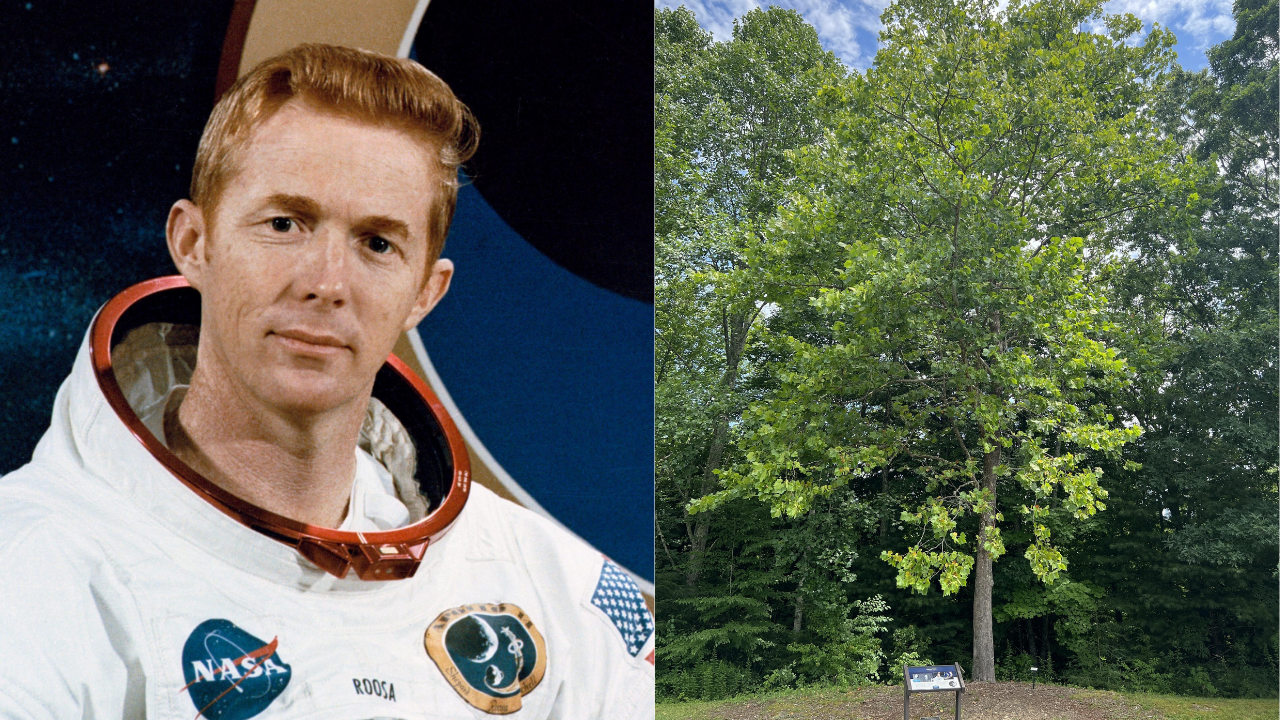
Stuart Roosa did not get to walk on the Moon.
In February 1971, while Alan Shepard and Edgar Mitchell were busy kicking up gray dust in the Fra Mauro highlands, hitting golf balls into the vacuum, and making history, Roosa was entirely alone. He was piloting the Command Module Kitty Hawk in a silent, solitary orbit sixty miles above the lunar surface. Every forty-five minutes, his spacecraft slipped behind the far side of the Moon, cutting off all radio contact with Houston. He was wrapped in a darkness so absolute it defied human comprehension.
But Roosa was not entirely alone. In his personal preference kit, tucked away in a small metal canister, he carried roughly five hundred hitchhikers. They were silent, microscopic vessels of potential life: seeds from loblolly pine, sycamore, sweetgum, redwood, and Douglas fir trees.
[Image of a Douglas fir tree]
While America stared at the fuzzy television broadcasts of astronauts bounding across the cratered wasteland, a quiet experiment was orbiting overhead. It was a joint venture between NASA and the United States Forest Service, born from a simple, poetic question: What happens to a seed that has tasted the deep void of space? Can a tree that has orbited the Moon still find its footing in the dirt of Earth?
Today, those seeds are giants. They are scattered across small-town courthouses, university campuses, and state parks across America. They look like ordinary trees. If you walked past one tomorrow, you would probably just see a pleasant canopy offering a patch of shade. But these are the Moon Trees, living monuments to a moment when humanity reached for the stars and remembered to look back at the soil.
The Canister in the Dark
To understand the emotional weight of these trees, you have to understand Roosa himself. Before he ever strapped himself into a Saturn V rocket, he was a smokejumper. In the early 1950s, he dropped out of airplanes into the raging forest fires of the Pacific Northwest. He knew the smell of burning pine. He knew the terrifying, suffocating power of nature on Earth. When the Forest Service approached him about carrying seeds into deep space, it was not a bureaucratic assignment. It was a deeply personal tribute to his roots.
The scientists wanted to know if radiation and zero gravity would mutate the seeds, rendering them sterile or warping their growth. So, they gathered hundreds of seeds from five distinct species, packed them into small plastic bags, and sealed them inside a canisters that slipped into Roosa’s gear.
Consider the journey those seeds took. They endured the violent, tooth-rattling vibrations of launch, breaking free of Earth’s gravity at twenty-five thousand miles per hour. They traveled a quarter-million miles through the harsh radiation of the cislunar void. Then, they spent days in the quiet, weightless belly of Kitty Hawk, orbiting a dead world.
Then came the return. The fiery re-entry through Earth's atmosphere, the splashdown in the Pacific, and the journey back to a laboratory.
But then, disaster struck.
During the decontamination procedures in Houston, the canister was subjected to a vacuum chamber. The pressure differential was too great. The canister burst open, exposing the delicate seeds to a violent rush of air and mixing the species up in a chaotic jumble. Ed Cliff, the Chief of the Forest Service at the time, feared the worst. The seeds were declared compromised. The experiment, it seemed, was dead before it could even begin.
Resurrection in the Soil
Forest Service geneticists refused to give up. They painstakingly separated the seeds and rushed them to two research stations: one in Gulfport, Mississippi, and another in Placerville, California. The scientists planted them with trembling hands, fully expecting to see withered brown shoots or nothing at all.
Instead, the earth did what the earth does. It woke them up.
Within weeks, green sprouts broke through the soil. Not only did they grow, but they grew with an astonishing, almost defiant vigor. The scientists watched in amazement as the space-faring seeds germinated just as successfully as their Earth-bound control counterparts. In many cases, they seemed to grow even faster, stretching toward the sun as if trying to climb back out of the atmosphere.
By the mid-1970s, the Forest Service had hundreds of healthy, young saplings. And America was about to celebrate its Bicentennial.
In 1975 and 1976, NASA and the Forest Service began shipping these cosmic saplings across the nation. They became living historical markers. A sycamore went to the White House. A loblolly pine was planted at the Kennedy Space Center. Another went to a small-town square in Indiana. They were planted by school children, governors, and veterans.
But because the distribution was handled with the decentralized chaos of a massive federal project, no one kept a master ledger. There was no centralized spreadsheet tracking every coordinate. The trees were planted, speeches were made, plaques were bolted into stone, and then, slowly, the world moved on.
The Forest That History Forgot
Decades passed. The Apollo program became a memory preserved in museums. Stuart Roosa passed away in 1994. And the Moon Trees kept growing, silently blending into the American landscape.
By the late 1990s, they had been largely forgotten. They were ghosts hiding in plain sight.
It took a third-grade teacher and a persistent NASA scientist to bring them back into the light. In 1996, Joan Goble, a teacher in Cannelton, Indiana, took her students on a field trip to a local state park. They stumbled upon a tree with a weathered plaque that read, "Moon Tree." Perplexed, Goble sent an email to NASA asking for clarification.
The email landed on the desk of Dave Williams, a planetary scientist at the Goddard Space Flight Center. Williams was captivated. He realized that NASA had lost track of its own living history. He launched a digital scavenger hunt, creating a website asking citizens to look for these cosmic relics in their own backyards.
The response was a slow, beautiful unraveling of local history. People looked up from their daily commutes and noticed the towering redwoods outside a California courthouse. They found a sweetgum thriving near a university library in New Orleans. They realized that the massive sycamore they had climbed as children in a park in Pennsylvania had actually been to the Moon and back.
To date, over eighty of the original Moon Trees have been found and verified. Many have died—victims of hurricanes, disease, or urban development—but their legacy is being cloned and replanted, a second generation of space trees ensuring the lineage survives.
A Lesson in the Bark
When you stand beneath a Moon Tree today, the experience is dizzying.
You can reach out and press your palm against the rough, deeply furrowed bark of a loblolly pine in Mississippi. It feels solid. It feels ancient. It feels entirely rooted in the terrestrial world. Yet, every cell of that tree contains the genetic blueprint of a seed that looked down upon the craters of the Moon.
There is a profound lesson in their survival. We often view space exploration as a journey of departure—an effort to leave Earth behind, to find new worlds, to escape our limitations. But the Moon Trees remind us that space exploration is ultimately an act of return. We brought the seeds into the blackness not to abandon them, but to see how much they loved the Earth. They came back, sunk their roots deep into the mud, and grew.
They stand as quiet sentinels in our parks and college campuses, bridging the unimaginable distance between the cold, sterile vacuum of space and the warm, wet, chaotic miracle of life on Earth. They are a reminder that no matter how far we travel into the dark, our true strength remains anchored in the soil.