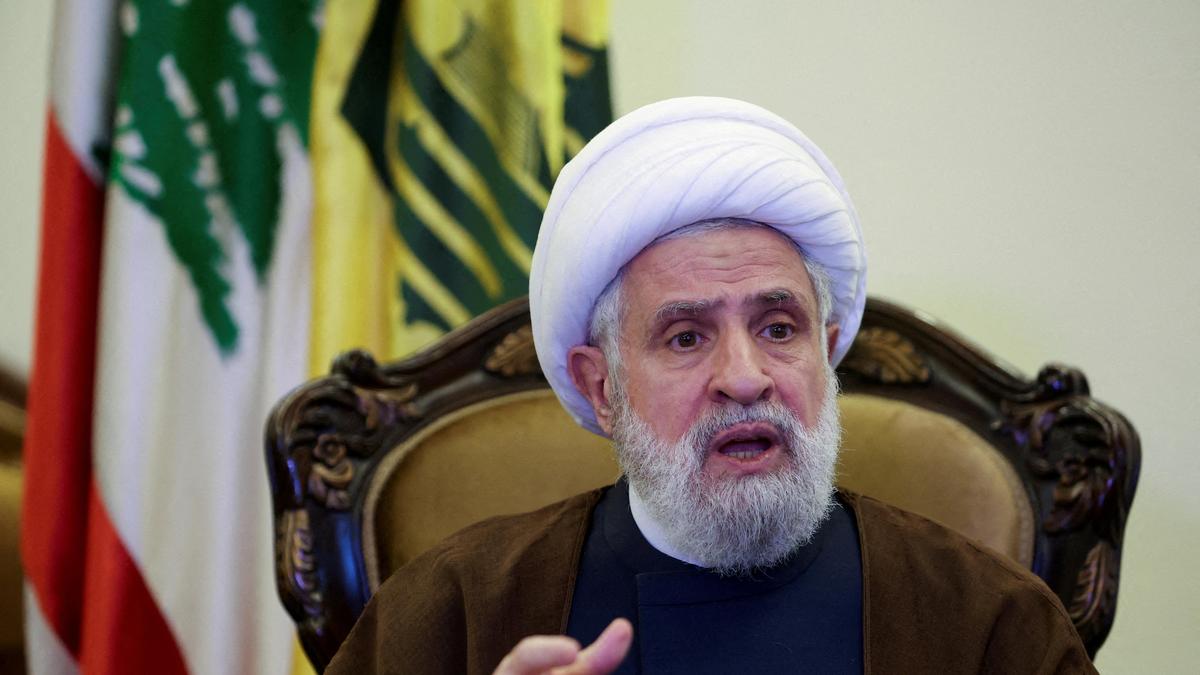
In a small, dimly lit cafe in southern Beirut, the steam from a cup of black coffee rises to meet the humid air. The man holding the cup doesn't drink. He watches the television mounted in the corner. On the screen, the image of a leader pulses with the static of a broadcast beamed from an undisclosed location. This isn't just a news segment. For the man in the cafe, and for millions across the Mediterranean coastline, this is the sound of a door slamming shut.
When the leadership of Hezbollah speaks, the words aren't merely political statements. They are physical barriers. The recent declaration rejecting direct negotiations with Israel regarding the maritime and land borders isn't a new strategy, but it is a hardening of a reality that has defined the region for decades. It is the sound of a stalemate becoming a lifestyle. Building on this topic, you can find more in: The Brutal Math of the Shahed Attrition War.
Consider the geography of this tension. To a cartographer, the border between Lebanon and Israel is a series of coordinates—the Blue Line, the Shebaa Farms, the exclusive economic zones of the gas-rich Mediterranean. But to the people living on either side, it is a psychological fault line. There is a specific kind of exhaustion that comes from living in a state of permanent "not-peace." It is a gray zone where the economy cannot breathe and the future cannot be planned because the foundation is made of sand and gunpowder.
The Language of the Unseen
Diplomacy usually requires a table. Two sides sit, perhaps with a mediator in the middle, and trade concessions like chips in a high-stakes game. But here, the table doesn't exist. Hezbollah’s refusal to engage in direct talks is rooted in a fundamental refusal to recognize the legitimacy of the entity across the line. This isn’t just stubbornness. It is the core of their identity. If you sit at a table with someone, you acknowledge they have a right to be there. For the resistance, that acknowledgment is a price they are unwilling to pay, regardless of the economic incentives buried beneath the seabed. Observers at Associated Press have shared their thoughts on this situation.
The stakes are invisible until they aren't. Beneath the waves of the eastern Mediterranean lie trillions of cubic feet of natural gas. For a country like Lebanon, currently suffocating under a debt crisis that has seen its currency lose nearly all its value, this gas is more than just energy. It is a lifeline. It represents the possibility of electricity that stays on for more than two hours a day. It represents schools that can afford heat and hospitals that don't have to choose which life-support machines to plug in.
Yet, the rhetoric remains unyielding. The vow to confront Israel, to meet any perceived encroachment with force, acts as a sovereign seal on the status quo.
The logic is circular. To negotiate is to surrender; to resist is to survive. But the survival is increasingly brittle.
A Tale of Two Maps
Imagine a hypothetical surveyor named Omar. Omar is tasked with drawing a map of his hometown near the border. In his mind, there are two maps. The first is the map of what could be: a coastline dotted with functional rigs, a border that is a point of transit rather than a point of friction, and a sovereignty that is protected by international law and mutual agreement.
The second map is the one he actually lives in. It is a map of red zones. It is a map where the "enemy" is a constant, hovering presence—a drone’s hum in the sky or a naval vessel on the horizon. In this map, the rhetoric of the leadership provides a sense of pride, a feeling that Lebanon is not being bullied. But pride is a difficult thing to eat when the grocery stores are empty.
The rejection of direct talks ensures that any resolution must pass through a convoluted series of middlemen—often the United States or the United Nations. This "indirectness" is a diplomatic dance that preserves face but wastes time. While the lawyers and envoys fly between capitals, the gas stays in the ground. The rigs on the Israeli side of the line continue to pump, fueling a different economy, while the Lebanese side remains a silent, untapped vault.
History is a heavy ghost in these rooms. The 2006 war is not a distant memory; it is a blueprint. Every time a vow of confrontation is made, the ghosts of 2006 are summoned. The fear isn't just of a missed economic opportunity, but of a return to the rubble. The leadership bets that the threat of conflict is a stronger shield than a signed treaty. They gamble that by remaining an unpredictable, militant force, they can extract better terms through back channels than they ever could at a formal summit.
The Mechanics of the Vow
When a leader says, "We will confront," it vibrates through different layers of society.
To the devoted, it is a promise of protection. It is the assurance that their land will not be sold out to foreign interests or "Zionist' ambitions. It is a rallying cry that provides a sense of agency in a world that often ignores them.
To the merchant in Tripoli or the tech worker in Beirut, it is a different kind of promise. It is the promise of continued instability. It is a signal to foreign investors that Lebanon is a "high-risk" environment. It is the reason why the young and the educated look at the airport as the only viable exit strategy.
The rejection of direct talks is, in many ways, a rejection of the modern world's method of conflict resolution. It is a throwback to a more binary era—friend or foe, martyr or traitor. There is no room for the "win-win" scenarios favored by Western diplomats. In this theater, any win for the other side is an absolute loss for your own.
The Invisible Toll
We often talk about the cost of war in terms of casualties and destroyed infrastructure. We rarely talk about the cost of the threat of war. It is a slow-motion tax on the human spirit.
It manifests in the way a father looks at his son, wondering if the boy will have to carry a rifle before he carries a briefcase. It shows up in the hesitation of a diaspora family deciding whether to send money home to build a house that might be leveled in a week. It is the pervasive sense that the "big decisions" are being made in bunkers and high offices, far removed from the daily struggle for bread and dignity.
The rhetoric of confrontation is a powerful tool for maintaining internal cohesion. When you are under threat, you don't argue with your leaders. You don't ask why the trash isn't being collected or why the banks have frozen your life savings. Externalizing the threat is an ancient and effective political maneuver. As long as the enemy is at the gates, the failures inside the city can be excused as necessary sacrifices for the cause.
But the gates are getting tired.
The Mediterranean Mirror
The sea doesn't care about borders. The water that laps against the shores of Haifa is the same water that reaches the rocks of Tyre. Underneath that water, the tectonic plates move with a slow, indifferent power. The natural gas deposits are indifferent to the flags flying above them.
There is a profound irony in the fact that the very resources that could save the nation are the ones most likely to trigger its next tragedy. The maritime dispute is a mirror reflecting the broader tragedy of the Levant: a region rich in history, talent, and resources, yet paralyzed by the inability to move past the grievances of the past.
The vow to confront is not just a military posture; it is a philosophical choice. It chooses the purity of the struggle over the compromise of the solution. It prioritizes the "no" over the "how."
As the broadcast ends in the Beirut cafe, the screen fades to a logo, and then to a commercial for something no one can afford. The man with the coffee finally takes a sip. It’s cold. He stands up, adjusted his coat, and steps out into the street.
Outside, the city is a cacophony of honking horns and the smell of exhaust. People are rushing to get home before the next power cut. In the distance, the sea glitters—a blue, undulating fortune that remains just out of reach, locked behind a door that nobody is allowed to open.
The stalemate continues, not because it works, but because the alternative requires a leap of faith that no one is yet brave enough to take. The vows have been made, the lines have been drawn, and the people wait in the silence between the speeches, wondering if the next sound they hear will be the start of a new era or the familiar, devastating roar of the old one.