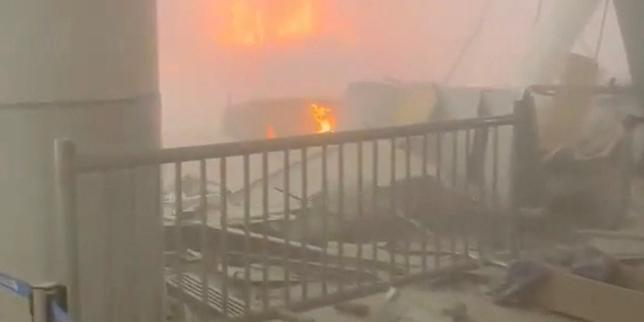
The recent Iranian strike on Kuwait International Airport, which resulted in one fatality, approximately sixty injuries, and significant infrastructure damage, marks a critical shift in the geopolitical risk profile of the Persian Gulf. Standard media coverage treats this event as an isolated flashpoint. A rigorous strategic analysis, however, reveals it as a deliberate disruption of regional transport architecture and a test of non-kinetic deterrence thresholds. Understanding the implications of this strike requires breaking down the event into three analytical vectors: the vulnerability of civilian aviation hubs under asymmetric doctrine, the economic ripple effects on Gulf logistics, and the breakdown of localized missile defense frameworks.
The Asymmetric Targeting Doctrine Behind Hub Disruption
State-sponsored strikes on civilian aviation infrastructure are rarely intended for raw territorial conquest. Instead, they operate under a doctrine of asymmetric cost-imposition. By targeting a primary transport node like Kuwait International Airport, the attacking force exploits a critical vulnerability in modern economic networks: high-density, centralized infrastructure is highly sensitive to kinetic disruption.
The logic of this targeting choice relies on three specific operational levers.
- The Disproportionate Shock Value: Civilian airports are soft targets compared to fortified military command centers. Hitting them guarantees immediate international media coverage, spiking global risk premiums without requiring the attacker to penetrate heavily defended airspace.
- The Denied Access Mechanism: Hitting a commercial runway or terminal forces immediate airspace closures. This functionally isolates a state commercially and logistically, severing its connection to global supply chains without a formal naval block.
- The Testing of Thresholds: By striking a nation historically positioned as a neutral or peripheral player in the immediate Iran-Israel-U.S. matrix, the attacker calibrates its aggression. It tests how far it can push regional kinetic actions before triggering a decisive, multi-national military intervention.
This strategy shifts the conflict from a traditional military-on-military engagement to an economic war of attrition, where the primary casualty is the target state's reputation for systemic stability.
Quantifying the Damage The Three Pillars of Kinetic Impact
Assessing the fallout of the attack requires looking past the immediate casualty counts to map the systemic damage across three distinct operational layers.
1. The Kinetic Damage Vector
The immediate physical impact—one fatality and roughly sixty wounded—reveals the weapon profiles utilized. In high-density civilian structures like airport terminals, the primary drivers of injury are not just explosive blasts, but secondary fragmentation caused by shattered glass, collapsing structural facades, and compromised interior architecture. The localized destruction of airport infrastructure means the strike bypassed peripheral defenses, directly impacting operational zones (either the tarmac, cargo bays, or passenger lounges). This points to either a failure in early warning detection or a saturated air defense grid unable to prioritize civilian vectors over military installations.
2. The Logistics Bottleneck Function
Kuwait International Airport serves as a vital dual-use node, supporting both heavy commercial traffic and international military transport logistics. The cost function of this disruption is non-linear. Closing or restricting an international airport triggers a cascade of compounding costs:
- Diversion Expenses: Rerouting inbound commercial flights to alternative hubs like Dammam or Doha strains regional air traffic control networks and rapidly inflates fuel burn rates for airlines.
- Supply Chain Stagnation: High-value, time-sensitive freight (such as medical supplies, electronics, and specialized oilfield equipment) is immediately grounded, creating a backlog that takes weeks to clear.
- The Idle Capital Penalty: Grounded aircraft, displaced flight crews, and halted ground-handling operations tie up massive amounts of capital, inflicting immediate balance-sheet damage on regional carriers.
3. The Risk Premium Escalation
The long-term economic damage is driven by institutional perception. Lloyd’s of London and global maritime/aviation underwriting syndicates adjust war risk premiums instantly following kinetic actions against civil infrastructure. A single successful strike reclassifies a country's airspace from a "low-risk transit zone" to an "active conflict corridor." This structural shift automatically increases insurance overhead for every flight entering Kuwaiti airspace, a cost that is inevitably passed down to consumers and corporate supply chains, driving inflation across the domestic economy.
Air Defense Architecture and the Saturation Problem
The vulnerability exposed at Kuwait International Airport underscores a fundamental flaw in regional missile defense strategies: the mathematics of interception saturation. Modern air defense systems, such as the MIM-104 Patriot batteries deployed throughout the Gulf, operate on highly sophisticated radar tracking and kinetic interception mechanisms. However, they are bound by strict resource constraints.
[Attacker Salvo: Low-Cost Drones + Ballistic Missiles]
                       │
                       ▼
         [Air Defense Radar Array]
                       │
         ┌─────────────┴─────────────┐
         ▼                           ▼
[Target Saturated]         [Depleted Interceptors]
         │                           │
         └─────────────┬─────────────┘
                       ▼
          [System Failure / Leakage]
                       │
                       ▼
         [Civilian Infrastructure Impact]
When an attacking force deploys a mixed salvo—combining low-cost loitering munitions (drones) with high-speed ballistic or cruise missiles—the defensive grid faces an optimization crisis. The radar arrays must track dozens of incoming profiles simultaneously. If the defensive system fires multiple interceptors per target to ensure a kill, it risks rapid inventory depletion.
The strike on the airport demonstrates a "leakage" event. Whether the defensive grid was overwhelmed by numbers, suffered an electronic warfare blackout, or was positioned primarily to defend nearby energy facilities (like the Al-Ahmadi refinery complex), the result is identical: civilian infrastructure was left exposed. This structural limitation proves that localized, point-defense systems are fundamentally inadequate against sustained, multi-vector kinetic campaigns.
The Strategic Realignment of Gulf Transport Corridors
The vulnerability of Kuwait's main aviation hub forces an immediate re-evaluation of regional infrastructure resilience. For the past decade, Gulf states have competed to build massive, centralized logistical hubs. This hyper-centralization is an operational vulnerability.
The second-order consequence of this strike is a forced shift toward logistical redundancy. Supply chain managers and state planners can no longer rely on a single mega-airport or deep-water port. We will see an accelerated push toward cross-border rail networks, such as the long-delayed GCC Railway project, and the expansion of secondary, decentralized domestic airfields located outside the direct line of sight of northern Gulf strike trajectories.
Furthermore, this event changes the geopolitical calculus for foreign multinationals operating in the region. Corporations must now integrate active kinetic risks into their continuity plans for the northern Gulf, a factor previously reserved for active combat zones.
Escalation Management and the Deterrence Deficit
The final strategic takeaway from the strike on Kuwait International Airport is the clear failure of conventional deterrence models in the region. When state actors can strike critical civilian infrastructure with minimal immediate kinetic retaliation, the traditional balance of power dissolves.
The immediate tactical play for regional states is twofold: they must aggressively procure short-range Counter-Unmanned Aircraft Systems (C-UAS) and point-defense systems specifically optimized for civilian hubs, while simultaneously negotiating deeper, integrated intelligence-sharing frameworks with international partners. Relying on isolated national defense umbrellas is an obsolete strategy. To survive a highly volatile security environment, regional infrastructure must be protected by an interconnected, automated regional defense architecture capable of managing saturation attacks in real time. The alternative is a persistent state of logistical vulnerability that threatens the economic foundation of the entire Gulf.