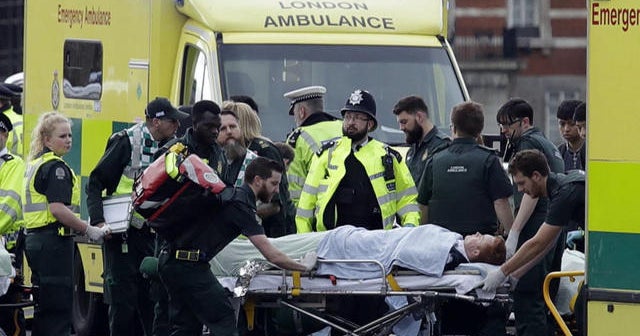
London is a city that prides itself on being a global melting pot, but that image shattered again recently. When two Jewish men were stabbed in what police are now treating as a terrorist incident, it wasn't just another crime report. It was a targeted strike on a specific community that has already been living on edge. If you're following these headlines, you've likely seen the brief reports, but the reality on the ground in London is far more tense than a news ticker suggests. This isn't just about a single violent act; it's about the terrifying trend of radicalization and the shifting focus of counter-terrorism efforts in the UK.
The attack happened in a busy part of the city, a place where people should feel safe walking to prayer or going about their business. Instead, two individuals were singled out because of their identity. The Metropolitan Police didn't take long to hand the case over to the Counter Terrorism Command. That move tells you everything. It says the evidence points toward a motive rooted in ideology rather than a random dispute.
Security Failures and the Terrorist Motive
We often hear about "lone wolf" attackers, but that term is becoming a bit of a cop-out. These individuals don't exist in a vacuum. They're usually swimming in a sea of online extremism and radical rhetoric that pushes them toward violence. When the police label an event like this as terrorism, they're acknowledging that the violence was meant to send a message. In this case, the message was one of hate toward the Jewish community.
I've looked at how these cases typically unfold. The speed at which the Counter Terrorism Command gets involved usually suggests they found materials—either digital or physical—that link the suspect to known extremist groups or ideologies. It's a grim pattern. We see an uptick in global tensions, and suddenly, local communities in London pay the price. People are scared. They're looking over their shoulders. You can't blame them when a trip to the shop or the synagogue can end in a hospital bed.
The security infrastructure in London is massive. We have one of the highest concentrations of CCTV in the world. Yet, cameras don't stop a knife. They only help catch the person afterward. The real failure often happens long before the blade is drawn. It's the failure to disrupt the radicalization process in its early stages.
The Impact on London Jewish Community
You can't talk about this stabbing without talking about the atmosphere in neighborhoods like Stamford Hill or Golders Green. The Jewish community has been forced to build its own security networks, like Shomrim and the Community Security Trust (CST). Think about that for a second. In a modern Western capital, a religious minority feels they need their own volunteer police force just to walk the streets safely.
This latest attack isn't an isolated incident. It's part of a surge in antisemitic hate crimes that has spiked over the last couple of years. Statistics from the CST show that incidents often double or triple during times of international conflict. But these men weren't in a war zone. They were in London.
The physical wounds of a stabbing might heal, but the psychological trauma ripples through the whole city. It changes how people dress, where they walk, and how they interact with strangers. Honestly, it’s a tragedy that in 2026, we’re still seeing people targeted for their faith with such blatant brutality.
How Counter Terrorism Command Operates
When the Met’s Counter Terrorism Command (SO15) takes over a case, the investigation shifts gears. They aren't just looking for witnesses to the stabbing. They're looking for the "why" and the "who else." They dive into encrypted apps, hard drives, and social media footprints.
They also look at the "chatter." Was this attack teased online? Was the suspect part of a forum where this kind of violence is cheered on? Usually, the answer is yes. Radicalization today happens in bedrooms, away from the eyes of parents or even the police, until it's too late.
The UK's threat level has been at "Substantial" for a long time, meaning an attack is likely. This stabbing proves that the threat isn't just from large-scale bombings or coordinated shootings. It’s the low-tech, high-impact violence that is the hardest to stop. A kitchen knife is easy to get. It’s easy to hide. And it’s incredibly effective at spreading terror.
What Needs to Change in Urban Security
We need to stop acting surprised every time this happens. The warning signs are usually there, buried in data or ignored by communities who don't want to "snitch." But if we want to stop these targeted attacks, the approach has to be more aggressive.
First, the prosecution of hate speech that crosses into the territory of inciting violence needs to be swifter. Too often, people are allowed to spew radical rhetoric online for years before they actually pick up a weapon. By then, the damage to their psyche—and the potential for violence—is already done.
Second, the visibility of police in sensitive areas shouldn't just happen after a stabbing. It needs to be a constant. When communities see the police only after blood has been spilled, it doesn't build trust. It builds resentment and a feeling of abandonment.
Finally, we have to address the "lone actor" problem by looking at the digital ecosystem. If someone is searching for "how to carry out a stabbing" or "target locations," that should trigger an immediate response. We have the technology. We just seem to lack the political will to use it effectively due to privacy concerns. But when people are being gutted on the sidewalk, the privacy of a potential terrorist should be the last thing we worry about.
Practical Steps for Staying Safe
If you live in or travel through London, you don't need to live in fear, but you do need to be aware. The "Run, Hide, Tell" guidance from the government is basic, but it saves lives.
- Keep your head up and your phone away when walking in crowded areas.
- Know your surroundings. Identify exits in buildings or shops.
- If you see something that feels off—someone loitering with no clear purpose or acting strangely—report it.
- Don't assume someone else will call the police.
The police depend on the public. If you see someone acting suspiciously or if you come across extremist content online, use the official reporting channels or call 101. In an emergency, it’s always 999. It’s better to be wrong about a suspicious person than to be right and stay silent.
This attack on two Jewish men is a stark reminder that the threat of terrorism is evolving and deeply personal. It’s not just about government buildings or landmarks anymore. It’s about the people standing next to you at the bus stop. Staying informed and staying vigilant is the only way to navigate this version of London.