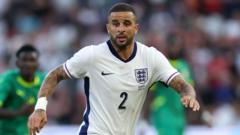
The grass at Wembley has a specific scent when the lights are at full tilt. It’s a mix of crushed clover, damp earth, and the metallic tang of high-octane anxiety. For Kyle Walker, that scent has been the backdrop of his professional life for over a decade. But as he stood in the dressing room recently, peeling the tape from his ankles for the final time as an England international, the air felt different. Heavier. Final.
He is leaving. Before the private jets fuel up for the next World Cup cycle, before the next wave of teenagers with lightning in their boots and no fear in their hearts takes over the wings, Walker has decided to close the book. He calls it a decision made with a "heavy heart but a proud soul." It sounds like a press release. It feels like a bereavement.
To understand why this matters, you have to look past the trophy cabinets and the sprint speeds. You have to look at the invisible weight of the shirt.
The Velocity of a Legacy
For years, Kyle Walker was England’s insurance policy. He was the man who could erase mistakes. If a midfielder misplaced a pass or a center-back got caught under a long ball, it didn’t matter. Walker would simply ignite. He ran with a mechanical, relentless efficiency that made elite attackers look like they were wading through chest-high water.
Think of a hypothetical young winger—let's call him Leo. Leo is nineteen, plays for a top club in Europe, and thinks he is the fastest thing on two legs. He breaks past the England midfield. He sees nothing but green grass and the goalkeeper. He thinks he’s won. Then, he hears the thud of boots behind him. He feels the displacement of air. Before he can even cock his leg to shoot, the ball is gone. Walker is already jogging away, chest out, not even breathing hard.
That is what England is losing. It isn’t just a right-back; it’s the sense of security that allows everyone else to take risks. When the safety net is pulled away, the high-wire act becomes a lot more terrifying.
The Pride of the Unseen Grunt Work
International football is a brutal cycle of hope and autopsy. We celebrate the goalscorers, the magicians who can bend a ball into the top corner from thirty yards. We rarely build statues for the man who ran sixty yards backward to prevent a corner in the eighty-ninth minute of a rain-soaked qualifier.
Walker lived in those margins. He wasn't the one usually hoisting the individual awards, but he was the one the managers whispered to before kickoff. He was the tactical Swiss Army knife. Need a third center-back to handle a physical striker? Put Kyle there. Need a traditional fullback to overlap and stretch the play? Kyle. Need someone to man-mark the fastest player on the planet? Call Kyle.
He retires with eighty-odd caps, a number that reflects a decade of showing up when it was cold, when the fans were booing, and when the media was sharpening its knives. He saw the transition from the "Golden Generation" hangovers to the modern era of semi-finals and finals. He was the bridge.
Why Walk Away Now?
The timing feels jagged. A World Cup is looming on the horizon—the great American desert beckoning with the promise of one last shot at the only trophy that has eluded him. To quit now, on the precipice, seems counterintuitive. Why not hang on? Why not take the paycheck and the squad seat?
The answer lies in the mirror.
Every elite athlete reaches a point where the body starts to send invoices for the debts incurred in their twenties. The recovery takes an extra hour. The hamstring feels a little tighter on a Tuesday morning. For a player whose entire identity is built on being the fastest man in the room, losing half a step isn't just a physical decline. It's an existential crisis.
Walker is smart enough to know that at thirty-four, the cliff is approaching. He chose to jump before he was pushed. There is a quiet, searing dignity in that. He didn't want to be the veteran being toasted by a twenty-year-old in a knockout game while the world watched his legs give out. He wanted to leave while the memory of his speed was still vivid, still frightening.
The Ghost in the Dressing Room
Imagine the first training camp without him. The players gather at St. George’s Park. There’s a space where the loudest laugh usually is. There’s a gap in the warm-up sprints where the benchmark used to be.
The younger players—the Sakas, the Fodens, the Bellinghams—look around. For their entire international careers, Walker has been the elder statesman who looked like he could outrun them all. His departure signals the end of an era of stability. It forces the team to grow up. No more insurance policy. No more reset button.
He spoke of being "sad but proud," a phrase that captures the duality of the professional sunset. You are sad for the boy who dreamed of the Three Lions, but you are proud of the man who didn't let them down.
The lights at Wembley will go down tonight. The groundskeepers will mow the grass, erasing the stud marks and the sweat. Someone else will inherit the number two shirt. They might be more technical. They might be better at crossing. But they won't be the human lightning bolt that spent ten years making sure the rest of the country could breathe a little easier whenever an opponent broke loose.
Kyle Walker is walking toward the tunnel. He isn't sprinting this time. He's taking his time, looking at the stands, feeling the weight of the air. He is leaving a hole that isn't shaped like a player, but like a heartbeat. The game moves on, as it always does, cruel and fast. But for a moment, the silence in the wake of his departure is deafening.
He did the work. He ran the miles. Now, he gets to sit down.