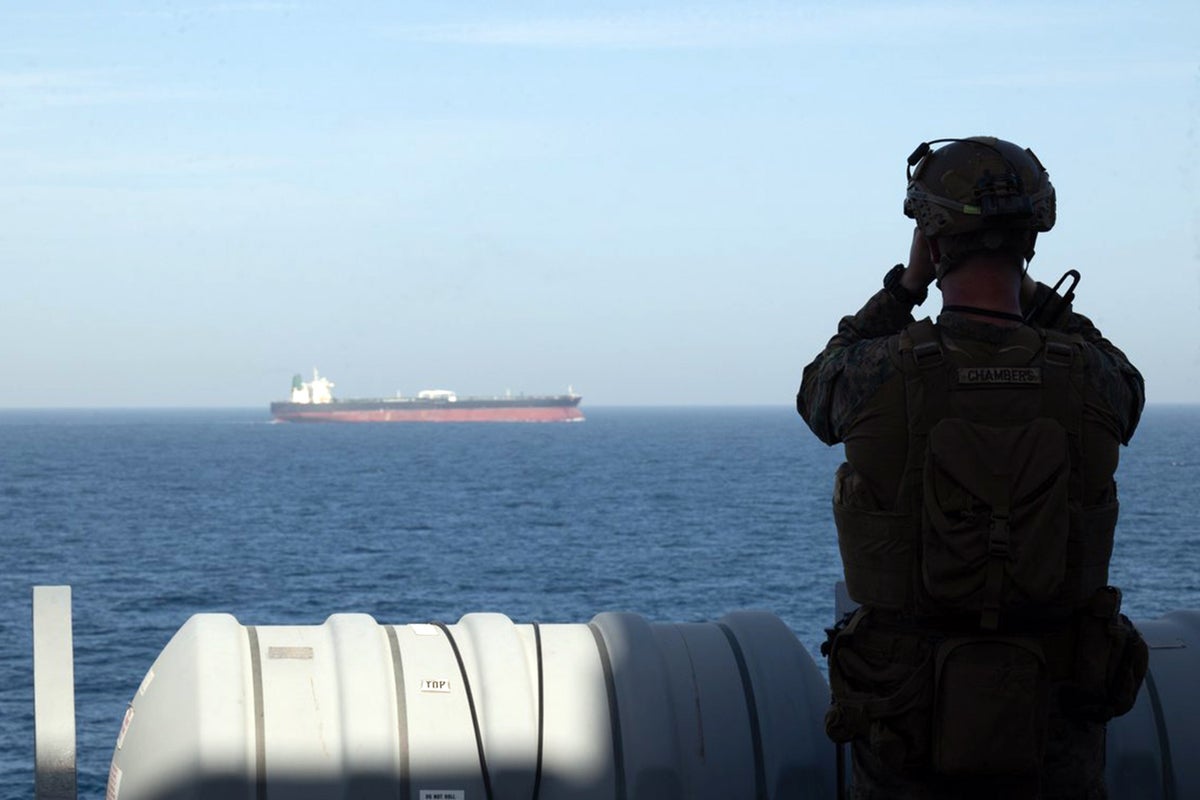
The seizure of an Iranian-affiliated tanker by United States forces in the Strait of Hormuz represents a shift from passive deterrence to active maritime interdiction, fundamentally altering the risk calculus for global energy transit. This maneuver serves as a high-stakes stress test of the "Tanker War" doctrine, where the primary objective is to disrupt the adversary’s revenue streams while maintaining the integrity of the world’s most critical maritime chokepoint. To understand the gravity of this escalation, one must move beyond the rhetoric of "piracy" and analyze the intersection of international maritime law, the mechanics of commodity seizure, and the tactical geography of the Persian Gulf.
The Strategic Geometry of the Strait of Hormuz
The Strait of Hormuz is a geographic bottleneck that dictates the flow of approximately 21% of global petroleum liquids. Its narrowest point consists of two-mile-wide shipping lanes in either direction, separated by a two-mile buffer zone. This physical constraint creates a high-density environment where any kinetic action has immediate systemic effects on insurance premiums and transit timelines. Meanwhile, you can find other events here: The Invisible Valve at the Edge of the World.
The U.S. intervention operates on the principle of Counter-Proliferation Interdiction. By seizing a vessel, the United States targets the logistics of Iranian oil exports, which Tehran uses as a primary tool for sanctions evasion and regional influence. The Iranian accusation of "piracy" is a deliberate legal framing intended to invoke Article 101 of the United Nations Convention on the Law of the Sea (UNCLOS). However, the U.S. position typically relies on domestic judicial warrants and executive orders regarding terrorism financing, creating a clash between national jurisdiction and international maritime norms.
Variables Governing Escalation
Risk in the Strait is defined by three primary variables: To see the full picture, we recommend the recent report by Al Jazeera.
- The Proximity of Kinetic Engagement: The distance between U.S. naval assets and Iranian Islamic Revolutionary Guard Corps Navy (IRGCN) fast-attack craft.
- The Legal Basis of Seizure: Whether the action is based on UN sanctions (multilateral) or U.S. Department of Justice warrants (unilateral).
- The Threshold of Retaliation: Iran’s historical tendency to respond in kind, often targeting commercial vessels with weak sovereign protection.
The Logistics of Asset Seizure
Seizing a VLCC (Very Large Crude Carrier) is an operational undertaking that requires massive coordination. It is not merely a boarding action; it is the redirection of a floating asset carrying millions of dollars in cargo. The process involves:
- Positive Identification (PID): Using satellite imagery, AIS (Automatic Identification System) tracking, and physical reconnaissance to confirm the vessel’s identity despite common "dark shipping" tactics like spoofing or renaming.
- Boarding and Control: Tactical insertion of specialized teams to take command of the bridge and engine room.
- Cargo Offloading and Custody: Transporting the vessel to a port where the crude can be legally offloaded and stored, often involving a complex web of "lightering" (transferring oil between ships).
[Image of ship to ship oil transfer]
This process exposes a critical vulnerability in the global shipping infrastructure. When a state-sanctioned seizure occurs, it disrupts the standard "contractual chain" of shipping, leaving insurers and cargo owners in a legal vacuum. The "piracy" label used by Tehran is designed to trigger specific insurance clauses that could theoretically force commercial entities to distance themselves from U.S.-led maritime security initiatives.
The Economic Cost Function of Maritime Friction
The primary impact of this event is not the loss of a single cargo of oil but the permanent elevation of the War Risk Premium. Every time a vessel is seized, the cost of operating in the Persian Gulf increases. This cost function is driven by:
Insurance Volatility
Marine insurers utilize a "Listed Area" system. The Strait of Hormuz is permanently listed, but seizures trigger immediate adjustments to Additional Premiums (AP). These premiums are calculated as a percentage of the vessel's hull value for a specific transit window. A sustained period of seizures could render transits economically unviable for smaller operators, centralizing the trade into the hands of state-backed fleets.
Operational Delay and Rerouting
While there is no viable alternative to the Strait for the majority of Persian Gulf exports, increased tension forces vessels to adopt defensive measures. This includes hiring private maritime security teams, steaming at higher speeds (which increases fuel consumption exponentially), and engaging in "silent" transits where AIS is disabled. These measures degrade the overall efficiency of the global supply chain.
The Iranian Doctrine of Asymmetric Response
Iran’s maritime strategy is built on the principle of Asymmetric Deterrence. They recognize that they cannot win a conventional blue-water engagement against the U.S. Navy. Instead, they focus on "gray zone" tactics designed to make the cost of U.S. presence prohibitively high.
- Mine Warfare: The deployment of limpet mines or bottom-dwelling influence mines.
- Swarm Tactics: Using dozens of fast-attack craft to overwhelm the defensive sensors and targeting systems of larger Western warships.
- Proxy Harassment: Utilizing regional allies to target shipping in the Bab el-Mandeb strait, effectively creating a "dual-chokepoint" crisis.
The seizure of the tanker by U.S. forces is a direct challenge to this doctrine. It signals that the U.S. is willing to assume the risk of Iranian retaliation to enforce its sanctions regime. The logic of the U.S. position is that allowing "dark fleet" transits to continue unchecked creates a greater long-term risk than the short-term spike in tension resulting from a seizure.
Structural Bottlenecks in International Law
The current crisis highlights a fundamental flaw in the governance of international waters. UNCLOS provides a framework for the "Right of Innocent Passage," but this right is conditional. Article 19 states that passage is not innocent if the vessel engages in any act aimed at interfering with the communications or any other facilities or installations of the coastal State, or any other activity not having a direct bearing on passage.
The United States, which is not a signatory to UNCLOS but recognizes it as customary international law, often operates under the "Freedom of Navigation" (FON) principle. Iran, conversely, argues that the Strait of Hormuz consists of its territorial waters and that it has the right to regulate transit. This legal disconnect ensures that every seizure will be met with accusations of illegality, regardless of the underlying evidence of sanctions violations.
Measuring the Effectiveness of Maritime Interdiction
To evaluate whether this seizure is a strategic success, one must look at three metrics:
- Volume of Sanctioned Oil Off-Market: Does the seizure materially reduce the total barrels Iran can export per month?
- Deterrence of Secondary Actors: Does this action discourage Greek, Chinese, or Indian shipowners from leasing their vessels to Iranian entities?
- Regional Stability Indicators: Does the action lead to a measurable increase in IRGCN harassment of neutral commercial shipping?
Initial data suggests that seizures have a high "deterrence signal" but a low "volume impact." The sheer number of vessels in the Iranian "dark fleet"—estimated to be over 300 ships—means that seizing one tanker is a drop in the ocean. However, the psychological impact on the maritime insurance market is profound. It forces shipowners to consider the possibility that their multi-million dollar assets could be tied up in U.S. court proceedings for years.
Tactical Realities of the Gulf Environment
The Persian Gulf is a shallow, congested body of water. Large U.S. destroyers and cruisers have limited maneuverability compared to the small, agile vessels favored by Iran. This creates a "Close-In Weapon System" (CIWS) dependency. If an escalation occurs, the engagement will happen at ranges where reaction times are measured in seconds.
The U.S. move to seize the tanker indicates a high level of confidence in their "Surface-to-Air" and "Surface-to-Surface" defensive umbrellas. It also suggests that the U.S. has integrated intelligence across multiple domains—cyber, signals, and human—to identify the exact moment the vessel was vulnerable for boarding.
The Failure of Current Diplomatic De-escalation
Current diplomatic efforts are struggling because they lack a shared definition of "maritime security." For Western powers, security means the unimpeded flow of commerce under international law. For Iran, security is viewed through the lens of "regional sovereignty," where external powers have no role in the Gulf.
This ideological divide ensures that incidents like the tanker seizure are not isolated events but are instead symptoms of a deeper structural conflict. The "The Three Pillars of Conflict" in the region remain:
- The nuclear proliferation timeline.
- The maritime sanctions enforcement.
- The regional proxy war dynamics.
As long as these three pillars remain unstable, the Strait of Hormuz will continue to be a theater of kinetic friction.
Final Strategic Calculation
The United States has moved into a phase of Active Enforcement. This is no longer about monitoring; it is about physical asset denial. The strategic play for global energy markets and regional actors is to prepare for a "High-Friction Norm."
Shipping companies must diversify their routes where possible or invest in hardened maritime security protocols. The United States must maintain a permanent and visible presence to prevent Iranian "tit-for-tat" seizures from escalating into a full-scale blockade.
The immediate forecast is an increase in maritime insurance premiums and a tightening of "Know Your Customer" (KYC) requirements for any vessel operating in the Persian Gulf. The seizure is a signal that the "gray zone" is shrinking, and the era of consequence-free sanctions evasion in the Strait of Hormuz has ended.
The next tactical move will likely come from Tehran, focusing on the seizure of a vessel with high symbolic value but low sovereign protection, such as a British or South Korean-flagged tanker. The U.S. must be prepared for a multi-front maritime crisis that extends beyond the Strait and into the wider Indian Ocean. Failure to protect neutral shipping following this seizure will undermine the very "Freedom of Navigation" principles the U.S. claims to uphold.