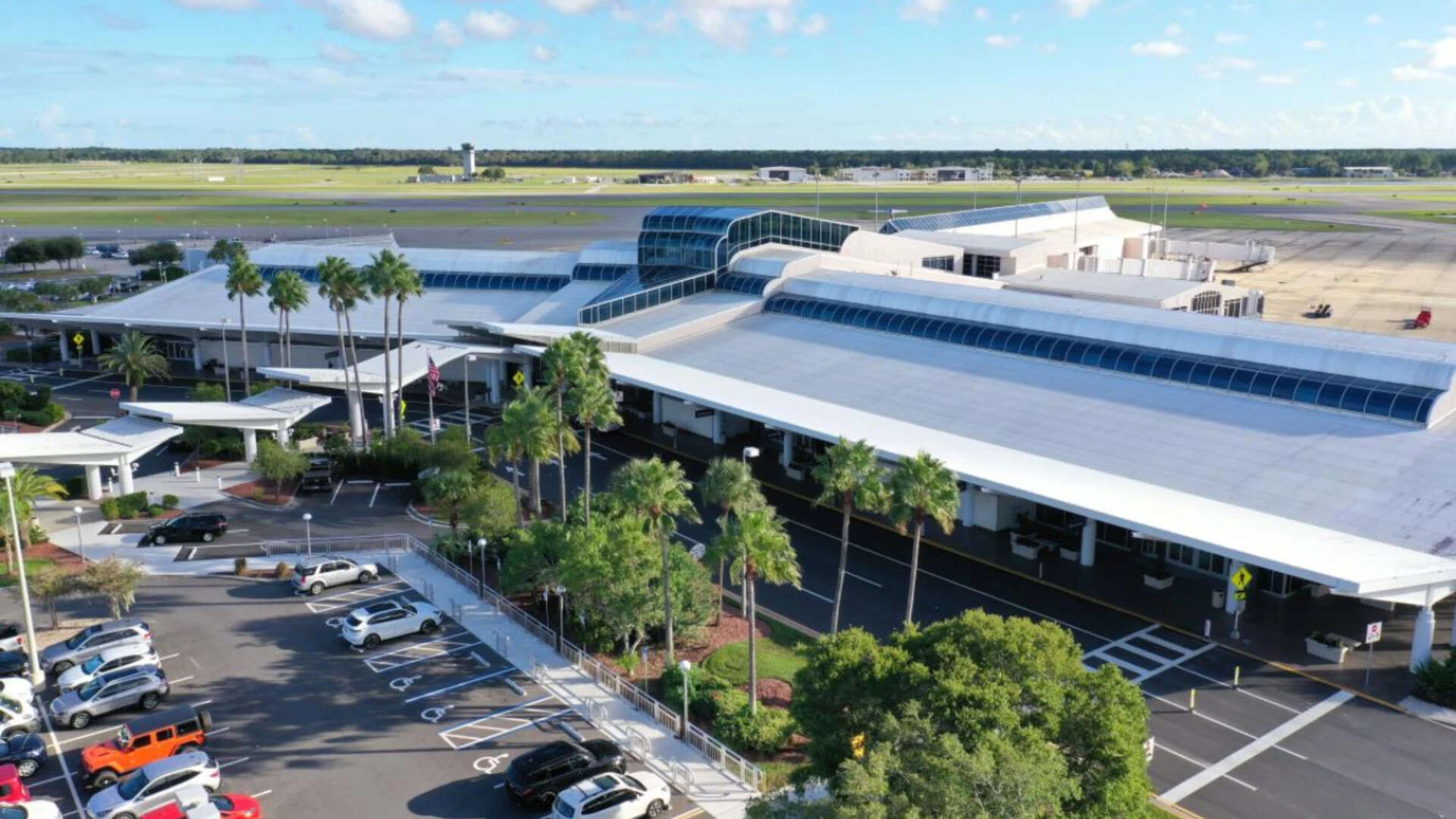
The security perimeter at Daytona Beach International Airport didn't just bend on the afternoon of the incident; it shattered. When a local man drove his vehicle through a locked gate and sped toward the tarmac, he wasn't just committing a crime. He was exposing the uncomfortable reality that many regional airports are far more vulnerable than the flying public realizes. The intruder didn't just breach a fence. He reached the aircraft. He attempted to board planes. In the high-stakes world of aviation security, these few minutes represent a catastrophic failure of the layered defense systems designed to keep the runway a sterile environment.
While national headlines focused on the chaotic visuals of a car crumpled against airport infrastructure, the real story lies in the terrifying ease of the penetration. Security experts have long warned that "soft targets" within the aviation network—the perimeter gates, the maintenance access points, and the general aviation hangars—are the weak links in a chain we assume is unbreakable. This wasn't a sophisticated terrorist operation. It was one man with a car and a reckless intent, yet he managed to bypass the primary barriers that separate civilian traffic from multi-million dollar jet engines and hundreds of passengers.
Anatomy of a Perimeter Failure
Airport security is supposed to work like an onion. The outer layer is the fence. The inner layers include surveillance, patrols, and finally, the hardened cockpits of the aircraft themselves. In Daytona Beach, the outer layer failed instantly. The driver didn't need a specialized kit or a team of experts. He used kinetic force.
Most regional airports use chain-link fencing topped with barbed wire, but the gates are the literal hinges of the entire operation. These gates are often the most frequently used and least reinforced points of the entire perimeter. When a vehicle hits a standard swing or slide gate at speed, the locking mechanisms often shear off. This is a physics problem that the Transportation Security Administration (TSA) and local airport authorities have struggled to solve without spending billions of dollars they don't have.
Once inside, the "sterile" nature of the airfield was gone. The intruder didn't just drive circles on the grass; he targeted the aircraft. This moves the incident from a simple trespassing or property damage case into a direct threat to aviation safety. If a person can reach a plane, they can sabotage it. They can hide in the wheel well. They can damage sensitive sensors that pilots rely on during takeoff. The breach at Daytona Beach proves that once the fence is down, there is very little stopping an individual from reaching the metal.
The Regional Airport Budget Crisis
To understand why this happens, you have to look at the ledgers. Major hubs like Atlanta's Hartsfield-Jackson or New York's JFK have the revenue to support massive, 24-hour paramilitary security forces and high-tech automated intrusion detection systems. Regional airports operate on thinner margins. They rely heavily on local law enforcement, which may be minutes away, and physical barriers that are often decades old.
Physical Barriers vs Modern Threats
We are still securing 2026 airports with 1970s technology. A chain-link fence is a psychological deterrent, not a physical one. It keeps out the honest and the lost. It does nothing to stop a determined actor in a two-ton vehicle.
- Standard Perimeter Fencing: Designed to prevent climbing, but offers zero resistance to vehicular ramming.
- Gate Latches: Often the weakest point, designed for convenience and ease of maintenance rather than high-impact resistance.
- Surveillance Gaps: Many smaller airports have cameras that record the breach but do not provide real-time alerts to a central command center that can intercept an intruder before they reach the taxiway.
The cost to upgrade every gate at every regional airport in Florida to "K-rated" crash standards—barriers specifically designed to stop a truck in its tracks—is astronomical. Without federal mandates and the funding to back them, airport managers are forced to play a game of risk management. They bet that a breach won't happen. In Daytona Beach, that bet was lost.
The Human Factor and Tactical Response
When the alarm finally sounds, the response time is everything. In this instance, the intruder was able to exit his vehicle and physically interact with aircraft. This suggests a lag between the initial breach and the arrival of armed security. In the world of counter-terrorism, this "gap time" is where the most damage occurs.
If an intruder can reach a plane, the security mission has already failed. The goal of airport security is "denial of access," not "apprehension after the fact." The fact that this individual was able to try multiple aircraft doors shows that the airfield was not being monitored with the level of scrutiny required for a facility of this importance. It highlights a reliance on reactive security rather than proactive interception.
Mental Health and the Unpredictable Intruder
Law enforcement later identified the individual and noted signs of a mental health crisis. This is a recurring theme in modern security breaches. Unlike a rational actor who might be deterred by the prospect of arrest or injury, an individual in a state of psychosis or extreme emotional distress does not weigh risks. They do not care about the "No Trespassing" signs or the height of the fence.
This makes the job of security personnel infinitely harder. You cannot negotiate with a car crashing through a gate. You cannot use traditional deterrents against someone who is not operating within a standard framework of logic. This reinforces the need for "hard" security—bollards, reinforced gates, and automated barriers—that function regardless of the intruder's motivation.
The TSA Oversight Gap
While the TSA is famous for making you take your shoes off, their role in perimeter security at regional airports is more about regulation than boots on the ground. They set the standards, but the local airport authority is responsible for implementation and costs. This creates a patchwork of security quality across the country.
You might feel safe because you went through a metal detector, but the person who just drove through the maintenance gate didn't have to follow those rules. This "backdoor" vulnerability is the dirty secret of the aviation industry. We spend billions of dollars screening passengers for 3.4-ounce bottles of shampoo while leaving the literal back gate vulnerable to a determined driver with a mid-sized sedan.
Infrastructure as the Only Solution
The Daytona Beach incident should serve as a wake-up call for the Florida Department of Transportation and federal aviation regulators. We can no longer treat airport fences as "suggestive" barriers.
- Hardened Access Points: Every vehicle gate that leads to a runway or taxiway must be reinforced with crash-rated bollards or gates.
- Automated Detection: Sensors must be integrated into the fencing. A breach should trigger an immediate, automated lockdown of the airfield and alert law enforcement via a high-priority channel.
- Rapid Response Teams: If an airport handles commercial traffic, there must be an armed response capability on the airfield side, not just in the terminal.
The intruder in Daytona Beach didn't have a weapon, and he didn't have a plan. He was a man in a car who decided to drive through a gate. But what if he had been someone else? What if the vehicle had been loaded with explosives? What if he had been a trained pilot with a grudge? The vulnerabilities he exposed are not unique to Daytona Beach. They are present in hundreds of airports across the United States.
We have built a massive security apparatus around the passenger terminal while leaving the airfield itself surprisingly exposed. The image of a car sitting on the tarmac next to a commercial jet is a visual representation of a system that is failing to address the most basic physical threats. It is time to stop focusing solely on what passengers are carrying in their pockets and start looking at what is driving through our fences.
Security is only as strong as its weakest point. On that afternoon in Daytona Beach, the weakest point was a simple gate and the assumption that no one would ever be bold enough to drive right through it. That assumption is now officially dead. The next step is for airport authorities to stop treating perimeter security as a secondary concern and start treating it as the frontline of aviation defense.
Identify the three highest-risk access points at your local regional airport and ask the board of directors what the specific "K-rating" is for those gates.