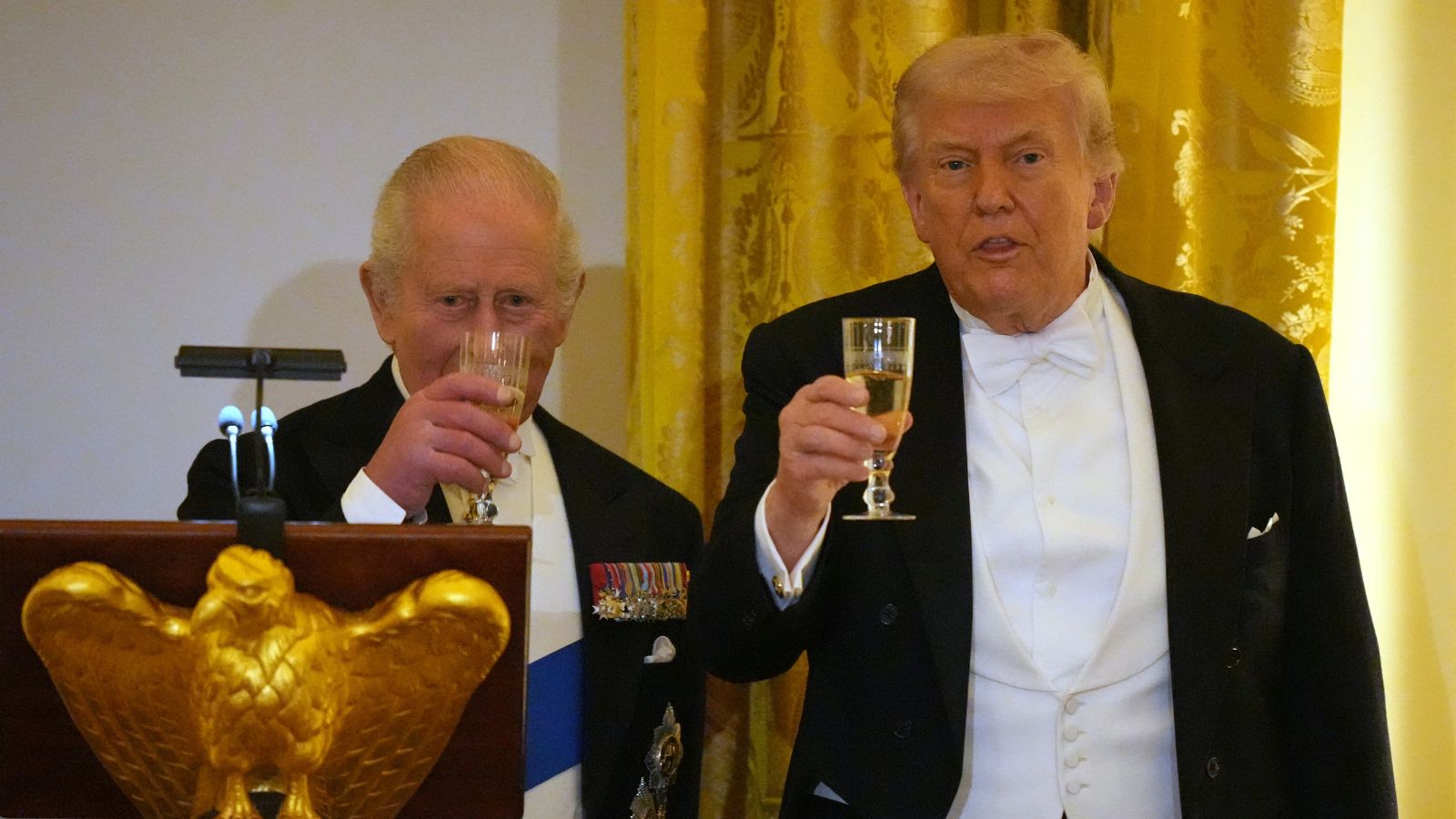
The intersection of celebrity brand management and geopolitical signaling often manifests in the deliberate use of personal anecdotes to establish rapport or historical legitimacy. When Donald Trump detailed his mother’s perceived affinity for King Charles III—characterizing it as a "crush"—he was not merely sharing a domestic memory. He was executing a calculated maneuver within a specific framework of soft power. This maneuver relies on the Legacy Validation Model, where an individual attempts to bridge the gap between populist political identity and established institutional prestige.
The Triad of Transatlantic Soft Power
To understand the strategic value of this narrative, one must categorize the interaction into three distinct operational pillars:
- Institutional Proximity: The attempt to align a volatile political brand with a stable, thousand-year-old institution (the British Monarchy).
- Humanization through Genealogy: Utilizing parental narratives to soften a public persona and provide a "root system" for current diplomatic stances.
- The Reciprocity Trap: Publicly praising a constitutional monarch who is legally and traditionally bound to remain apolitical, thereby creating a one-sided vacuum of public sentiment that the monarch cannot easily rebut or mirror.
The narrative regarding Mary Anne MacLeod Trump’s admiration for King Charles functions as a bridge. By framing the King as "cute" or desirable through the lens of a mother’s perspective, Trump shifts the discourse from policy-heavy diplomatic friction to a relatable, albeit simplified, social context.
Analytical Breakdown of the "Crush" Narrative
The specific claim that Mary Trump had a "crush" on King Charles is a fascinating case study in Relatability Engineering. From a strategic standpoint, this serves multiple functions:
Structural Humanization
Political figures often face "the ivory tower problem," where their distance from the average citizen creates a perceived empathy gap. By referencing his mother—an immigrant from the Isle of Lewis—Trump grounds his relationship with the UK in a working-class origin story. The anecdote suggests that even the highest levels of international relations are subject to the same fan-culture and domestic interests as a suburban household.
The Prestige Transfer Mechanism
The British Royal Family remains the world's most successful brand in terms of "sovereign aura." By associating his family’s private history with the persona of King Charles, Trump attempts a transfer of prestige. In this logic, if a family member admired the King, the family itself belongs within the social orbit of the King. This is a common tactic in high-stakes networking where "association by admiration" replaces "association by rank."
The Psychological Coefficient of the "Cute" Descriptor
The use of the word "cute" to describe a reigning monarch is a linguistic disruption. In formal diplomacy, King Charles is typically described through adjectives denoting duty, stewardship, or environmental advocacy. Trump’s choice of "cute" serves two tactical ends:
- Dominance Signaling: Describing a peer or a superior figure with a diminutive or aesthetic term (usually reserved for those with less power) subtly asserts a level of social comfort or even superiority. It removes the "mystique" of the Crown and replaces it with a casual, almost paternalistic familiarity.
- Engagement Metrics: In the attention economy, a former President calling a King "cute" generates a significantly higher velocity of media mentions than a standard statement on "shared democratic values."
Categorizing the Trump-Charles Diplomatic History
The relationship between these two figures is defined by a clash of divergent philosophies: Trump’s transactional populism versus Charles’s institutional environmentalism. Their interactions can be mapped across a Friction-Cooperation Matrix:
| Variable | Donald Trump | King Charles III |
|---|---|---|
| Primary Driver | National Sovereignty / Trade | Global Sustainability / Continuity |
| Communication Style | Direct / Disruptive | Formal / Nuanced |
| Source of Authority | Electorate Mandate | Hereditary Tradition |
| Strategic Goal | Disruption of Globalist Norms | Preservation of Institutional Relevance |
The anecdote about Mary Trump acts as a lubricant within this matrix. It seeks to bypass the significant policy disagreements—specifically regarding the Paris Climate Agreement, which Charles championed and Trump exited—by pivoting to a non-falsifiable emotional connection.
The Scottish Connection as a Geopolitical Anchor
The geography of this narrative is not incidental. Mary Anne MacLeod’s Scottish heritage provides the "biological license" for Trump’s interest in British affairs. The MacLeod lineage from the Outer Hebrides is a recurring theme in Trump’s self-conception as a "son of Scotland."
When he references his mother’s view of the King, he is reinforcing his connection to the United Kingdom’s Northern Frontier. This serves a dual purpose: it validates his significant real estate investments in Scotland (Aberdeen and Turnberry) while providing a sentimental justification for his frequent commentary on British internal politics, including Brexit and the leadership of the Royal Family.
Risk Factors and Strategic Limitations
While the "crush" anecdote facilitates immediate media engagement, it carries inherent risks within the framework of long-term strategic positioning.
The Gravity Dilution Risk
Over-humanizing a diplomatic relationship can lead to a "gravity dilution," where the serious business of trade deals, security pacts, and military alliances is overshadowed by tabloid-style narratives. If the primary takeaway of a bilateral history becomes a mother’s crush, the operational weight of the parties involved may be perceived as diminished by professional diplomatic corps.
Unilateral Sentiment Mismatch
The British Monarchy operates on a principle of "never complain, never explain." This creates a permanent asymmetry. Trump can offer unlimited anecdotes, but the King cannot reciprocate without violating constitutional norms. This leads to a Perception Bottleneck where the public only hears one side of the personal history, potentially leading to a backlash from the UK public who view the narrative as an intrusion into the private dignity of the Sovereign.
The Cause-and-Effect of Royal Commentary
Every public statement regarding the Royal Family by a high-ranking US official triggers a specific causal chain:
- Statement Emission: A personal anecdote is shared (the "crush").
- Media Amplification: Outlets prioritize the "human interest" angle over policy analysis.
- Diplomatic Calibration: The Foreign, Commonwealth & Development Office (FCDO) must assess if the statement requires a formal response (usually it does not).
- Public Sentiment Shift: The narrative either reinforces the "special relationship" or is viewed as an opportunistic use of the Monarchy for personal branding.
In this instance, the effect is a reinforcement of the Trump brand as one that is "in" but not "of" the global elite. He positions himself as someone who understands the allure of the Monarchy through his mother’s eyes, yet speaks of it with the casualness of a billionaire who views himself as an equal to kings.
Strategic Forecast for Personal-Diplomatic Narratives
As the global political landscape becomes increasingly personality-driven, the use of Ancestral Anecdotage will likely increase. This is the practice of using deceased relatives' preferences or histories to justify current political alliances or to create an emotional shield against criticism.
The strategic play here is the "Legacy Shield." By attributing the sentiment to his mother, Trump makes the statement virtually unassailable. To criticize the "cute" comment is to criticize a son’s memory of his mother’s harmless admiration. It is a masterful use of an emotional proxy to dominate a news cycle.
Moving forward, analysts should expect a further blending of "sovereign branding" and "populist storytelling." The efficacy of this strategy depends entirely on the audience's willingness to accept personal sentiment as a valid substitute for institutional protocol. For the Trump strategy, the goal is not to adhere to protocol but to redefine it through the lens of personal history and family legacy.
The final strategic move in this context is the Normalization of the Informal. By consistently treating the British Monarchy as a set of characters in a personal family drama, a political figure can reduce the formal barriers to entry, making the "Special Relationship" feel less like a treaty and more like a family reunion. This reduces the complexity of international relations to a level that is easily consumed by a mass audience, ensuring the narrative remains controlled by the storyteller rather than the institutions themselves.