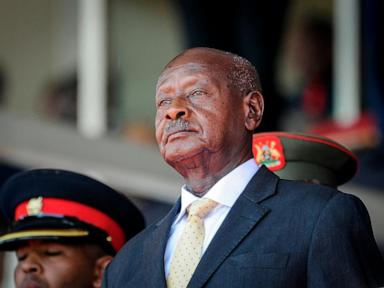
The inauguration of Yoweri Museveni for a sixth elective term marks the transition of the Ugandan state from a traditional autocracy to a managed dynastic succession model. This shift is not merely a product of longevity but a deliberate restructuring of the state’s coercive and administrative architecture. By examining the elevation of Muhoozi Kainerugaba—the President’s son—to the role of Chief of Defence Forces and de facto political heir, we can identify a specific strategy of "institutional hollowing" designed to ensure regime survival beyond the biological lifespan of its founder.
The Tripartite Architecture of Ugandan Power
To understand the current political trajectory in Kampala, one must view the state not as a monolith but as three intersecting spheres of influence that maintain the Museveni hegemony.
- The Military-Industrial Core: The Uganda People’s Defence Forces (UPDF) serves as the ultimate guarantor of the status quo. Unlike traditional professional militaries, the UPDF’s elite units, specifically the Special Forces Command (SFC), operate with a high degree of autonomy. The SFC has functioned as a training ground for the dynastic heir, providing both the tactical resources and the loyalty-based network required to suppress internal dissent and external threats.
- The Patronage Bureaucracy: The National Resistance Movement (NRM) functions less as a political party and more as a mechanism for resource distribution. Legislative compliance is secured through a cost-benefit analysis where loyalty is rewarded with state contracts, ministerial appointments, or local administrative autonomy.
- The Legalistic Façade: The regime utilizes "rule by law" rather than the "rule of law." This involves the systematic use of the judiciary and the electoral commission to provide a veneer of constitutionalism to actions that fundamentally undermine democratic principles. The repeated removal of presidential age limits and term limits illustrates the malleability of the legal framework when it conflicts with executive retention.
The Muhoozi Project and the Cost of Succession
The emergence of Muhoozi Kainerugaba is the primary variable in Uganda’s current political equation. His ascent follows a predictable logic of coup-proofing. By placing a family member at the apex of the military hierarchy, the President mitigates the risk of a military-led transition that often plagues long-term authoritarian regimes.
However, this strategy introduces a significant "Legitimacy Deficit" that the regime must manage. The transition from a liberation leader (Museveni) to a dynastic successor (Muhoozi) requires a shift in the regime’s foundational narrative. Museveni relies on the "Security Dividend"—the idea that he brought peace after decades of chaos. Muhoozi lacks this historical capital, necessitating a new brand of "Generational Nationalism" that often manifests in aggressive social media rhetoric and highly choreographed public rallies.
The Operational Risk of Dynastic Transition
Succession planning in this context is a high-stakes optimization problem. The regime must balance three conflicting objectives:
- Internal Elite Cohesion: Older "bush war" veterans who fought alongside Museveni often view Muhoozi’s rapid promotion with skepticism. The regime manages this through "forced retirement and replacement," where older generals are moved to civilian diplomatic roles or sidelined, replaced by younger officers whose careers are entirely dependent on the heir.
- Economic Stability: Uganda’s economy is sensitive to Western donor sentiment and regional trade stability. A clumsy transition risks capital flight. The government attempts to offset this by securing alternative infrastructure financing from non-Western actors, thereby reducing the leverage of traditional democratic donors.
- Public Containment: The demographic reality of Uganda—where the median age is approximately 16—creates a structural mismatch between a 1980s-era leadership and a Gen Z/Millennial population. The suppression of figures like Robert Kyagulanyi (Bobi Wine) is a tactical necessity to prevent this demographic energy from crystallizing into a coherent movement.
Structural Constraints on the Opposition
The failure of the Ugandan opposition to prevent this consolidation is not due to a lack of popular support but a lack of "Structural Leverage." The regime has effectively monopolized the three primary avenues of political change:
- Electoral Interference: Through the use of "preventative detention" and the deployment of the military during election cycles, the cost of voting for the opposition is kept artificially high for the average citizen.
- Media and Information Control: While the internet remains a battleground, the physical infrastructure of information—radio and television—is heavily regulated or owned by NRM-leaning interests.
- Financial Asymmetry: The state treasury and the NRM’s campaign fund are effectively indistinguishable. This creates a feedback loop where the opposition cannot build the necessary infrastructure to challenge the regime at a national scale, while the regime uses state resources to co-opt opposition leaders.
The Geopolitical Buffer
Uganda’s longevity is bolstered by its role as a regional security partner. By positioning the UPDF as a vital component of peacekeeping missions in Somalia and a bulwark against instability in the Democratic Republic of Congo and South Sudan, Museveni has made himself "too useful to fail" for international powers.
This security export model creates a shield against meaningful sanctions. When Western nations criticize human rights abuses, the Kampala administration can leverage its military contributions to regional stability as a bargaining chip. This creates a "Security Rents" economy where the state receives political and financial support in exchange for providing boots on the ground in conflict zones.
The Fragility of the "Managed" Model
Despite the appearance of total control, the dynastic model contains inherent points of failure. The most significant is the "Double-Edged Sword of Loyalty." In a system where loyalty is bought, the price of that loyalty increases as the regime ages. If the state’s revenue streams—primarily tax receipts and natural resource exports—cannot keep pace with the demands of the patronage network, the system will face internal fractures.
The second fragility is the "Successor’s Dilemma." Muhoozi must differentiate himself from his father to appeal to the youth, but he cannot deviate too far without undermining the very system that supports him. His impulsive public statements regarding foreign policy (notably concerning Kenya and the Tigray conflict) suggest a volatility that could alienate the regional allies his father spent decades cultivating.
Strategic Forecast for the Current Term
The current term will be defined by the formalization of the "Muhoozi Project." We should expect the following tactical maneuvers:
- Legislative Restructuring: Look for attempts to move toward a parliamentary system for electing the President. This would allow the NRM-dominated parliament to select the next leader, bypassing the risks and costs of a direct national election.
- SFC Expansion: The Special Forces Command will likely continue to receive a disproportionate share of the defense budget, further insulating the inner circle from the broader military.
- Aggressive Debt Management: As the regime funds its patronage and security apparatus, debt-to-GDP ratios will come under pressure. The government will likely prioritize short-term liquidity over long-term fiscal health, potentially leading to increased friction with international financial institutions.
The transition is no longer a "potential" event; it is an active process. The objective of the state is to reach a point of "Irreversible Momentum," where the cost of opposing the Muhoozi succession becomes higher than the cost of accepting it. For domestic and international stakeholders, the strategy should not be based on the hope of a democratic opening, but on managing the risks associated with a hardening, hereditary autocracy that has successfully decoupled itself from traditional accountability mechanisms.