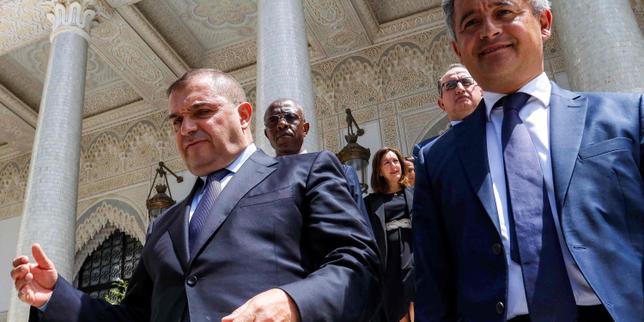
The recurring diplomatic engagements between France and Algeria, exemplified by ministerial visits to Algiers to "rebuild trust," operate under a persistent structural deficit. While political rhetoric framing these interactions focuses on goodwill and historical reconciliation, an analytical breakdown reveals a complex game-theoretic matrix. Bilateral relations are governed by three interdependent variables: consular mechanics, security interdependencies in the Sahel, and memory politics.
Until these core drivers are decoupled from domestic electoral cycles, diplomatic interactions will yield only temporary stabilization rather than systemic alignment. This analysis deconstructs the structural bottlenecks preventing a permanent equilibrium between Paris and Algiers.
The Consular Leverage Matrix
The primary friction point in bilateral operations lies in the asymmetric reciprocity of the visa-readmission mechanism. This system functions as a direct causal loop between French domestic immigration policy and Algerian consular cooperation.
+-----------------------------------+
|  French Domestic Policy Pressure  |
+-----------------------------------+
                  |
                  v
+-----------------------------------+
| Visa Issuance Reduction (Lever)   |
+-----------------------------------+
                  |
                  v
+-----------------------------------+
| Algerian Consular Non-Cooperation | (Consular Passes Withheld)
+-----------------------------------+
                  |
                  v
+-----------------------------------+
| Depressed Deportation Execution   | (OQTF Bottleneck)
+-----------------------------------+
The mechanics of this bottleneck depend on the Obligation de quitter le territoire français (OQTF) execution rate. For France to deport an undocumented Algerian national, the Algerian consulate must issue a consular pass (laissez-passer consulaire).
France uses visa issuance as a blunt economic lever. By restricting the volume of Schengen visas granted to Algerian nationals, Paris attempts to increase the opportunity cost for Algiers' non-cooperation.
This lever frequently backfires due to a miscalculation of domestic incentives. For the Algerian administration, the political cost of appearing compliant with French security dictates outweighs the marginal utility of higher visa quotas for its middle class. The result is a structural stalemate:
- The French Bottleneck: Administrative backlog in handling OQTFs, leading to saturated detention centers and political pressure on the Ministry of the Interior.
- The Algerian Counter-Lever: Deliberate bureaucratic friction in verifying the nationality of deportees, which stretches the legal time limits of French administrative detention.
This transactional approach to consular affairs guarantees volatility. When France restricts visas, bilateral cooperation on counter-terrorism and intelligence sharing deteriorates. When France relaxes visa restrictions to restore diplomatic channels, domestic political opposition in Paris capitalizes on the perceived concession, forcing a subsequent policy retrenchment.
Security Interdependencies and the Sahelian Vacuum
The second systemic pillar is the security architecture of North Africa and the Sahel region. The withdrawal of French military assets from Mali, Burkina Faso, and Niger has fundamentally altered the regional balance of power, forcing a recalculation in both Paris and Algiers.
Algeria operates under a strict constitutional doctrine of non-interventionism outside its borders, though recent amendments allow for limited peacekeeping operations. This doctrinal constraint creates a strategic divergence with France's historically interventionist posture.
+-------------------------------------------------------------+
|               Sahelian Security Vacuum                      |
|  (French Military Withdrawal / Transnational Terrorism)    |
+-------------------------------------------------------------+
               /                               \
              /                                 \
             v                                   v
+----------------------------+       +----------------------------+
|      French Objective      |       |     Algerian Objective     |
| Containment of migration & |       | Border insulation &        |
| jihadist expansion.        |       | Strategic denial of        |
|                            |       | external powers.           |
+----------------------------+       +----------------------------+
             \                                   /
              \                                 /
               v                               v
+-------------------------------------------------------------+
|                     Structural Stalemate                    |
| Zero-sum intelligence sharing & persistent border fragility |
+-------------------------------------------------------------+
The collapse of the 2015 Algiers Peace Accord in Mali illustrates the limits of current bilateral coordination. France viewed the accord as a political framework to stabilize northern Mali while targeting jihadist groups kinetically. Algeria viewed it as a mechanism to preserve Mali's territorial integrity and exclude non-African military actors from its immediate periphery.
With French forces removed from the equation, the security dynamic has shifted from a cooperative containment model to a competitive insulation model. Algeria faces an increased financial and military burden to secure its 1,400-kilometer border with Mali and Niger.
France, stripped of its direct operational footprint, relies on Algerian intelligence to monitor transnational terrorist networks. Algiers leverages this reliance to neutralize French criticism of its internal political governance, creating an unacknowledged security-for-silence transaction.
The Political Economy of Memory Politics
The exploitation of shared history serves a specific diversionary function in the domestic political economies of both nations. Rather than a sentimental hurdle to be cleared, "memory politics" functions as a highly rationalized instrument of statecraft.
In Algeria, the revolutionary legitimacy of the state remains a core pillar of regime stability. The narrative of resistance against French colonial rule is utilized to generate cross-factional cohesion during periods of economic volatility, particularly when hydrocarbons revenues fluctuate. Concessions to France on historical files—such as the return of archives or the recognition of specific colonial crimes—are strictly rationed to prevent domestic accusations of capitulation.
In France, the electoral map has become highly sensitive to themes of national identity, immigration, and colonial history. The presence of large voter demographics with direct ties to Algeria—including the Franco-Algerian diaspora, the Pieds-Noirs community, and descendants of Harkis—means any diplomatic gesture toward Algiers triggers immediate domestic political pushback.
+-------------------------------------------------------------------------+
|                        The Memory Loop Stalemate                        |
+-------------------------------------------------------------------------+
|                                                                         |
|  French Executive Gesture ---> Domestic Right-Wing Backlash (France)    |
|               ^                                       |                 |
|               |                                       v                 |
|  Algerian Diplomatic Recoil <-- Algerian Domestic Legitimacy Demands     |
|                                                                         |
+-------------------------------------------------------------------------+
This polarization transforms symbolic gestures into zero-sum calculations. A joint commission of French and Algerian historians established to review the colonial era cannot resolve these fundamental structural incentives. The commission’s outputs are consistently subordinated to current political needs, rendering historical truth a variable of diplomatic convenience rather than a foundation for real alignment.
Strategic Realignment Protocols
To move past this cycle of crisis and superficial reconciliation, the bilateral relationship requires a fundamental re-engineering of its operational frameworks. The following structural shifts are necessary to establish a stable, transactional equilibrium.
1. Decouple Consular Mechanisms from Political Rhetoric
The linkage between visa allocation and OQTF execution must be formalized through a transparent, automated quota system rather than arbitrary ministerial decrees.
France should establish a multi-tier visa framework that guarantees predictable allocations for economic, academic, and scientific cohorts. This baseline quota should be legally insulated from day-to-day diplomatic disputes.
In return, Algeria must integrate its civil registry database with a secure digital verification protocol accessible by French immigration authorities. This would reduce the verification period for undocumented nationals from months to a fixed 14-day window.
By automating the verification of identity, the issuance of consular passes becomes an administrative reflex rather than a political concession, neutralizing its utility as a diplomatic weapon.
2. Transition to a Regional Containment Architecture
The security relationship must shift from ad-hoc intelligence sharing to a formalized, deniable security architecture focused on the Sahel. France must acknowledge that its unilateral interventionist model in West Africa is obsolete.
Future cooperation should focus on a division of labor: France provides satellite reconnaissance, electronic intelligence, and logistical hardware support, while Algeria manages regional mediation and border interdiction operations.
This framework respects Algerian sovereignty and constitutional constraints against external deployment, while giving France an indirect mechanism to contain the expansion of transnational militancies that threaten European maritime borders.
3. Establish Institutional Isolation for Historical Files
The management of historical grievances must be permanently removed from the purview of executive ministries and placed within an independent, endowed foundation governed by international academic standards.
This institution should be tasked with a legally binding schedule for archival digitisation and reciprocal access, removing the arbitrary classification of documents by intelligence agencies on either side.
By institutionalizing this process, political leaders in both Paris and Algiers lose the ability to manufacture diplomatic crises or stage performative reconciliations to satisfy short-term domestic electoral demands.
The Realistic Horizon
The structural constraints governing Franco-Algerian relations preclude a profound "historic reconciliation." The divergent demographic realities of a shifting European electorate and the sovereign imperatives of an Algerian state navigating regional volatility ensure that friction remains the baseline condition.
The optimal strategic outcome is not emotional harmony, but a well-managed, highly transactional partnership. By professionalizing border mechanics, stabilizing regional security roles, and isolating historical grievances from daily governance, both nations can mitigate the risks of sudden diplomatic rupture and replace volatile sentimentality with predictable statecraft.