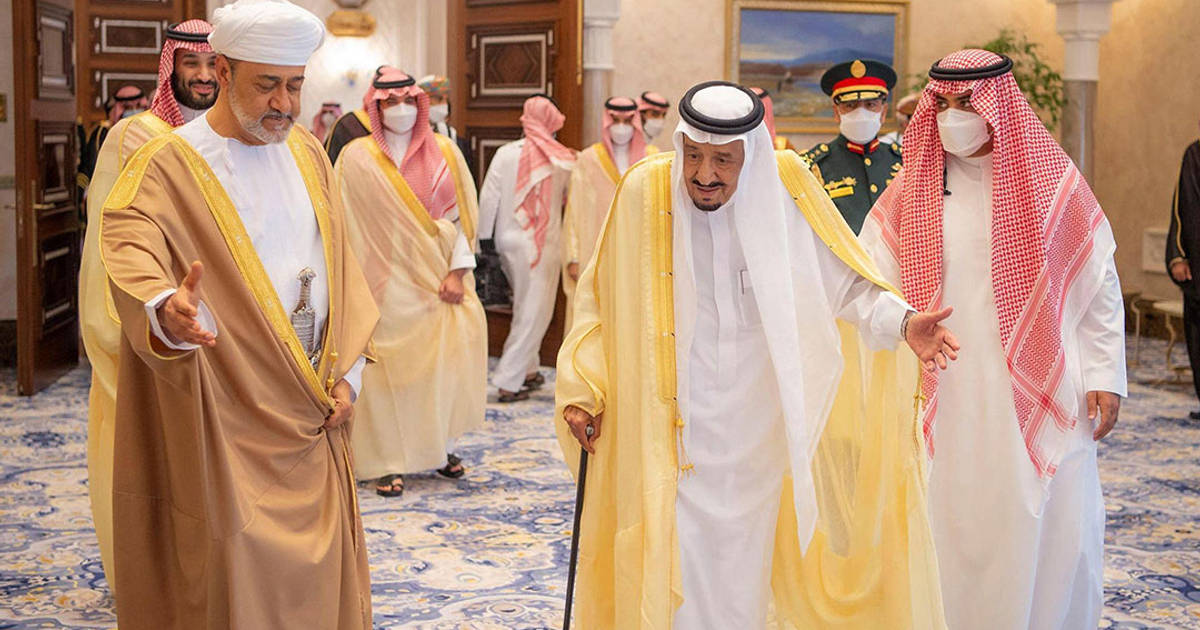
Oman’s diplomatic strategy is not a product of ideological pacifism but a calculated application of "Negative Peace" maintenance to prevent regional systemic collapse. The Sultanate’s recent push for Iranian de-escalation functions as a pressure-relief valve for the Strait of Hormuz, where the cost of a kinetic conflict would result in an immediate 20-30% spike in global Brent crude prices and a total breakdown of the regional insurance market. By offering "off-ramps," Muscat is providing a structural mechanism for Iran and its adversaries to retreat from the brink of total war without suffering the political cost of a perceived loss in domestic sovereignty.
The Architecture of Omani Neutrality
Oman operates on a doctrine of Functional Equidistance. Unlike traditional neutrality, which involves total withdrawal from geopolitical friction, functional equidistance requires active, high-level engagement with all belligerents simultaneously. This creates a unique communication node that reduces the "Signal-to-Noise Ratio" in international relations.
Muscat’s role is defined by three specific structural components:
- Sovereign Deniability: Oman provides a physical and political space where adversaries can conduct back-channel negotiations. This allows states to explore concessions that would be politically suicidal if discussed in public or through formal diplomatic channels.
- Information Asymmetry Reduction: In the lead-up to conflict, miscalculation is the primary driver of escalation. Oman acts as a verified relay for "Red Lines," ensuring that neither side accidentally crosses a threshold that triggers an automated military response.
- The Off-Ramp Protocol: This is a pre-negotiated sequence of de-escalatory actions—such as prisoner swaps, frozen asset releases, or maritime stand-downs—that allow both parties to claim a "humanitarian" or "procedural" victory while avoiding a direct military confrontation.
The Cost Function of Regional War
To understand why Oman is intensifying its diplomatic efforts now, one must quantify the externalities of an Iran-West conflict. The Sultanate’s economy, while diversifying under Vision 2040, remains tethered to the stability of the Indian Ocean trade routes.
Maritime Logistics and Insurance Premiums
A war in the Persian Gulf would not just stop the flow of oil; it would fundamentally break the maritime logistics model.
- War Risk Surcharges: During periods of heightened tension, maritime insurance premiums for vessels entering the Gulf can increase by 500% to 1,000% within 48 hours.
- Chokepoint Vulnerability: The Strait of Hormuz handles approximately 21 million barrels of oil per day. Even a temporary closure or "shadow blockade" (harassment of tankers) creates a backlog that takes months to clear, leading to global inventory depletion.
- Alternative Route Constraints: While the East-West Pipeline in Saudi Arabia and the ADCOP pipeline in the UAE provide some redundancy, they lack the aggregate capacity to replace the Hormuz throughput.
Oman’s geography—positioned outside the Strait with a coastline on the Arabian Sea—gives it a tactical advantage. It serves as the "Safe Harbor" for redirected trade, but this advantage is negated if the entire region enters a state of total war, which would paralyze the very infrastructure Oman has spent billions developing in Duqm and Salalah.
The Iran-Oman Nexus: A Relationship of Strategic Necessity
The relationship between Muscat and Tehran is often misinterpreted as a political alliance. It is more accurately described as a Mutual Survival Pact based on maritime shared-governance.
Iran views Oman as its only reliable window to the West. For Tehran, the Omani channel is a tool for Sanctions Arbitrage and crisis management. By maintaining this channel, Iran ensures that it is never truly "contained" in a total vacuum, which provides the regime with the psychological and strategic room to negotiate when domestic or economic pressures become untenable.
Conversely, Oman views a stable Iran as essential for its own territorial integrity. A collapse of the Iranian state or a massive military intervention would trigger a refugee crisis and environmental disasters (oil spills) that Oman is not equipped to manage. Therefore, the "off-ramps" mentioned by Omani diplomats are not just suggestions; they are existential requirements for the Sultanate’s 25-year development plan.
Logical Barriers to De-escalation
Despite the availability of Omani-mediated off-ramps, several friction points prevent an immediate return to the status quo:
- The Credibility Gap: Agreements like the JCPOA have suffered from "Contractual Decay." Iran is hesitant to accept new off-ramps if they perceive the long-term benefits as reversible by subsequent Western administrations.
- Proxy Entanglement: The "Decentralized Command" model used by Iranian proxies means that even if Tehran agrees to an Omani-mediated de-escalation, local actors in Yemen, Iraq, or Lebanon may initiate kinetic actions that force a re-escalation.
- Domestic Political Leverage: For the U.S. and its allies, "diplomacy" is often framed as "weakness" in domestic election cycles. This forces leaders to adopt a more hawkish public stance than they might take in private Omani-led sessions.
The Three Pillars of the Omani Proposal
The current push for diplomacy focuses on a tiered approach to stabilizing the region:
- Maritime De-confliction: Establishing a hotline between regional navies and Western task forces to prevent tactical misunderstandings in the Strait of Hormuz.
- Economic Reciprocity: Linking Iranian "Good Behavior" (e.g., slowing enrichment or curbing proxy support) to the incremental release of humanitarian funds or the easing of specific export restrictions.
- Regional Security Dialogue: Moving away from "Big Bang" treaties toward a series of small, verifiable "Micro-Agreements" that build the trust necessary for larger negotiations.
The Risk of Diplomatic Exhaustion
There is a measurable limit to the Omani model. For decades, the Sultanate has relied on the personal prestige and long-standing relationships of its leadership. As regional dynamics shift toward more transactional, fast-paced "Realpolitik" (seen in the Abraham Accords and the Saudi-Iran normalization brokered by China), Oman’s quiet, slow-burn diplomacy faces a relevance crisis.
If the "off-ramps" are not taken, Oman risks being bypassed as a mediator. This would leave the region without its most experienced neutral party, significantly increasing the probability that a future crisis will escalate to a full-scale kinetic engagement because no party has a "face-saving" exit strategy.
Strategic Forecast: The Shift to Multipolar Mediation
The effectiveness of Omani diplomacy is increasingly dependent on its ability to synchronize with other non-Western powers. We are seeing a transition from Oman as a "Unilateral Mediator" to Oman as a "Regional Hub" for broader international efforts.
The primary move for stakeholders now is the formalization of the Omani channel into a permanent Regional Crisis Management Center. This would move the "off-ramp" strategy from an ad-hoc diplomatic push to a structured, institutionalized framework. Such a center would provide the real-time data sharing and technical verification needed to sustain peace in an era where cyber-warfare and drone technology have shortened the escalation ladder to minutes rather than days.
For global markets, the success of this Omani push is the only factor preventing a shift from "Managed Tension" to "Systemic Contagion." The diplomatic off-ramps are built; the variable remains whether the belligerents possess the domestic political capital to steer toward them.
The immediate tactical play for Western and regional powers is to utilize the Omani channel to establish a Low-Level Non-Aggression Memorandum. This document should focus exclusively on maritime safety and the protection of energy infrastructure, separating these "Economic Essentials" from the broader, more contentious debates over nuclear proliferation and regional hegemony. By narrowing the scope of the Omani mediation, the probability of a verifiable, short-term win increases, creating the necessary momentum for deeper structural stabilization.


