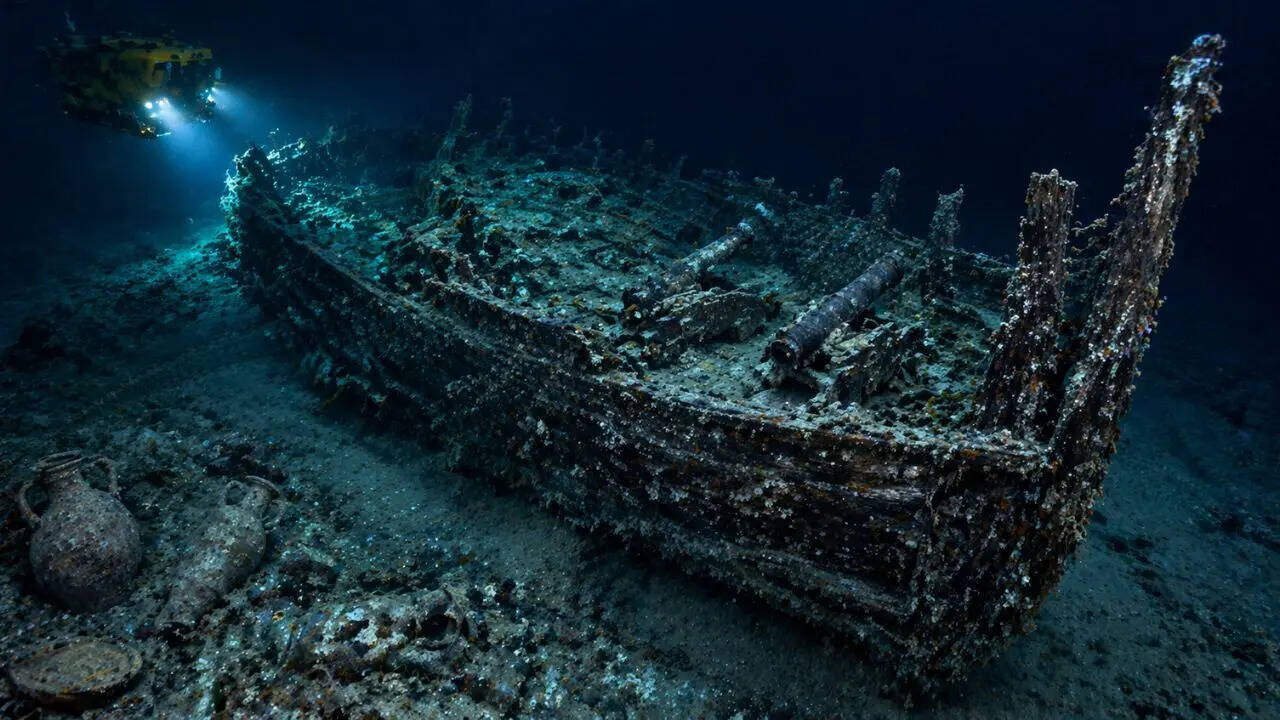
Stop romanticizing the wreckage.
Every time a deep-sea submersible bumps into a piece of 260-year-old timber, the media industrial complex spins a yarn about "hidden empires" and "lost civilizations." The latest frenzy surrounding a merchant vessel found 3,000 feet deep in the Mediterranean is no different. Reporters are breathlessly claiming this ship proves the existence of a sophisticated, shadow-government pirate network. If you liked this piece, you might want to read: this related article.
It doesn’t.
It proves that 18th-century logistics were a nightmare and that we are desperate to project modern geopolitical structures onto disorganized maritime criminals. This wasn't an "empire." It was a series of failing startups with high churn rates and terrible exit strategies. For another angle on this event, see the recent update from NBC News.
The Logistics of a Ghost Ship
The ship in question—found with a cargo of ceramics, spices, and weaponry—is being framed as a hub of a secret trade route. To the untrained eye, a ship carrying goods from five different cultures looks like a masterpiece of international diplomacy. To anyone who understands supply chain fragility, it looks like a desperate scavenger hunt.
True empires require stability. They require fixed ports, tax codes, and predictable insurance rates. Pirates operated on the exact opposite. What historians are calling a "hidden empire" was actually a fragmented black market born out of the sheer inefficiency of the Ottoman and European naval powers.
If you find a truck flipped over in a ditch today carrying stolen iPhones, knock-off Gucci bags, and crates of avocados, you don't call it a "subterranean retail kingdom." You call it a heist gone wrong.
The Deep Sea Data Trap
Deep-sea archaeology suffers from a massive confirmation bias. We assume that because a ship is found at 3,000 feet, it must have been part of something grand and elusive. We treat depth as a proxy for importance.
In reality, the Mediterranean is a graveyard of mediocrity. For every "empire-building" vessel, there are ten thousand boats that sank because the captain was drunk or the hull was rotten. By focusing on the "260-year-old mystery," we ignore the brutal math of 18th-century shipping.
- Failure Rates: In the mid-1700s, roughly 5% to 10% of long-haul voyages ended in total loss.
- The Insurance Lie: Lloyds of London wasn't built on the success of these ships; it was built on the statistical certainty that they would fail.
- The Pirate "Wage": Most pirates were former merchant sailors fleeing debt. They weren't building a new world; they were trying to survive the old one for six more months.
When you look at the manifest of this "lost pirate ship," you see high-margin luxury goods. The competitor article claims this indicates a sophisticated distribution network. It doesn't. It indicates that the pirates knew they couldn't compete on volume, so they had to gamble on high-risk, high-reward theft. That’s not an empire. That’s a desperate pivot.
Why Everyone is Asking the Wrong Questions
If you look at the "People Also Ask" sections for maritime history, you see questions like: How did pirates govern their territories? or What was the currency of the pirate empire?
These questions are fundamentally flawed because they assume "territory" and "currency" existed in a way we would recognize. Pirates didn't hold territory; they occupied gaps in the map where legitimate states were too weak to project power. Their "currency" was immediate liquidity—mostly booze, food, and silver that was melted down as fast as it was stolen.
The idea of a "Pirate Empire" is a Victorian-era invention, later polished by Hollywood and now exploited by tech companies selling underwater scanning equipment. It sells tickets. It gets clicks. It does not, however, stand up to a rigorous economic audit.
The Technological Delusion
We are currently in a gold rush for deep-sea data. Companies are pouring millions into autonomous underwater vehicles (AUVs) and remotely operated vehicles (ROVs). To justify these expenditures, they need to find "empires." They need to find "lost history."
I have seen venture capital firms throw money at maritime "salvage" startups that are essentially just high-tech gambling operations. They use the language of archaeology to mask the reality of asset stripping. When they find a ship like this one, the PR department goes into overdrive to frame it as a cultural milestone.
If they admitted it was just a medium-sized merchant vessel that got caught in a storm while carrying stolen pots, the stock price wouldn't move. So, they call it a "lost empire."
The Mediterranean wasn't a Secret Network
The "secret" nature of these routes is another myth. Everyone knew where the pirates were. The British, the French, and the Spanish navies weren't "baffled" by a hidden empire. They were simply making a cold, hard calculation: Is the cost of clearing the sea lanes higher than the cost of the lost cargo?
For decades, the answer was yes. It was cheaper to let the pirates exist as a "tax" on trade than to fund a permanent standing fleet in every corner of the Mediterranean.
This vessel, sitting in the silt at 3,000 feet, is a monument to that calculation. It represents a moment where a group of criminals got lucky, stayed lucky for a few months, and then ran out of luck.
Stop Hunting for Atlantis
The obsession with these shipwrecks prevents us from understanding the real history of the Mediterranean. The real story isn't a "hidden empire" of rebels. The real story is the crushing, bureaucratic weight of the empires that survived.
We want pirates to be the "disruptors" of the 18th century. We want them to be the Silicon Valley founders of the high seas, breaking things and moving fast. But history isn't a pitch deck.
These men were mostly starving, diseased, and terrified. Their ships were leaking sieves. Their "empires" lasted as long as the wind held out.
If you want to find a hidden empire in the Mediterranean, stop looking at the bottom of the ocean. Look at the ledgers of the banks in Venice, Genoa, and London. That’s where the power was. That’s where the routes were actually managed. The pirates were just the noise in the system.
Worship the wreckage if you want. Just don't call it a kingdom. It’s just a very expensive pile of garbage that took 260 years to find.
Burn the maps. Forget the treasure. The empire never existed.