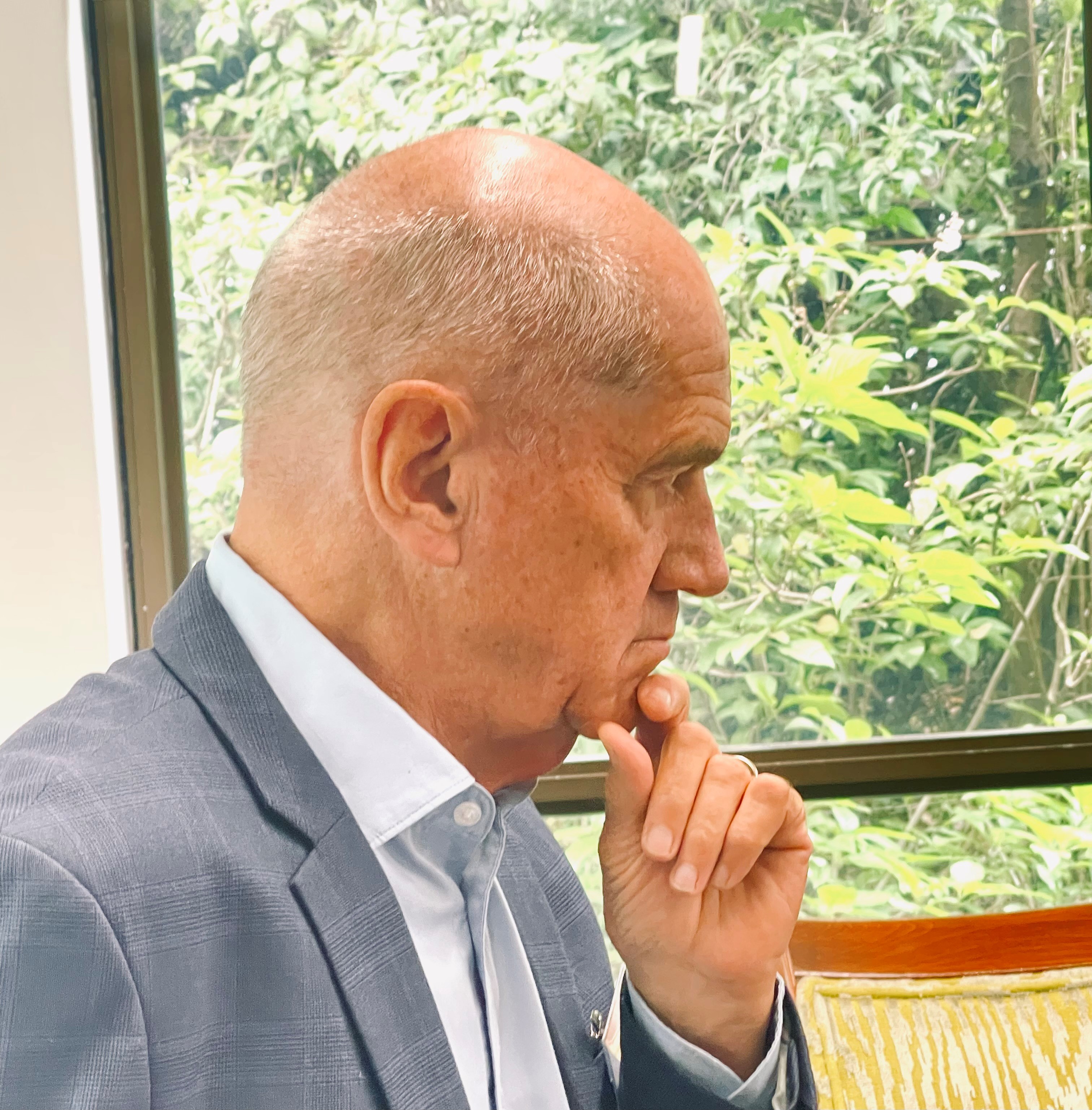
The chattering classes in Pretoria are currently busy patting themselves on the back. They see the appointment of Roelf Meyer as the next South African ambassador to the United States as a masterstroke of "bridge-building." They call it a return to the pragmatic glory days of the 1994 transition. They are dead wrong.
This isn’t a strategic pivot. It is a desperate, nostalgic retreat. Meanwhile, you can explore related developments here: The Myth of Maritime Security Why Tanker Seizures are a Calculated Theater of Control.
By sending Meyer to Washington, the Ramaphosa administration is signaling that it has run out of contemporary ideas. It is reaching into a thirty-year-old toolbox to fix a geopolitical engine that has been completely redesigned. The consensus suggests that Meyer—the man who negotiated the end of Apartheid alongside Cyril Ramaphosa—is the only person who can smooth over the jagged edges of the US-South Africa relationship.
That premise is fundamentally flawed. Washington doesn't care about 1994 anymore. Washington cares about 2026. To see the complete picture, check out the recent analysis by Reuters.
The Myth of the Great Negotiator
The "lazy consensus" argues that Meyer’s personal chemistry with the President and his history as a negotiator will open doors in the West Wing. This ignores the brutal reality of modern realpolitik.
Diplomacy in the current era isn't about shared history or "knowing the guy." It is about cold, hard alignment on trade, security, and technology. Meyer’s expertise is in internal constitutional settlements. But the friction between Pretoria and Washington isn’t a constitutional disagreement; it’s a collision of global interests.
South Africa has spent the last three years flirting with the BRICS expansion and maintaining a "non-aligned" stance on the Ukraine conflict that looks remarkably like alignment with Moscow to anyone in the State Department. Sending a "grand old man" of the transition to explain away these choices is like bringing a cavalry horse to a drone fight.
I’ve seen governments make this mistake repeatedly. They confuse "stature" with "utility." They think a big name compensates for a bad policy. It never does. The Americans will be polite. They will host the dinners. They will talk about the "miracle of 1994." And then, the moment the dessert plates are cleared, they will continue to squeeze South Africa on AGOA (African Growth and Opportunity Act) eligibility and scrutinize every military exercise Pretoria holds with "adversarial" powers.
Trading on Depreciated Capital
Let’s talk about the currency of diplomacy. South Africa’s greatest export for three decades wasn't gold or platinum; it was moral authority.
Meyer represents the peak of that authority. But moral authority has a shelf life. In the halls of the US Congress, the "Rainbow Nation" narrative is no longer a get-out-of-jail-free card. When lawmakers in D.C. look at South Africa today, they don't see the triumph of 1994. They see:
- A collapsing logistics network (Transnet).
- A power grid that functions on a prayer (Eskom).
- A foreign policy that increasingly diverges from Western security interests.
The appointment of Meyer is an attempt to spend moral capital that has already been devalued by years of domestic mismanagement. It’s an appeal to sentimentality in an age of transactionalism. If you want to influence the US in 2026, you don't send a negotiator; you send a deal-maker who understands rare earth minerals, green hydrogen, and semiconductor supply chains.
The AGOA Trap
Everyone is asking: "Can Meyer save AGOA?"
This is the wrong question. The real question is: "Why is South Africa still so dependent on a unilateral trade preference that can be snatched away at the whim of a mid-level US Senator?"
By framing Meyer’s mission around saving AGOA, Pretoria admits its own vulnerability. It positions South Africa as a supplicant rather than a partner. A truly contrarian—and effective—strategy would be to move beyond the begging-bowl diplomacy of the past.
Imagine a scenario where, instead of sending a veteran of the CODESA talks to plead for trade preferences, South Africa sent a high-powered tech consortium to negotiate bilateral investment treaties that make South Africa indispensable to the American EV battery market. That creates leverage. Meyer, for all his skills, represents a version of South Africa that was happy to be the "moral leader" while its industrial base eroded.
The High Cost of Nostalgia
There is a danger in this appointment that the media is completely ignoring: the "Old Guard" echo chamber.
When you appoint someone from the inner circle of the 1990s, you aren't just appointing an individual. You are appointing a mindset. This mindset believes that the West owes South Africa a certain level of deference because of its history. This is a dangerous delusion.
The US is currently engaged in a massive strategic decoupling from China and a proxy confrontation with Russia. It is retooling its entire global footprint. In this environment, "historical significance" is a line item that gets cut first.
Meyer’s presence might actually hinder the necessary professionalization of the diplomatic corps. Instead of building a robust, data-driven foreign service that can navigate the complexities of the US-China trade war, Pretoria is relying on the "Cyril and Roelf show." It’s a personality-driven strategy in a world governed by systemic shifts.
A Better Way to Disrupt
If the goal is to actually reset the relationship, Pretoria should stop trying to "explain" its foreign policy and start making it valuable.
Washington doesn't need to be convinced that Roelf Meyer is a good man. They know he is. They need to be convinced that South Africa isn't a liability to their African strategy. This requires:
- Brutal honesty on security: Stop the vague "non-aligned" rhetoric and define exactly where South Africa’s interests lie.
- Economic competence: No ambassador can sell a country where the ports don't work. The best "diplomacy" Meyer could do is actually staying home and fixing the Department of Public Enterprises.
- Diversifying the portfolio: Move the conversation away from 1994 and toward 2050.
The downside of my take? It’s cold. It lacks the "feel-good" factor of seeing two old lions of the transition back together. It acknowledges that South Africa is just another middle power fighting for relevance in a fractured world.
But the "feel-good" factor doesn't sign trade deals. It doesn't stop the US Treasury from flagging South African banks. It doesn't fix the fact that South Africa’s influence in Washington is at an all-time low.
Sending Roelf Meyer to Washington is like trying to reboot a classic film with the original cast thirty years later. The actors are still great, but the audience has moved on, the genre has changed, and the special effects look dated.
Stop trying to relive the miracle. Start competing in the reality.
South Africa doesn’t need an ambassador to the past. It needs a strategy for a future where it is no longer the world’s moral darling. The Meyer appointment isn't a bold move; it's the final gasp of a diplomatic era that died a decade ago.
Stop cheering for the nostalgia act and start worrying about the fact that we have nothing else to offer.
The era of the "Negotiated Settlement" is over. The era of the "Global Grind" is here. Act accordingly.