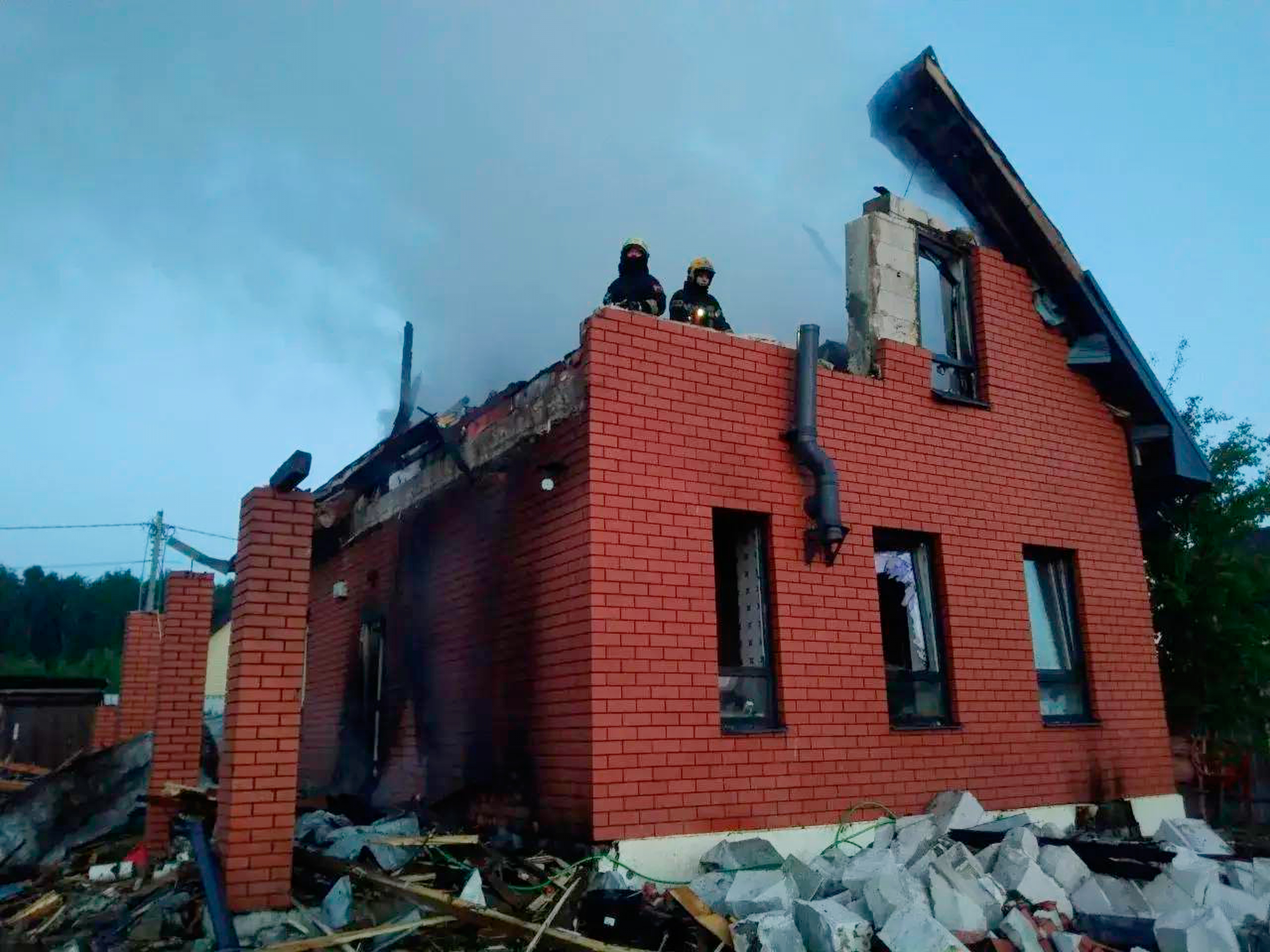
The headlines are obsessed with body counts. They track four dead here, twelve wounded there, and call it a "large-scale strike." They are looking at the wrong map. While mainstream media fixates on the tragic but statistically minor human toll of recent Ukrainian drone incursions into Russian territory, they are missing the systemic collapse of 20th-century military doctrine happening right in front of them.
The story isn't that Ukraine hit a residential building or a power station. The story is that a nation with effectively no traditional air force has neutralized the "shatterproof" air defenses of a nuclear superpower using hobbyist components and duct tape.
The Myth of the Iron Dome Economy
Most analysts are stuck in a cost-benefit loop that favors the legacy defense industry. They see a $2 million S-400 interceptor missile swatting down a $30,000 cardboard drone and call it a win for the defender because the target survived.
That is financial illiteracy.
In a war of attrition, the side that spends $2 million to stop $30,000 loses every single time. It doesn't matter if you intercept 90% of the incoming fire. The 10% that gets through creates a PR nightmare and structural damage, while the 90% you "successfully" intercepted just drained your treasury and your missile stockpiles. We are witnessing the first "Asymmetric Bankruptcy" in modern history. Russia is being forced to play a game of whack-a-mole where the hammer costs more than the house.
I have spent years watching defense contractors pitch "unbreakable" electronic warfare suites. They are selling 1990s solutions to 2020s problems. You cannot "jam" a drone that uses simple visual navigation or fiber-optic trailing wires. You can't out-produce an enemy whose supply chain is basically every Alibaba warehouse on the planet.
Why Military Pundits Are Wrong About Precision
The "People Also Ask" sections of the internet are currently flooded with questions like: Can drones win the war? or Why doesn't Russia just jam the signal?
These questions are flawed because they assume drones are a replacement for artillery or jets. They aren't. Drones are the democratization of terror and precision.
Standard military doctrine relies on "The Big Pivot." You move a massive division, you support it with heavy bombers, and you capture a hill. It’s slow, expensive, and loud. Ukraine’s recent strikes on oil refineries and storage depots inside Russia prove that the "hill" doesn't matter anymore. If you can bypass the front lines entirely and gut the enemy's gas station, the tanks on the front line become very expensive paperweights.
The media calls these "large-scale strikes." By historical standards, they are tiny. A dozen drones is a scouting party in 1944. But in 2026, a dozen drones is a surgical strike on the Russian economy's jugular.
The Brutal Reality of Collateral Damage
We need to stop pretending that "precision" means "clean."
The competitor articles lament the civilian casualties in these strikes. Let’s be cold-blooded for a second: in total war, the distinction between a "military target" and "dual-use infrastructure" is a legal fiction maintained by people who don't have to fight. When a drone hits an oil refinery that provides fuel for T-90 tanks, that is a military success. If that refinery is in a populated area, there will be casualties.
The contrarian truth? These strikes are actually reducing the total lethality of the war. By targeting the Russian industrial base rather than just meat-grinding soldiers in a trench in Donbas, Ukraine is attempting to shorten the logistical tail of the Russian army. If you can't fuel the truck, you can't send the soldier to the front.
It is a paradox: more explosions in Russia might actually lead to fewer deaths on the battlefield.
The Industrial Sabotage Playbook
If you want to understand the true impact of these strikes, stop looking at the casualty reports and start looking at the insurance premiums.
When a drone hits a Russian refinery in Samara or Ryazan, the physical damage might be fixed in a month. But the "Risk Premium" is permanent. Foreign workers leave. Parts—often smuggled in despite sanctions—become harder to source. Shipping companies demand higher rates.
I’ve seen this in the private sector: a single cyber-attack doesn't bankrupt a company because of the lost data; it bankrupts them because of the subsequent five years of compliance, audits, and lost trust. Ukraine is running a physical "DDOS attack" on the Russian state. They are flooding the system with low-cost threats that require high-cost responses.
The Failure of "Sophisticated" Air Defense
We were told for decades that the Russian S-300 and S-400 systems were the gold standard. They are built to kill F-16s and Tomahawk missiles—targets with huge heat signatures and high radar cross-sections moving at supersonic speeds.
They are effectively useless against a lawnmower engine attached to a wing made of plastic and foam flying at 80 miles per hour ten feet above the treeline.
Imagine trying to catch a mosquito with a sniper rifle. That is the current state of Russian air defense. They are firing million-dollar projectiles at targets that are literally too slow and too small for the radar to track effectively.
The Actionable Truth for Global Security
What does this mean for the rest of us?
- The Tank is a Coffin: Any military still investing heavily in heavy armor without a robust, localized anti-drone bubble is just buying overpriced coffins.
- The End of Distance: Physical borders are now suggestions. If a DIY drone can fly 800km to hit a target, then the "rear" no longer exists. Every city is the front line.
- Decentralized Production is King: You cannot win a war against a factory that is actually 1,000 garages connected by a Telegram channel.
The "experts" will tell you that Russia will eventually adapt. They'll say they'll build their own drone swarms. They will. But that doesn't fix the fundamental problem: the defense is now exponentially more expensive than the offense.
The era of the "Superpower" is being dismantled by the era of the "Super-Empowered Individual."
The four dead and twelve wounded in the latest strike are a human tragedy, but they are a distraction from the structural reality. The Russian Bear isn't being killed by a hunter; it’s being bled to death by ten thousand gnats. And there isn't a missile in the world fast enough to stop a gnat.
Stop looking at the body count. Start looking at the bill.