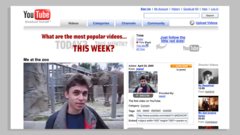
The Victoria and Albert Museum (V&A) just committed a high-profile act of taxidermy. By acquiring and "displaying" Jawed Karim’s Me at the zoo alongside a preserved version of the 2005 YouTube watchpage, they aren't celebrating digital culture. They are embalming it.
The art world is obsessed with the "first." The first brushstroke, the first printing press, the first 19-second clip of a guy talking about elephant trunks. But applying a 19th-century curatorial lens to a 21st-century liquid medium is a fundamental failure of understanding. The V&A is treating a living ecosystem like a static artifact. It is the equivalent of pinning a butterfly to a board and claiming you’ve captured the essence of flight.
The Myth of the Static Page
The "lazy consensus" among curators is that we must preserve the original interface to understand the impact of the platform. They want you to look at the clunky, 2005-era HTML and feel a sense of nostalgia. This is a distraction.
YouTube was never about the page. It was about the protocol of participation.
When you frame a webpage in a gallery, you strip away the only thing that made it revolutionary: the feedback loop. Digital history isn't a series of still images; it’s a chaotic, multi-directional flow of data. By freezing the watchpage, the V&A has deleted the comments, the related video algorithms (however primitive), and the real-time metadata that gave the video its soul.
They’ve turned a firehose into a photograph.
If you want to understand the history of the internet, you don't look at the UI. You look at the shift in power dynamics. Me at the zoo wasn't significant because it was "good" or even "first" (plenty of video hosting existed before YouTube). It was significant because it lowered the barrier to entry to zero.
The Curation Paradox
Traditional museums operate on scarcity. They value the one-of-a-kind. The internet operates on abundance and replication.
By putting YouTube in a museum, the V&A is trying to impose scarcity on a medium that thrives on being everywhere at once. It’s an institutional power grab—an attempt to remain relevant in a world where the public doesn't need a gatekeeper to access history.
I’ve spent two decades watching tech companies "disrupt" industries only to see legacy institutions try to "contain" that disruption in a velvet-roped room. It never works. You cannot curate the internet because the internet is curated by the billion-headed hydra of the user base.
The V&A claims this move helps us "understand our digital heritage." Wrong. It helps us ignore it. It creates a comfortable, sanitized version of history where the internet is a series of "pivotal moments" rather than a messy, ongoing, and often toxic evolution.
The Watchpage Was a Lie
Let’s talk about the technical reality that the V&A’s display ignores. The 2005 watchpage they are showing is a reconstruction. It’s a simulation.
The web is built on layers of code that are constantly breaking. To "show" a 2005 page today, you have to run it through modern browsers, on modern hardware, using emulators that approximate how a server would have responded two decades ago.
It’s not an original. It’s a deepfake of history.
In the software world, we call this bit rot. Data doesn't just sit there; it decays. The files become unreadable. The dependencies vanish. By the time a museum gets its hands on a "digital artifact," they are essentially showing you a high-resolution scan of a ghost.
The V&A is showcasing the "look" of the early web while completely ignoring the "logic" of it. They are obsessed with the skin and indifferent to the skeleton.
Stop Treating Code Like Canvas
If museums actually wanted to preserve the history of YouTube, they wouldn't show the video. They would show the infrastructure.
- They would display the server architecture that allowed for global scaling.
- They would map the data centers that consume more energy than small nations.
- They would analyze the compression algorithms that made $19$ seconds of video playable on a 56k modem.
But infrastructure isn't "sexy." It doesn't look good on a gallery wall. So instead, we get a loop of a guy at a zoo.
We are teaching the next generation that the history of technology is a history of "content." It isn't. It’s a history of engineering, economics, and attention-grabbing. Me at the zoo is the least interesting thing about YouTube’s inception. The most interesting thing is the $1.65$ billion Google paid for it eighteen months later.
The Actionable Truth for Digital Historians
If you actually care about preserving the digital age, stop visiting museums. Start backing up the raw data.
The institutional obsession with "important" videos ignores the fact that the true history of the web lies in the mundane, the deleted, and the demonetized. The V&A is picking the winners of history based on 2026 sensibilities.
True digital preservation requires:
- Functional Emulation: Don't show me a screenshot; let me interact with the broken, slow, buggy mess that was the early web.
- Contextual Aggregation: Show the video alongside the 4chan threads, the early blog posts, and the IRC chats that reacted to it in real-time.
- Radical Transparency: Admit that once a digital object enters a museum, it is no longer the thing it claims to be. It is a derivative work.
The V&A isn't saving YouTube. It's just adding another trophy to its collection of dead things. The real YouTube is out there, evolving, rotting, and being deleted one copyright strike at a time.
The museum is the last place you should go to see the truth.
Burn the gallery. Save the source code.