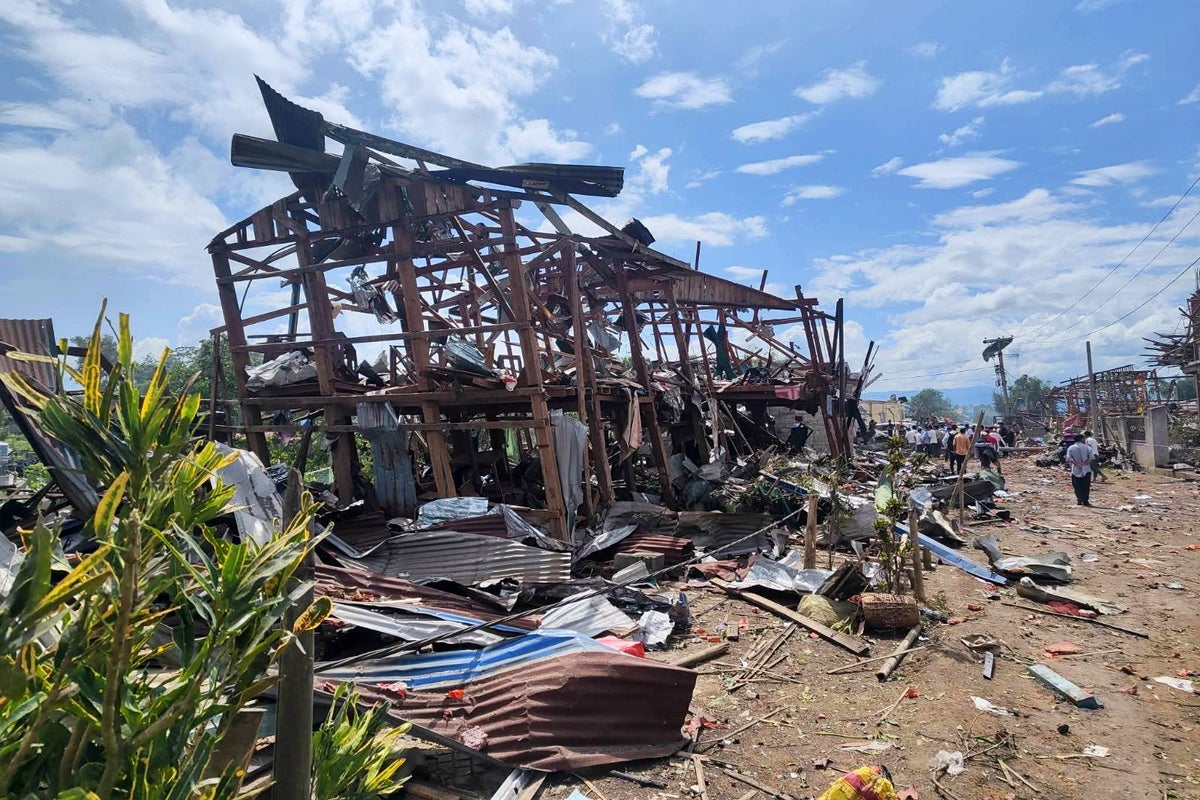
Mainstream media outlets covering the mass casualty explosion in Myanmar’s Shan State are suffering from acute analytical blindness. The reporting on the disaster in Kaung Tat village follows a predictable, lazy template: a tragic accident, a staggering body count of over 45 dead, and a vague reference to the region being under the administration of an ethnic armed group.
By treating this as an isolated regulatory mishap or a standard wartime tragedy, the international press completely misses the macroeconomic reality staring them in the face. This was not a mere industrial accident. It is a stark exposure of the structural failure of rebel governance and the dark mechanics of the parallel war economies keeping Myanmar’s civil conflict alive.
The Illusion of Sovereign Control
For the past year, Western analysts and regional observers have cheered the territorial gains of the Three Brotherhood Alliance. When the Ta'ang National Liberation Army (TNLA) wrested control of Namhkam township and surrounding border territories from the central military junta, it was heralded as a triumph of decentralized governance. The narrative claimed that ethnic armed organizations were finally transitioning from guerrilla outfits into legitimate, stable micro-states capable of providing security and administration.
The Kaung Tat blast blows that fantasy to pieces.
Imagine a scenario where an internationally recognized government stores massive, industrial-grade stockpiles of volatile gelignite directly beneath residential quarters in a major mining hub, with zero safety protocols, zero zoning laws, and zero emergency infrastructure. The international community would rightfully condemn it as a rogue state operation demonstrating criminal negligence. Yet, because the TNLA wears the mantle of a resistance movement, the media sanitizes the narrative, framing the explosion as a stroke of bad luck in a war zone.
Let’s be precise about what occurred. The TNLA’s own economic department admitted to storing these explosives. This was an official rebel enterprise. The multi-ton stockpile was not designated for the frontlines; it was meant for the lucrative ruby and stone quarrying mines dotting the Chinese border.
I have watched armed factions across Southeast Asia attempt to balance the dual roles of a standing army and a corporate syndicate for over a decade. They fail at the administrative side almost every single time. When an armed group prioritizes the rapid extraction of mineral wealth to fund an ongoing insurgency, regulatory oversight is always the first casualty. The corporate entities run by these rebel groups operate in a complete legal vacuum, answerable to nothing but their own bottom lines and logistics pipelines.
The Hypocrisy of Resource-Driven Resistance
The premise that ethnic armed organizations offer a safer, more structured alternative to the junta’s tyranny ignores the predatory economic models these groups rely on. Mainstream reports avoid asking the most vital question: why are massive amounts of highly sensitive mining explosives sitting in an unfortified village depot right on the Chinese border?
The answer lies in the warping of the local economy.
- The Revenue Trap: Rebel governance requires massive capital. Without formal tax bases or access to international credit, control over resource-rich nodes becomes existential.
- The Squeezed Borderlands: Proximity to the Chinese frontier means immediate access to markets, but it also creates intense pressure to scale up extraction operations rapidly, bypassing basic safety standards to maximize cash flow.
- The Civilian Shield: Storing commercial explosives inside civilian centers is a calculated, defensive maneuver used by non-state actors globally. It deters junta airstrikes on logistical nodes, effectively using civilian populations as human shields for economic assets.
The true cost of this economic model is paid exclusively in civilian lives. When the junta drops a bomb on a village, the world rightly calls it a war crime. When a rebel group's commercial cash cow explodes due to systemic incompetence and kills dozens of innocent villagers, the press calls it an oversight.
Dismantling the PAA False Premises
When looking at the broader regional dynamics, the standard inquiries found in public forums and media Q&As are fundamentally flawed.
Does territorial fragmentation in Shan State benefit the local population?
The short-term answer from observers is often yes, pointing to the absence of junta terror campaigns in rebel-held towns. But this perspective ignores the long-term structural degradation. Replacing a brutal, centralized military dictatorship with a fragmented patchwork of warlord fiefdoms does not create a functioning state. It creates a network of corporate-military syndicates that compete for resource revenues while leaving the local population completely exposed to industrial catastrophes and economic exploitation.
Can China broker a stable peace in northern Myanmar?
Beijing’s primary interest in northern Shan State is not human rights, democracy, or institutional stability; it is logistical predictability. China brokers temporary ceasefires exclusively to secure its trade corridors, pipelines, and the steady flow of raw materials. The fact that this blast occurred just three kilometers from the Chinese border underscores Beijing’s willingness to tolerate chaotic, hyper-dangerous corporate enterprises on its doorstep, provided the resources continue crossing the frontier.
The Unforgiving Reality of the Factional Economy
The raw data from organizations monitoring the conflict shows an undeniable trajectory. While the international community focuses entirely on political transitions and frontline maps, the internal administrative capacities of liberated zones are deteriorating. Managing a black-market mining operation requires a completely different skill set than governing a community.
The immediate corporate-style response from the TNLA—promising an internal investigation and pledging accountability—is a public relations exercise designed to placate both local anger and Chinese observers. It mimics state behavior without possessing any of the underlying institutional machinery required to enforce actual systemic change.
The hard truth that nobody wants to acknowledge is that the civilian populations in Myanmar's borderlands are trapped between two extractive regimes. On one side is a predatory military junta that views them as hostile insurgent pools; on the other are under-regulated ethnic armed corporations that view their villages as convenient logistical depots for high-risk economic enterprises.
Until analysts stop treating these ethnic administrations as romanticized rebel heroes and start evaluating them as unaccountable corporate-military entities, disasters like the Kaung Tat explosion will continue to be misdiagnosed. The tragedy in Shan State wasn't an accident of war. It was the predictable, devastating overhead of a completely unchecked wartime economy.