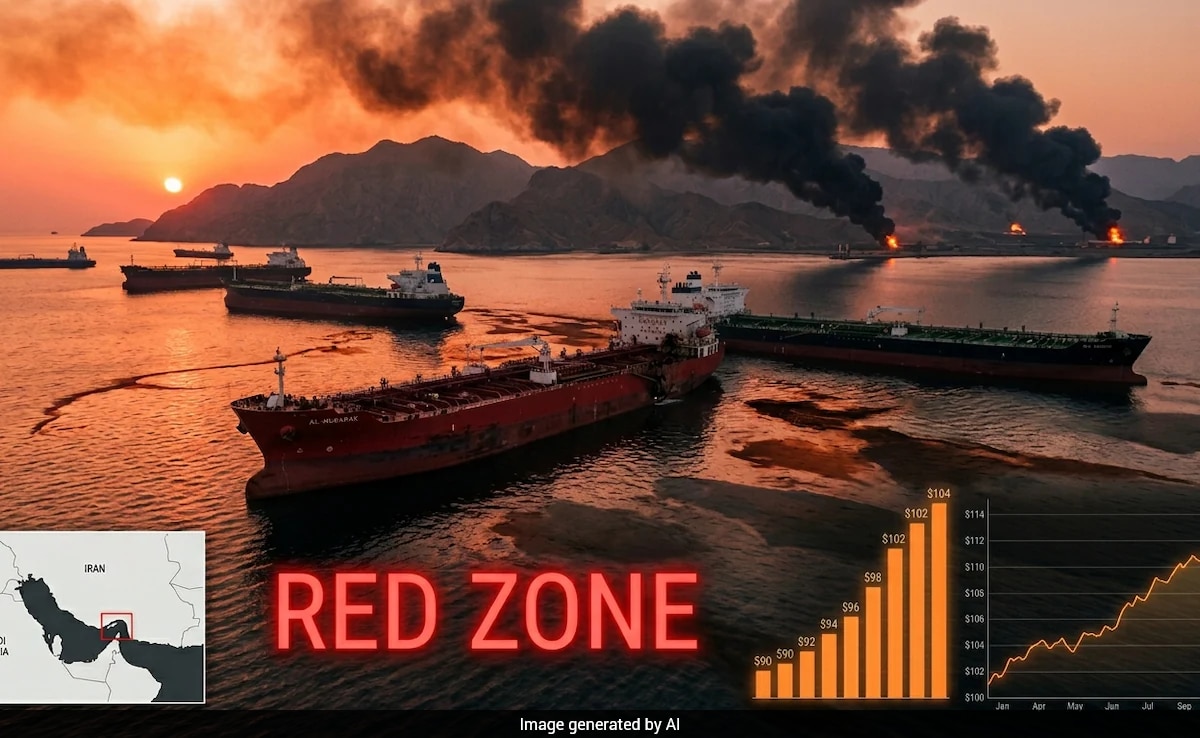
The global energy market has officially entered the red zone, and the emergency safety nets designed to prevent a total economic collapse are about to snap. When Iran effectively choked off the Strait of Hormuz in early March following the outbreak of the regional war, Western policymakers and financial analysts pointed to strategic petroleum reserves and alternative pipelines as foolproof shields. That confidence was misplaced. By restricting nearly 20 million barrels per day of normal crude and refined product flows down to a mere 5% trickle, the blockade has exposed a brutal truth. The world is running out of options, and the current emergency measures are merely masking a systemic deficit that could push Brent crude toward $200 per barrel before the end of the year.
The immediate math is unyielding. Under normal conditions, the Strait of Hormuz is the irreplaceable artery for a quarter of the world’s seaborne oil trade and 20% of global liquefied natural gas (LNG). Today, despite emergency efforts to reroute crude through Saudi Arabia’s East-West pipeline and the UAE’s Habshan-Fujairah link, roughly 14 million barrels per day have been abruptly pulled from global supply.
The International Energy Agency (IEA) coordinated a massive, record-breaking release of 426 million barrels from strategic stockpiles in March, supplemented by another 100 million barrels from non-US OECD nations like Japan and South Korea. This massive injection of state-controlled oil succeeded in keeping Brent crude temporarily tethered near the $104 mark.
It is a artificial ceiling.
The Invisible Depletion of the Oil on Water Buffer
The true gravity of the crisis is hidden in maritime transit data, specifically the volume known as oil-on-water. When a choke point like Hormuz closes, the initial impact is not felt immediately at the refinery gate. Supertankers that loaded cargo days or weeks before the blockade continue steaming toward their destinations in Asia and Europe.
This created a false sense of stability throughout March and April. Refiners kept processing cargo, and consumers kept buying fuel, unaware that the pipeline behind them had emptied.
That buffer has now vaporized. Data from Goldman Sachs reveals that global visible crude and fuel inventories are declining at an unprecedented rate of 8.7 million barrels per day. Crucially, two-thirds of this massive drawdown is coming directly from a collapse in oil-on-water stocks.
Hormuz Status: Operating at ~5% capacity
Volume Missing: ~14 million barrels per day
Current Drawdown: 8.7 million barrels per day (Record pace)
The float is gone. Refiners can no longer rely on the inertia of the global shipping network to maintain operations. They are now directly dependent on local commercial inventories and government stockpiles that are depleting at nearly double the average speed projected at the start of the conflict.
Why Strategic Reserves Cannot Fill the Void
The IEA’s emergency release strategy was built for a short-term disruption—a pipeline explosion, a seasonal hurricane, or a brief labor strike. It was never engineered to counter a prolonged, multi-month military blockade of the Persian Gulf.
- Logistical Bottlenecks: You cannot pump oil out of underground salt caverns fast enough to replace a missing ocean of crude. The maximum sustainable withdrawal rate of global strategic reserves caps out far below the 14 million barrels missing daily.
- Refinery Incompatibility: Oil is not a uniform commodity. The complex refineries of South Korea, Japan, and China are calibrated to process the sour, heavy crudes typical of the Persian Gulf. Drawing down light, sweet crude reserves from Western stockpiles creates a chemical mismatch, forcing refiners to cut yields or modify operations at the worst possible moment.
- The Psychological Cliff: Every barrel released from a strategic reserve today is a barrel that cannot be used tomorrow. As commercial traders see state-owned inventories plunge toward critical minimum thresholds, anxiety increases. The market begins pricing in a future where governments are entirely defenseless, transforming a physical shortage into a speculative frenzy.
The Illusion of the Pipeline Bypass
A frequent talking point among optimistic market commentators is the existence of regional bypass infrastructure. Saudi Arabia operates the Petroline, a massive pipeline system connecting the Abqaiq oil fields to the Red Sea port of Yanbu. The United Arab Emirates possesses the Habshan-Fujairah pipeline, terminating outside the Persian Gulf on the shores of the Gulf of Oman.
On paper, these lines represent a combined nominal capacity of up to 7 million barrels per day. In reality, they are operating under severe constraints that prevent them from stabilizing the market.
+--------------------------+-----------------------+-----------------------+
| Pipeline Infrastructure  | Nominal Max Capacity | Effective Real-World  |
|                          | (Barrels/Day)         | Output (Current)      |
+--------------------------+-----------------------+-----------------------+
| Saudi Petroline          | 7.0 Million           | 3.0 to 4.0 Million    |
| UAE Habshan-Fujairah     | 1.5 Million           | 0.8 Million           |
| Iran Goreh-Jask          | 1.0 Million           | Non-Operational       |
+--------------------------+-----------------------+-----------------------+
Saudi Arabia’s state-backed energy giant, Aramco, claimed to have upgraded the Petroline’s capacity to 7 million barrels per day last year. However, sustainable flows have never been tested at this level. Friction, pressure drops, and aging pumping stations limit the real-world throughput to a fraction of that figure. Furthermore, moving oil to the Red Sea port of Yanbu simply shifts the geopolitical risk elsewhere, forcing tankers to navigate the dangerous waters of the Bab el-Mandeb strait.
The UAE’s line to Fujairah is running at maximum operational limits but accounts for less than a million barrels of daily relief. Iran's own Goreh-Jask bypass pipeline, designed to skip the strait entirely, remains plagued by technical failures and lacks the necessary terminal infrastructure to load large crude carriers.
Relying on pipelines to fix a maritime blockade is like trying to empty a swimming pool with a garden hose. The volume is simply too small for the scale of the crisis.
The Impending Industrial Cracks in Asia and Europe
While the United States produces a significant amount of its own shale oil, its major trading partners are directly exposed to the Hormuz shutdown. The geopolitical fallout is splitting along geographic lines, creating distinct crises in the East and West.
Asia's Threat of Structural Rationing
The economic engine of Asia runs almost entirely on Persian Gulf energy. China, India, Japan, and South Korea absorb roughly 75% of the crude and 59% of the liquefied natural gas that normally transits the Strait of Hormuz.
Japan and South Korea possess substantial national stockpiles, but their industrial sectors are highly vulnerable. Chemical plants, automakers, and heavy manufacturers require a constant stream of petroleum products to sustain production. In India, Prime Minister Narendra Modi has already issued urgent directives to aggressively scale back non-essential fossil fuel consumption while accelerating alternative energy initiatives. The country's foreign exchange reserves are being heavily strained by the soaring cost of spot-market crude, mirroring the economic damage seen during the pandemic.
China presents a more complex problem. While Beijing has spent over a decade building a massive underground strategic crude reserve, its domestic refineries are cutting processing volumes sharply as seaborne imports dwindle. If the blockade continues through July, the Chinese manufacturing sector will face rolling power outages and localized fuel rationing, disrupting global supply chains for consumer electronics and automotive components.
       [Strait of Hormuz Blockaded]
              /            \
             /              \
 [Asia: 75% Oil/59% LNG]   [Europe: 20% Global LNG Lost]
      |                           |
Refinery Cutbacks          30% Storage Depletion
      |                           |
Industrial Rationing       Stagflation & Political Shift
Europe's Secondary Gas Shock
Europe's direct imports of Persian Gulf crude are relatively small, accounting for less than 5% of the region's supply. However, Europe is highly vulnerable to the loss of Qatari liquefied natural gas.
The blockade hit at the worst possible moment. A harsh winter left European gas storage levels depleted to just 30% capacity. With Qatari LNG entirely cut off, Dutch TTF gas benchmarks have nearly doubled to over €60 per megawatt-hour.
The European Commission’s Spring Economic Outlook has already revised its Brent crude projections upward by 46% for the year, warning of a severe stagflationary shock. High energy costs are dragging down industrial output in Germany and Italy, while rising consumer inflation threatens to fuel political instability across the continent.
Why Demand Destruction Will Not Save the Market
A standard economic theory holds that when prices rise too high, demand naturally drops, balancing the market. Some analysts point to declining jet fuel imports in Europe and slowing commercial transport in North America as signs that this self-correcting mechanism is working.
This perspective misjudges the nature of the current crisis. Petroleum demand is highly inelastic; people must commute to work, food must be transported to supermarkets, and critical infrastructure must remain powered.
        [High Prices Hit Consumers]
                     |
         [Demand Drops Inelastically]
                     |
    [Severe Global Economic Contraction]
                     |
   [Stagflation: High Prices + Low Growth]
When demand drops because people can no longer afford fuel, it does not represent a healthy market correction. It signals a severe economic contraction.
Wood Mackenzie’s latest modeling indicates that if the blockade remains unresolved through the summer, global energy demand will drop by 6 million barrels per day. This drop will not be driven by a smooth transition to alternative fuels, but by factories shutting down, shipping fleets lowering speeds to conserve fuel, and consumers cutting discretionary spending to pay for basic necessities.
The global economy cannot absorb a 14 million barrel deficit through voluntary conservation. The gap is too wide.
The Dark Scenario Facing the Energy Sector
If negotiations between Washington, Tel Aviv, and Tehran remain stalled over uranium stockpiles and maritime access, the market will soon face an unprecedented reality. The IEA has explicitly warned that the global oil market will enter the "red zone" by July or August, coinciding with the peak summer travel season and heightened seasonal air-conditioning demand in the Middle East.
Once the remaining oil-on-water vessels finish unloading, the physical shortage will hit the market with full force. At that point, the option to release more strategic reserves will become ineffective.
Phase 1: March–April -> Oil-on-Water buffer masks physical deficit.
Phase 2: May–June   -> Strategic reserves temporarily cap prices; spot shortages emerge.
Phase 3: July–August -> Reserves depleted; industrial rationing begins; Brent approaches $200.
If the Strait of Hormuz remains closed through the final quarters of the year, Brent crude will move swiftly past its historical peak of $126 toward the $200 threshold predicted by energy economists. This shift would trigger a global economic contraction of 0.4%, upending monetary policy and forcing central banks to halt planned interest rate reductions in a desperate bid to counter supply-side inflation.
The era of cheap, reliable energy buffers is over. The global supply chain is operating on borrowed time, sustained by a dwindling reserve of state-held crude that cannot last through the summer. Industrial operators and corporate treasuries that fail to prepare for a prolonged blockade are ignoring the clear structural warning signs.
The global energy market is out of options, and the real crisis has only just begun.