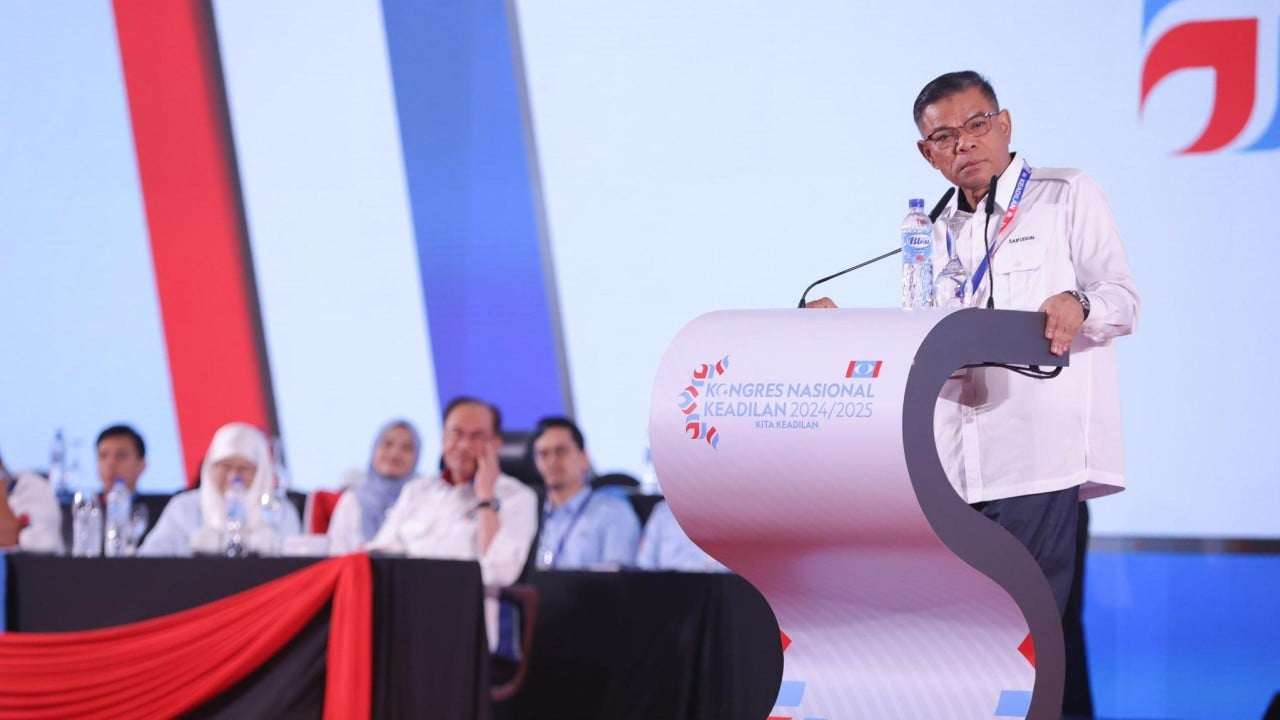
Rain slicked the pavement outside the Home Ministry as Saifuddin Nasution Ismail stepped to the podium. To a casual observer, he was just a politician defending a bureaucratic process. To the millions watching on digital screens across the Malay Peninsula and beyond, he was a gatekeeper holding back a phantom tide. The air in the room felt heavy, not just with the humidity of a Kuala Lumpur afternoon, but with the weight of a rumor that refused to die.
The rumor is simple, terrifying, and—according to the data—entirely fabricated. It suggests that 54,000 Chinese nationals are being quietly, systematically minted into Malaysian citizens. It implies a betrayal of the soil. It suggests that the blue identification card, the MyKad, is being handed out like flyers in a shopping mall.
But numbers are cold. Fear is warm. To understand why this matters, we have to look past the spreadsheets and into the eyes of someone like "Ah Boon," a hypothetical but deeply representative figure of the stateless struggle.
Ah Boon has lived in a small village in Perak for sixty-five years. He speaks fluent Malay with a thick northern accent. He knows the scent of the durian orchards better than he knows his own family history. Yet, because of a missing marriage certificate from the 1950s or a clerical error at a rural registration office, he carries a red identity card. He is a permanent resident, but not a citizen. He cannot vote. He cannot apply for a government subsidy. He is a ghost in his own home.
When people scream about 54,000 foreigners "stealing" citizenship, they aren't talking about Ah Boon. They are talking about a fear of the "Other." They are talking about the anxiety of a changing demographic.
The Anatomy of a Fabricated Panic
The Home Minister didn't just deny the claims; he dismantled them with the precision of a surgeon. The figure—54,000—wasn't pulled from thin air, which is what makes the misinformation so potent. It was a total number of applications received, not a total number of citizenships granted. There is a massive, yawning chasm between a person asking for a home and a country saying yes.
In Malaysia, the path to citizenship is not a walk; it is a marathon through a field of thorns. It requires years of residency, proof of good character, and a proficiency in the Malay language that would challenge many native speakers. The National Registration Department (JPN) is not a charity. It is an institution defined by a "No" until an undeniable "Yes" is earned.
Consider the reality of the 45 applicants who were actually granted citizenship recently. These weren't anonymous faces from a flight out of Beijing. These were individuals who had lived, worked, and paid taxes in Malaysia for decades. They are people who have waited longer for a blue card than most TikTok users have been alive.
When the Minister stood there, he wasn't just defending a policy. He was defending the integrity of the MyKad itself. If citizenship were as easy to obtain as the rumors suggest, the document would lose its power. Its value lies in its difficulty.
The Invisible Stakes of the Digital Lie
We live in an era where a grainy screenshot of a Facebook post carries more weight than a gazetted government report. The viral claim suggested that the government was "clearing the path" for Chinese nationals to tip the scales of the next election. It is a narrative designed to trigger a primal survival instinct.
But look at the mechanics of the process. Every application for citizenship undergoes a rigorous vetting process that involves the police, the special branch, and multiple layers of bureaucratic scrutiny. There is no "fast track" for a specific ethnicity. The law does not have a "bypass" button.
The real tragedy of this misinformation isn't just the political instability it causes. It’s the collateral damage. Every time a false narrative about "easy citizenship" goes viral, it makes the life of the genuinely stateless harder. It makes the officers at the JPN more hesitant. It adds more red tape to the pile, burying the elderly man in Perak and the abandoned child in Sarawak under even more layers of suspicion.
The stakes are not just about who gets to vote. They are about who gets to belong.
A Language of Belonging
There is a specific kind of heartbreak in being told you don't belong to the only land you’ve ever known. Malaysia is a beautiful, complex mosaic, but that mosaic is held together by a shared understanding of who we are. When rumors suggest that the "who" is being manipulated by foreign powers, the glue begins to fail.
Saifuddin Nasution’s rejection of these claims was an attempt to reapply that glue. He pointed out that since 2017, only a fraction of applications from Chinese nationals have even been considered, let alone approved. The process is so stringent that even those married to Malaysians for twenty years often find themselves stuck in a perpetual loop of "Processing."
The narrative of the "Chinese Influx" ignores the mundane, exhausting reality of the immigration office. It ignores the stacks of folders, the thumbprints, and the interviews. It replaces a complex human struggle with a simplified villain.
Imagine standing in a queue for half a day, holding a folder of every document you’ve ever owned, only to be told your birth certificate is "incomplete" because your father’s name was spelled with a double 'L' in 1948. That is the real face of Malaysian citizenship. It is not a gift. It is a hard-won victory.
The Echo in the Dewan Rakyat
The halls of Parliament often echo with grand speeches, but the most important words are often the ones spoken in the quiet of a press conference. By addressing the 54,000 figure directly, the Ministry attempted to puncture a balloon that was growing dangerously large.
If we allow ourselves to believe that citizenship is a commodity being traded in the shadows, we lose faith in the state. If we believe that 54,000 people can just "appear" on the electoral roll, we lose faith in democracy. The Minister’s defense was a plea for a return to a fact-based reality.
He reminded the public that the burden of proof lies with the claimant. If there are 54,000 "instant" citizens, where are they? Where are the addresses? Where are the names? They don't exist because they are ghosts created by an algorithm designed to provoke outrage.
The Finality of the Blue Card
In the end, the blue card is just a piece of plastic. It has a chip, a photo, and a name. But for those who don't have it, it is the difference between being a person and being a number. For those who fear its "misuse," it is a shield that they feel is being cracked.
The truth is less exciting than the conspiracy. The truth is that the system is slow, the system is painful, and the system is remarkably consistent. There is no secret door. There is no hidden ink. There is only the long, arduous trek toward being recognized by the land beneath your feet.
As the sun sets over the Putrajaya skyline, the files are closed and the lights are turned off in the Ministry. The 54,000 figure will likely continue to haunt the darker corners of the internet, a digital ghost that no amount of logic can entirely exorcise. But for the people on the ground, the reality remains unchanged. The gates are heavy. The keys are rare. And the home we call Malaysia remains a place that demands everything of those who wish to call it their own.
A man sits at a kitchen table in a small town, staring at a red card, hoping that one day, the noise will die down enough for his own quiet plea to finally be heard.