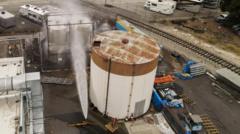
The immediate danger has passed in Riverside County, but the technical reality of what nearly happened in Perris, California, reveals a unsettling gap in industrial oversight. When a rail car carrying 188,000 pounds of styrene monomer began to overheat and vent chemical gas into the atmosphere, it wasn't just a local evacuation—it was a race against a self-sustaining chemical reaction that could have leveled a neighborhood. While officials have officially declared the threat eliminated, the incident exposes how close our logistics hubs sit to the edge of catastrophe.
Styrene is the backbone of the modern plastics industry. It is also a volatile chemical that requires constant monitoring. On that sweltering day in August, the temperature inside a single tank car began to climb, signaling the start of polymerization. This is a process where individual molecules link together to form long chains. It generates heat. As the heat rises, the reaction speeds up, creating more heat in a feedback loop that eventually leads to a violent rupture of the vessel.
The crisis ended because the temperature finally dropped below the critical threshold of 214 degrees Fahrenheit. If it had hit that mark, experts feared a "boiling liquid expanding vapor explosion," or BLEVE. That didn't happen. But the fact that it came so close raises questions about how a stabilized chemical was allowed to reach its tipping point on a siding near a major interstate.
The Chemistry of a Near Miss
To understand why this was so dangerous, you have to look at the chemistry of stabilization. Styrene is usually shipped with an inhibitor, typically 4-tert-butylcatechol (TBC). This chemical acts like a brake on a car parked on a hill. It prevents the molecules from bonding. However, these inhibitors have a shelf life. They are consumed over time, and their effectiveness is heavily dependent on temperature and oxygen levels.
When a tank car sits idle for too long in the California sun, the inhibitor depletes. Once the "brake" fails, the chemical begins to cook itself. In Perris, the car had reportedly been stationary for several days. This is a common occurrence in the American rail system, where "precision scheduled railroading" often results in hazardous materials sitting in staging areas longer than intended.
The heat was the primary enemy. At temperatures above $65^{\circ}F$, the rate of inhibitor consumption increases significantly. In the high desert heat of Riverside County, that tank was essentially a slow-motion pressure cooker. The venting that residents saw—the white plume rising into the sky—was the tank's safety valves doing their job, releasing pressure to prevent an immediate blast. But venting is a last resort. It releases toxic fumes into the air, and it doesn't always stop the internal temperature climb.
Why Technical Oversight Failed
The industry likes to talk about "fail-safes," but the Perris incident shows that the most important fail-safe is human intervention before the reaction starts. This car was part of a larger shipment, yet it was the only one that went rogue. This suggests a specific failure in that vessel—perhaps a lower initial load of inhibitor or a faulty seal that allowed oxygen to deplete faster than expected.
Monitoring these cars is notoriously difficult once they are in transit. Most tank cars do not have real-time, remote temperature monitoring systems that alert a central command when a reaction begins. Instead, we rely on physical inspections and the hope that the math behind the inhibitor load holds up until the car reaches its destination.
The Limits of Emergency Response
Local fire departments are often the first on the scene, but they are rarely equipped to handle a runaway polymerization. In Perris, the strategy was simple: wait and watch. Drones equipped with thermal imaging cameras were the only way to safely monitor the car because the risk of explosion was too high to send in a ground crew to manually cool the tank.
- Thermal Imaging: Used to track the "hot spot" moving within the liquid.
- Evacuation Zones: Set at a 2,000-foot radius based on the potential blast pressure wave.
- Water Deluge: Often avoided in the early stages because the thermal shock of cold water on a stressed steel shell can sometimes trigger a structural failure.
The "elimination" of the threat was not a triumph of technology, but a lucky break in the weather and the slow stabilization of the chemical as the reaction ran out of steam. Had the ambient temperature remained over 100 degrees for another 48 hours, the outcome likely would have been different.
The Hidden Logistics Crisis
This isn't just about one tank in California. It is about a national infrastructure that treats high-hazard chemicals as standard freight. The United States moves millions of tons of hazardous materials by rail every year. The system is designed for efficiency, not necessarily for the storage of volatile compounds in high-heat environments.
When a rail car is "timed out"—meaning it sits longer than its inhibited shelf life allows—there is no universal alarm that goes off. The responsibility lies with the shipper and the carrier to track these windows. In a stressed supply chain, these windows are frequently missed. We are currently operating a "just-in-time" delivery model for chemicals that require "just-in-case" safety protocols.
The Problem with Precision Railroading
In recent years, major rail carriers have shifted toward models that prioritize long trains and minimized dwell times in yards. However, when disruptions occur—labor shortages, track maintenance, or equipment failure—these long trains are broken up and cars are left on sidings. These sidings are often in residential or light-industrial areas not zoned for hazardous material storage.
The Perris tank sat near Interstate 215, a major artery for Southern California commerce. The closure of that freeway for days caused a ripple effect through the regional economy, but the cost of a full-scale explosion would have been measured in lives, not just dollars.
The Regulatory Gap
Current Department of Transportation (DOT) regulations focus heavily on the structural integrity of the tank car—the "tank" itself. There is far less emphasis on the active monitoring of the cargo's chemical state. We require double hulls and specific pressure relief valves, yet we do not require the very sensors that would provide an early warning of a thermal runaway.
The technology exists. Small, battery-powered sensors can be magnetically attached to tanks to transmit temperature and pressure data via satellite or cellular networks. The cost is negligible compared to the cost of an evacuation or a derailment. Yet, adoption is stalled by a lack of a federal mandate and pushback from logistics companies wary of the added layer of data management.
Looking at the Structural Integrity
The tank car in question was a DOT-111, a workhorse of the industry that has faced criticism for years. While newer models like the DOT-117 have thicker shells and better thermal protection, thousands of older cars remain in service. Even a modern car, however, cannot hold back the force of a styrene polymerization if the pressure relief valves are overwhelmed.
When the steel reaches a certain temperature, its tensile strength drops. The internal pressure of a runaway reaction can exceed 300 psi in seconds. At that point, the tank doesn't just leak; it "unzips." The resulting fireball and shrapnel can travel over half a mile. In Perris, the cooling of the tank allowed the steel to maintain its integrity, but we were working with a very thin margin of safety.
A Warning for the Future
The Perris incident will likely be filed away as a successful emergency response. That is a dangerous mistake. It was a failure of the preventative system that was corrected by the passage of time and a bit of luck. As climate change increases the frequency and intensity of heatwaves, the "safe" window for shipping inhibited chemicals will shrink.
If the industry does not move toward active, real-time monitoring of volatile shipments, we will see more of these plumes. We will see more "exclusion zones" carved out of our cities. The goal shouldn't be to get good at managing a chemical crisis; it should be to ensure the crisis never starts in a rail siding in the first place.
The rail industry must move toward a model where every car carrying a "time-sensitive" hazardous material is treated as a live asset. That means GPS tracking combined with internal thermal sensors. It means strict "dwell-time" limits that, if exceeded, trigger an immediate inspection or re-stabilization of the cargo. Until these measures are standard, every stationary tank car in the summer heat is a potential bomb waiting for its inhibitor to run out.
The Perris evacuation has been lifted, and the freeway is open, but the chemical reality remains. We are moving 19th-century infrastructure through 21st-century heat, and the brakes are wearing thin. The next tank car might not cool down on its own.