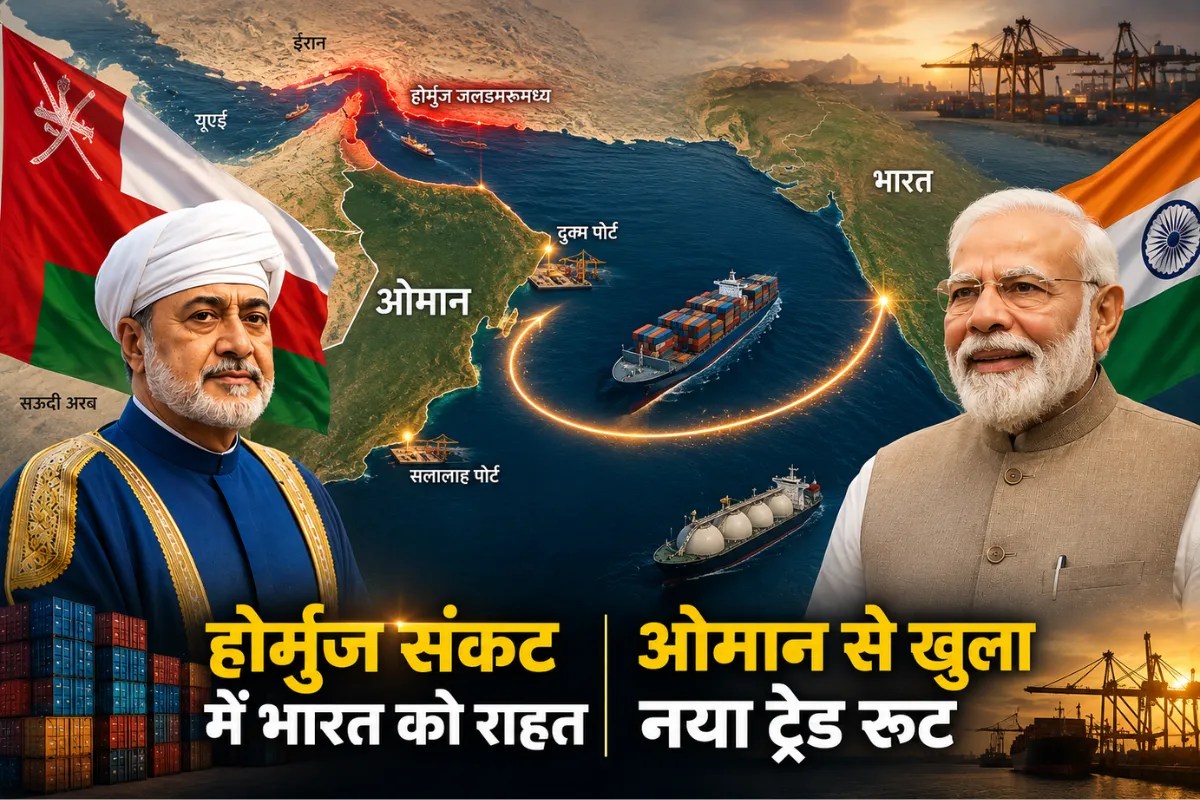
Middle East tensions are cooking the global energy market right now. Brent crude is bouncing over $110 a barrel, and if you look at the UAE, fuel prices just hit a four-year high this June 2026. Why? Because the Strait of Hormuz is a geopolitical chokepoint that keeps choking. One-fifth of the world’s oil supply squeezes through that narrow strip of water, and whenever someone fires a missile or seizes a tanker, India’s economic heart skips a beat.
But as of today, June 1, 2026, New Delhi just pulled off a quiet, brilliant chess move.
The Comprehensive Economic Partnership Agreement (CEPA) between India and Oman is officially live. Most analysts are staring at the trade numbers, whispering that Oman is too small to move the needle. They're wrong. This isn't just a trade pact about selling more basmati rice or buying cheaper urea. It’s a radical supply chain pivot that gives India a backdoor into the Middle East without touching the volatile Strait of Hormuz.
The Strategic Escape from the Hormuz Trap
To understand why this is a massive deal, look at a map. Most Gulf heavyweights like Kuwait, Qatar, and Iraq are stuck inside the Persian Gulf. To get their oil out to India, tankers must sail right through the Strait of Hormuz. If Iran decides to close the gate, or if war breaks out, those ships are sitting ducks.
Oman is different. It’s the ultimate geographic cheat code.
Much of Oman's coastline sits safely outside the Strait of Hormuz, facing directly into the Arabian Sea and the Gulf of Oman. By signing this free trade deal, India is essentially building a secure maritime bridge to Omani ports like Salalah and Duqm.
Look at what happened over the last year as regional conflicts flared up. India's imports from major Gulf economies tanked from $15 billion in April 2025 down to $9.8 billion in April 2026. Our exports to the region dropped from $4.4 billion to $2.7 billion. Shipping lines panicked, insurance premiums skyrocketed, and routes got messed up.
Yet, Oman was the wild exception. India's imports from Oman didn't just crawl up—they exploded by 246.4%, jumping from $430 million to nearly $1.5 billion. India used Oman as a lifeline for crude oil and fertilizer when everything else was hitting the fan. The new trade pact formalizes this safety valve.
What Happens to the Tariffs Today
Let’s talk numbers because the tariff drops are immediate and aggressive. This isn't a slow five-year phase-out.
Oman has eliminated or sharply reduced tariffs on a massive 98.08% of its tariff lines for Indian goods. In plain English, that means 99.38% of everything India exports to Oman is now entirely tariff-free. On the flip side, India did its part by cutting duties on about 78% of its own tariff lines, covering roughly 94.81% of Omani imports.
Sure, India kept its sensitive sectors locked down. You won't see cheap dairy products, chocolates, or jewelry flooding the Indian market from Oman anytime soon. New Delhi protected those domestic industries. But for industrial goods, the floodgates are wide open.
The $1.2 Billion Export Divert
A recent analysis showed that Oman can comfortably absorb roughly $1.2 billion worth of Indian exports that currently route through more vulnerable, Hormuz-dependent Gulf nations. If you're an Indian exporter handling industrial machinery, engineering products, or electrical infrastructure, your game plan just changed.
Consider electrical transformers. India exports over $76 million worth of these to the Gulf region annually. Oman already buys a decent chunk of that, but now Indian manufacturers can scale up without worrying about their cargo getting trapped in a naval crossfire. The same goes for insulated electrical conductors, where regional trade tops $107 million.
Even consumer goods get a free pass. India exported more than $267 million in cosmetics and personal care products to the region recently, and Oman bought nearly half of it. Now, with zero-tariff access, Indian brands have a massive price advantage on Omani shelves.
Moving Beyond a Small Market Mindset
The biggest criticism of this deal from the bears is Oman's size. It’s a nation of 55 lakh people with a GDP hovering around $110 billion. Critics argue that it can’t replace the sheer market size of the UAE or Saudi Arabia.
That misses the entire point of modern supply chain strategy.
You don't look at Oman as a final destination; you look at it as a distribution hub. By securing 100% Foreign Direct Investment (FDI) allowances for Indian firms in several Omani sectors, Indian logistics companies, textile giants, and pharma manufacturers can set up shop in Oman’s free zones.
Imagine shipping raw materials tariff-free to Duqm, doing final assembly or processing in a secure zone outside the Hormuz chokepoint, and then distributing those products to East Africa, Europe, or the rest of the GCC. It bypasses the risk entirely.
Immediate Steps for Indian Businesses
If you run an export-import business or manage supply chains in India, you shouldn't wait around to see how this plays out. The pact is active today. Here is what needs to happen on your operations floor right now.
- Audit Your Gulf Route Risk: Evaluate how much of your current cargo passes through the Strait of Hormuz. Calculate the insurance premium spikes you paid over the last 12 months.
- Re-Route Through Salalah or Duqm: Talk to your freight forwarders about shifting transshipment hubs. Using Oman's external ports might add a bit of coastal transit time to certain inland Gulf destinations, but it eliminates the crippling volatility of Hormuz insurance surcharges.
- Check the Duty Rules: Review the specific Harmonized System (HS) codes for your products. If you export textiles, garments, leather, machinery, or pharmaceuticals, ensure your documentation reflects the new zero-tariff status to claim immediate cost benefits.
This trade agreement isn't a magical cure for all global shipping headaches. The Red Sea is still a mess, and global freight rates are stubborn. But by anchoring its trade strategy to Oman’s neutral, stable, and uniquely placed coastline, India just bought itself a massive insurance policy against Middle Eastern geopolitical chaos.