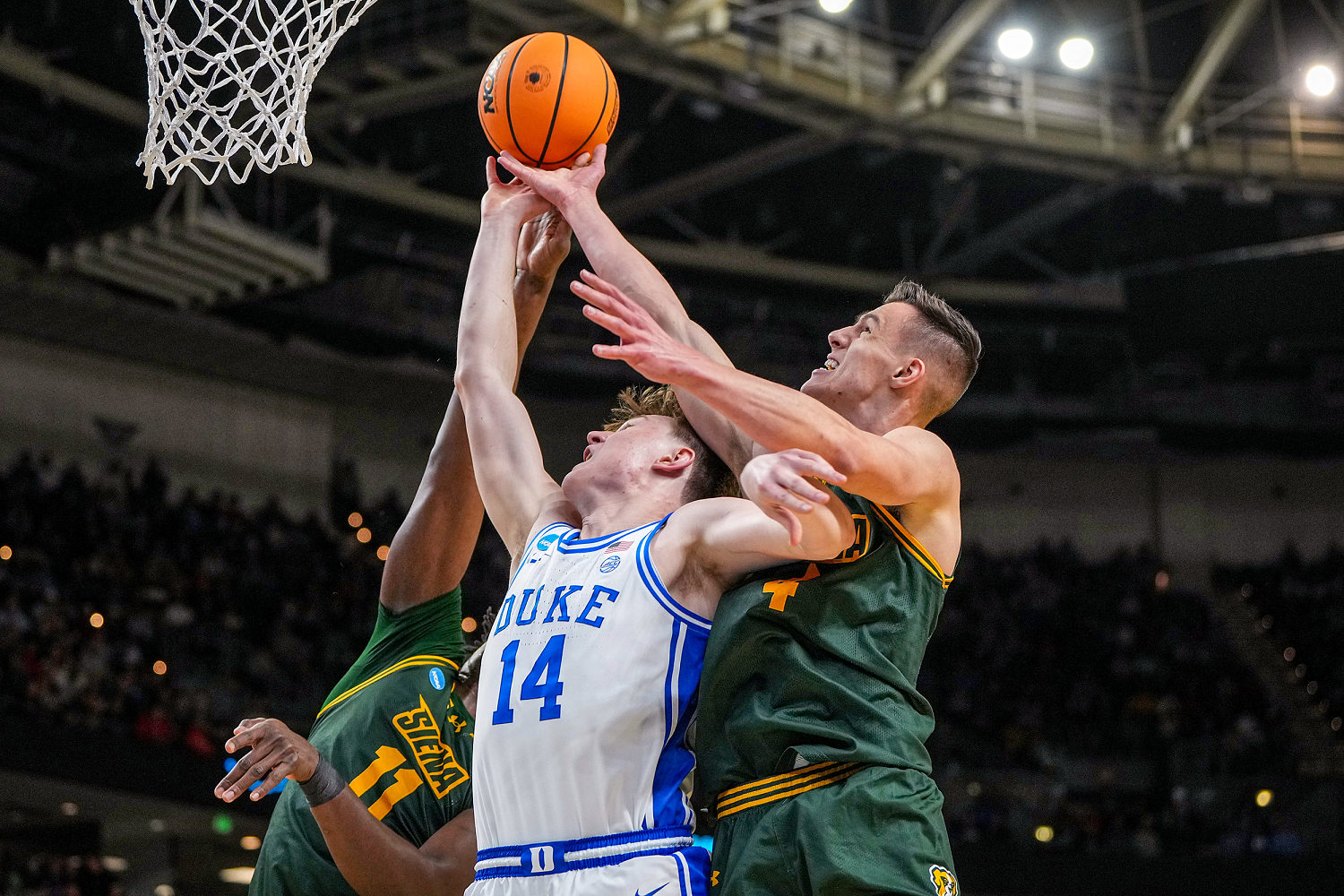
The scoreboard at the Greensboro Coliseum didn't just reflect a narrow escape for the Duke Blue Devils; it exposed the structural cracks in a basketball empire. When a No. 1 seed survives a No. 16 seed by the skin of its teeth, the narrative usually shifts to the "magic of March" or the "resilience of champions." That is the easy way out. The harder truth is that Duke’s near-collapse against Siena was a failure of tactical preparation and a cautionary tale about the psychological weight of the jersey.
For forty minutes, the gap between the most storied program in college basketball and a scrappy mid-major from the Metro Atlantic Athletic Conference evaporated. Duke didn't just struggle to shoot; they struggled to exist in the space Siena forced them to occupy. This wasn't an fluke. It was a blueprint for how to dismantle a giant. Learn more on a related topic: this related article.
The Anatomy of a Near Disaster
The game remained undecided until the final possessions because Duke allowed Siena to dictate the pace. Usually, a top seed uses its superior depth and athleticism to turn the game into a track meet. Instead, the Saints dragged the Blue Devils into a mud fight.
Siena’s defensive strategy centered on a high-pressure man-to-man that dared Duke’s guards to beat them off the dribble without using screens. It was a gamble. By taking away the pick-and-roll, Siena forced Duke into a series of stagnant isolation plays. The ball stopped moving. The rhythmic passing that defined Duke’s regular season vanished, replaced by panicked heaves as the shot clock ticked toward zero. Further reporting by Bleacher Report explores similar views on this issue.
The numbers tell a story of efficiency lost. Duke shot poorly from the perimeter, but their real failure was at the rim. They missed layups. They fumbled entry passes. They played with the tight shoulders of a team that had everything to lose, while Siena played with the reckless abandon of a team that had already won just by being there.
The Mental Toll of the Top Seed
Pressure is a physical force in the NCAA Tournament. We often talk about it as an abstract concept, but you could see it in the sweat on the brows of the Duke freshmen. For these players, a first-round exit wouldn't just be a loss; it would be a historical stain. No No. 1 seed had ever lost to a No. 16 at that point in the tournament’s history, and the fear of being the first was visible in every hesitant jumper.
Siena thrived on this. Every time the crowd roared for the underdog, the basket seemed to shrink for the Blue Devils. The psychological advantage shifted early in the first half when Siena realized Duke wasn't going to blow them out. Once an underdog realizes they belong on the floor, the talent gap starts to matter less than the momentum.
The Coaching Chess Match
While much of the post-game chatter focused on player performance, the real battle happened on the sidelines. Siena’s staff identified a specific weakness in Duke’s defensive rotation. They noticed that Duke’s big men were slow to hedge on high ball screens, leaving a pocket of space at the top of the key.
Siena exploited this repeatedly. They ran a series of high-post handoffs that drew Duke’s rim protectors away from the paint, opening up back-door cuts that resulted in easy buckets. It was a masterclass in situational scouting. Duke’s staff, meanwhile, seemed slow to adjust. They stuck to their base defense for too long, relying on raw talent to overcome tactical deficits.
The Myth of the Unbeatable Giant
We treat elite programs like they are machines. We expect them to execute with robotic precision regardless of the opponent. This game proved that even the most well-funded, highly-recruited teams are vulnerable to the basic fundamentals of the game.
Box out. Move without the ball. Communicate on switches.
Siena did these things better than Duke for thirty-five minutes. The only reason Duke survived was a late-game surge fueled more by individual desperation than cohesive strategy. A few key offensive rebounds and a handful of made free throws spared them the ignominy of a historic upset, but the invincibility was gone.
Why the Margin Matters
A win is a win in the bracket, but a scare like this has long-term consequences. Future opponents saw the tape. They saw that Duke can be rattled by physical, ball-denial defense. They saw that if you take away the transition game, Duke struggles to find points in the half-court.
The "scare" serves as a scouting report for the rest of the field. It provides a template for teams with far more talent than Siena to use in later rounds. When a powerhouse struggles this early, it emboldens the mid-tier teams in the second and third rounds. The aura of the blue blood is diminished, and in a tournament decided by confidence, that is a dangerous development.
The Flaw in the One and Done Era
Duke’s reliance on elite, short-term talent is a double-edged sword. While they have the highest ceiling in the country, they often lack the institutional memory and veteran composure found in older, less "talented" rosters.
Siena featured juniors and seniors who had played together for years. They had chemistry that can't be bought or recruited. Duke, conversely, relied on players who were still learning each other’s tendencies under the brightest lights imaginable. In the regular season, talent wins. In the tournament, when every possession is a life-or-death struggle, that lack of shared history becomes a liability.
Physicality and the Officials
The game was also a testament to how officiating can swing a matchup. The referees allowed a high level of hand-checking and body contact in the paint. This favored Siena’s aggressive, blue-collar style. Duke, accustomed to the more pristine officiating of the ACC, struggled to adapt to the "let them play" mentality of the tournament.
Every time a Duke player drove to the basket expecting a whistle, they were met with a chest-to-chest bump that went uncalled. This led to frustration, which led to turnovers, which led to the transition points that kept Siena in the hunt.
Beyond the Box Score
The legacy of this game isn't the final score. It is the realization that the distance between the top and the bottom of the Division I hierarchy is smaller than the pundits want to admit. The democratization of talent, fueled by expanded scouting and international recruiting, means that a No. 16 seed is no longer a walkover.
Siena didn't play like a cellar-dweller. They played like a disciplined, well-coached unit that lacked only the size to finish the job. If they had possessed one more six-foot-ten forward to contest the final Duke runs, we would be talking about the greatest upset in the history of the sport.
Duke walked away with the victory, but they left their confidence in the locker room. They were exposed as human. They were shown to be a team that can be bullied, a team that can be confused, and a team that can be beaten if you aren't afraid of the name on the front of the jersey.
The next time Duke steps on the floor, they won't just be playing their opponent; they will be playing the ghost of the Siena game. Every missed shot will feel heavier. Every turnover will feel like the start of another slide. The Blue Devils were supposed to cruise through the opening weekend to preserve their legs for the Final Four run. Instead, they had to empty the tank just to survive the first night.
Look at the tape of the final two minutes. Duke didn't celebrate like a team that had just taken a step toward a title. They looked like a group that had just survived a car wreck. They were shaken, exhausted, and acutely aware of how close they came to the end. The myth of the No. 1 seed as a safe bet is officially dead.
Watch the defensive rotations in their next matchup. If the hesitation remains, the survival against Siena wasn't a wake-up call; it was a premonition of an inevitable exit.