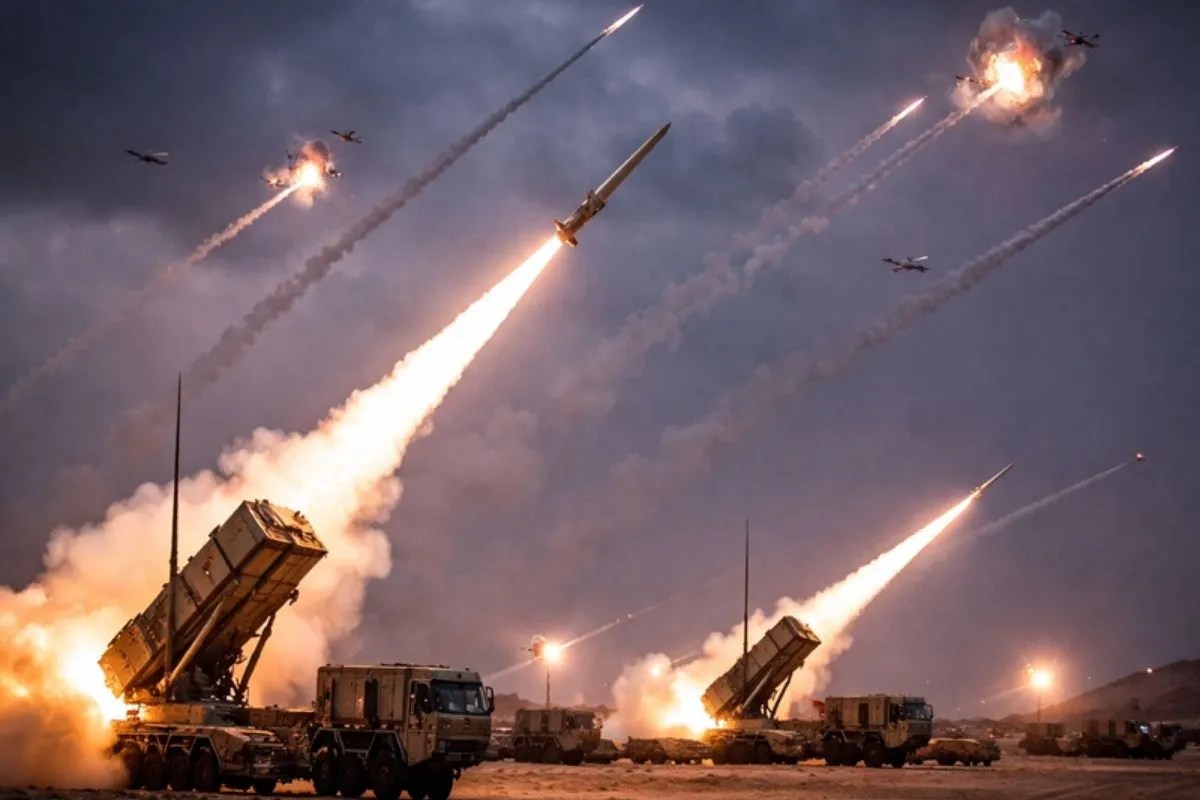
The air in the Al-Tanf garrison usually smells of dry dust and diesel. It is a lonely outpost, a speck of strategic defiance sitting near the border where Syria, Jordan, and Iraq meet. For the soldiers stationed there, the night is rarely silent, but it is usually predictable. You learn to live with the hum of generators and the distant, restless shifting of the dunes. Then comes the sound that changes everything. It isn’t a bang, not at first. It is a high-pitched, metallic scream that tears through the atmosphere, a sound that signals the arrival of something built thousands of miles away with the sole purpose of finding a very specific coordinate.
When Iran launched its missiles toward U.S. and British military assets, the world saw a headline about regional escalation. But if you were under that sky, you saw the end of an era of perceived safety. Meanwhile, you can read other stories here: The Calculated Silence Behind the June Strikes on Iran.
The missiles didn’t just travel across borders. They traveled across a psychological divide. For decades, the West viewed these flashpoints as contained. We looked at maps and saw colored zones of influence. We measured strength in carrier strike groups and stealth signatures. Yet, on this night, the math shifted. Iran signaled that its reach is no longer confined to the shadow wars of the Levant or the murky waters of the Strait of Hormuz. By striking targets associated with the two most prominent Western powers in the region, Tehran stripped away the veneer of untouchability.
The Anatomy of a Calculated Strike
The technology behind these launches tells a story of relentless, quiet evolution. While global headlines focused on nuclear deal negotiations and economic sanctions, engineers in underground facilities were perfecting guidance systems. They weren't looking for the "perfect" weapon that could win a world war. They were looking for the "good enough" weapon that could humiliate an eagle. To explore the full picture, we recommend the excellent report by Associated Press.
Consider the trajectory of a ballistic missile. It is a violent, beautiful arc of physics. Once it leaves the mobile launcher—often hidden in a rugged ravine or a nondescript warehouse—it becomes a mathematical certainty. The interceptors used by U.S. and British forces, like the Patriot or the Type 45 destroyer’s Sea Viper system, are marvels of engineering. They are designed to hit a bullet with another bullet.
But math is a cruel mistress.
If you fire one missile, the defense wins. If you fire twenty, and you time them to arrive alongside low-flying "suicide" drones that clutter the radar screens like a cloud of digital locusts, the defense has to make a choice. It’s a terrifying game of sensory overload. The radar operator in a darkened command center has seconds to distinguish between a decoy, a drone, and a high-explosive warhead screaming in at Mach 5.
The Human Cost of the Invisible Chessboard
We often talk about these strikes in terms of "assets" and "strategic depth." We forget the person holding a lukewarm coffee in a shipping container office when the sirens go off.
Imagine a young radar technician from a small town in the English Midlands. They aren't thinking about the geopolitical nuances of the Shia Crescent or the historical grievances of the 1953 coup. They are looking at a green phosphor screen. They are watching a dot that represents a kinetic energy event capable of vaporizing their entire world. When that dot persists despite electronic countermeasures, the abstract becomes visceral. The ground shakes. Not just from the impact, but from the sonic boom of the interceptors trying to save them.
The British involvement adds a layer of historical irony that isn't lost on the region. London’s footprint in the Middle East is deep and scarred. By targeting British military sites alongside American ones, Iran is messaging a refusal to acknowledge the "Special Relationship" as a shield. They are treating the Atlantic alliance as a single, unified target.
This isn't just about territory. It’s about the erosion of the "Over There" mentality. For a long time, Western publics felt that these wars happened in a vacuum. We sent the hardware, the hardware did the job, and the consequences stayed buried in the sand. But the precision shown in these recent strikes suggests that the vacuum has a leak.
The Invisible Stakes of Precision
The real danger isn't a massive, fiery explosion that starts World War III. The real danger is the "surgical" strike.
If a nation can hit a specific warehouse on a massive base without destroying the barracks next door, they aren't just attacking a target. They are conducting a live-fire demonstration for the world’s buyers. The technology is no longer the sole province of the superpowers. We are entering an age of "democratized destruction."
When Iran proves it can bypass sophisticated jamming and hit a Western base, every other middle-tier power watches. They take notes. They realize that you don't need a billion-dollar stealth bomber to exert your will. You just need a few dozen well-calibrated rockets and the nerve to push the button.
This creates a terrifying paradox for the U.S. and the UK. If they respond with overwhelming force, they risk a conflagration that no one—not even the hawks—really wants. If they don't respond, the threshold for what constitutes an "acceptable" attack moves. Today it’s a remote outpost. Tomorrow it’s a port. The day after, it’s a ship in a vital shipping lane.
The Ghost in the Machine
We must also look at the role of intelligence. These missiles didn't find their way by accident. Every successful strike is a failure of secrecy. It means someone, somewhere, knew exactly where the high-value targets were moved. It means the "invisible" stakes are actually quite visible to those with the right sensors.
The digital battlefield is now inseparable from the physical one. Before the first engine ignited on the launchpad, a thousand cyber-skirmishes likely took place. Probing the fire-control networks. Testing the response times of the satellite arrays. If you can delay a warning signal by even forty-five seconds, you have won the engagement before it started.
The sheer speed of this evolution is what keeps military planners awake. We are moving away from the era of "Shock and Awe" and into the era of "Stress and Attrition." You don't have to sink the entire fleet; you just have to make it too expensive and too risky for the fleet to stay.
The Silence After the Siren
Back at the base, after the smoke clears and the "All Clear" sounds, there is a specific kind of silence. It’s the silence of realization.
The soldiers walk out and see the craters. They see the fragments of twisted metal, some of it bearing markings in a language they can’t read. They realize that the distance between their home and this conflict has evaporated. The desert isn't a buffer anymore. It’s a front line that can be crossed in minutes by a piece of machinery that costs less than a luxury sports car.
The geopolitical analysts will spend the next weeks debating the "proportionality" of the response. They will use words like "deterrence" and "de-escalation." But those words feel hollow when you’ve felt the heat of a warhead that traveled over a thousand miles to find you.
The strategy has shifted from grand maneuvers to a game of nerves. Iran is betting that the West’s stomach for a prolonged, messy, and technologically taxing conflict is shrinking. They are betting that every missile that gets through—even if it hits an empty runway—is a victory in the war of perception.
The world is watching the sky, waiting for the next flash. We are no longer observing a regional spat. We are witnessing the birth of a new kind of global friction, where the lines on the map matter less than the code in the guidance chip.
The desert is quiet again, for now. But the dust hasn't settled. It’s just waiting for the next scream from the stars.
A single, unexploded fragment of a fin sits in the sand, cooling in the moonlight, a jagged reminder that the world just got much, much smaller.