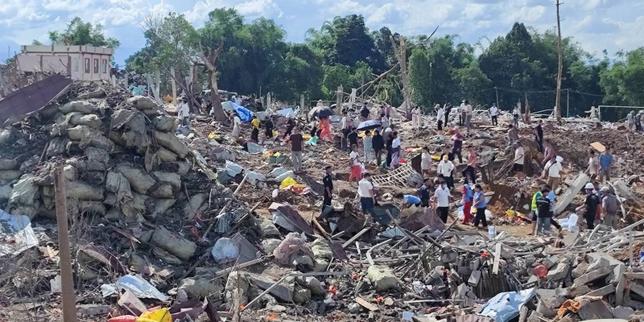
The air in northern Myanmar usually tastes of damp earth and woodsmoke as October settles in. In the Mung Lai Hkyet displacement camp, tucked away near the town of Laiza, families were winding down. Children were asleep. Elders were murmuring prayers or quiet stories. These were people who had already lost their original homes to the long-running conflict between the military and ethnic minority resistance groups. They lived in makeshift shelters, believing that a camp for displaced civilians would remain a sanctuary.
Then came the flash.
It happened around 11:30 PM. A massive explosion ripped through the darkness, tearing apart bamboo huts, shattering concrete structures, and instantly vaporizing any sense of safety. The shockwave felt like a physical blow to the chest for miles around. When the dust finally settled, more than thirty people were dead, including women and children, and dozens more lay mutilated in the debris.
This is not a dry statistic from a faraway geopolitical chessboard. It is the reality of a forgotten war that continues to grind human lives into dust while the rest of the world looks away.
A Sanctuary Reduced to Ash
To understand what happened in that camp, one must understand what it means to live in a displacement zone. Consider a mother who has spent years fleeing active combat. You pack your life into a single bag, hold your child’s hand, and walk until you find a place where the sound of artillery is distant enough to sleep. You build a life out of tarpaulins and hope.
The explosion at Mung Lai Hkyet shattered that fragile illusion. The camp sits in territory controlled by the Kachin Independence Army (KIA), one of the country's most powerful ethnic armed organizations. For decades, the KIA has fought for self-determination against the central military government. Because of this, the civilians living under their administration are routinely caught in the crossfire.
Witnesses described the immediate aftermath as a scene from a nightmare. The blast left a massive crater in the center of the camp. Nearby blocks of houses were completely flattened. Rescuers worked by the dim light of mobile phones and flashlights, pulling body parts from the wreckage. The local hospital in Laiza was quickly overwhelmed, its floors slick with blood as doctors rushed to treat amputations and severe blast injuries.
The military junta quickly denied responsibility for the strike, suggesting that the tragedy was caused by an explosion at a KIA ammunition storage site. But local activists and international observers paint a different picture. The sheer scale of the destruction points to a coordinated aerial attack or a heavy artillery barrage, tactics that the military regime has increasingly relied upon to terrorize populations living in rebel-held areas.
The Strategy of Disruption
The war in Myanmar changed drastically after the February 2021 military coup. What began as localized protests against the overthrow of the democratically elected government soon evolved into a nationwide armed resistance. Regular citizens—teachers, engineers, students—joined hands with established ethnic armed groups like the KIA to fight back.
But the military’s response has followed a brutal, decades-old counter-insurgency doctrine known as the "Four Cuts." The goal is simple: cut off food, funding, intelligence, and recruits to the resistance. If you cannot defeat the guerilla fighters in the jungle, you target the civilians who provide them with moral and logistical support.
When a displacement camp is bombed, it sends a clear psychological message to the entire population. It says: You are not safe anywhere. No wall, no camp, no international law can protect you.
The numbers tell a grim story, but they fail to capture the psychological toll. Across Myanmar, over two million people have been internally displaced since the coup. These are families living in constant flight, moving from one temporary camp to another, watching the skies every time they hear the drone of an airplane engine. Education is disrupted. Healthcare is nonexistent. Chronic malnutrition is rising.
The Echoes of Silence
What happens when the international community treats these tragedies as routine news updates? The silence becomes a form of complicity.
Every time a bomb falls on a school, a hospital, or a displaced persons camp in Kachin State, or Sagaing Region, or Karen State, statements of "grave concern" are issued by global bodies. Diplomatic language is polished and polite. Meanwhile, the flow of aviation fuel and weapons to the junta continues through porous borders and shadowy corporate networks.
The real problem lies in the normalization of the crisis. Because the conflict in Myanmar is complex, fractured across dozens of ethnic groups and local defense forces, it lacks a simple narrative for external onlookers to consume. It is easier to look away. It is easier to treat an explosion that kills thirty innocent people as an isolated incident rather than part of a systematic campaign of violence.
But for the survivors of Mung Lai Hkyet, there is no looking away. They must now bury their dead in the very earth they fled to for protection. They must rebuild their shelters with the knowledge that the next strike could come tonight, tomorrow, or next week.
The fires in the camp have been extinguished, and the smoke has cleared into the mountain air. What remains is a crater, a pile of splintered bamboo, and the heavy, undeniable weight of human grief.