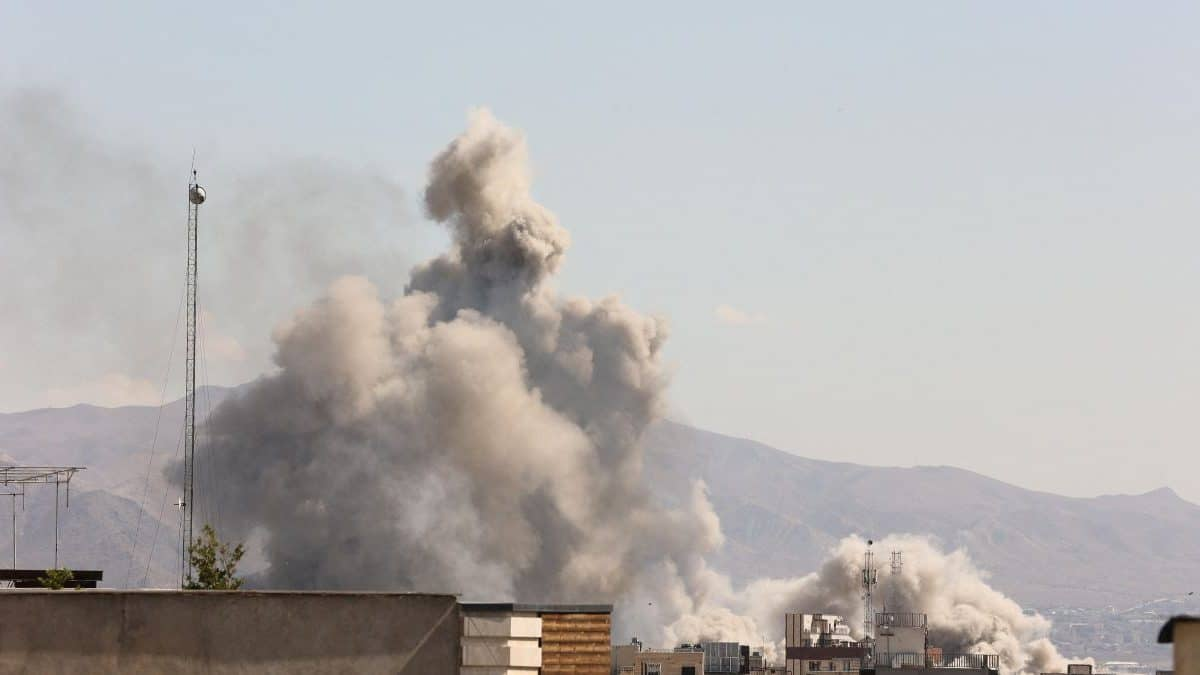
The smell of ozone usually belongs to a summer storm. But inside the corridors of Gandhi Hospital on a Tuesday night in Tehran, that sharp, metallic scent didn't signal rain. It signaled the end of a fragile peace.
Farid, a night nurse whose shoes clicked rhythmically against the linoleum, was checking a drip when the first vibration arrived. It wasn't a sound. It was a pressure in the marrow of his bones. Then came the roar—a sound so heavy it seemed to displace the very air in the room. The windows didn't just break; they dissolved into a thousand glittering diamonds that peppered the ward.
This is what happens when geopolitical chess moves from a map in D.C. or Tel Aviv into a hallway filled with the scent of antiseptic and the rhythmic hiss of ventilators.
The reported airstrikes, a coordinated effort between Israeli intelligence and U.S. tactical support, were aimed at high-value targets nestled within the city's infrastructure. On paper, these are "surgical" strikes. In reality, there is no such thing as a scalpel that weighs a thousand pounds. When the munitions hit, the ground becomes liquid. The lights flickered, hummed a dying note, and then vanished.
Silence in a hospital is terrifying.
The Weight of the Dark
In the intensive care unit, silence is a death sentence. The mechanical lungs that keep twenty souls tethered to this earth stopped their rhythmic pumping. For a heartbeat, the only sound was the settling of dust and the distant, frantic shouting from the street below.
Consider the logistics of a catastrophe. When a power grid fails under the weight of an explosion, the emergency generators are supposed to kick in within seconds. But Gandhi Hospital is an old veteran of a city under constant economic and political strain. The bypass failed.
Farid didn't think about the "why." He didn't think about the decades of tension between the Islamic Republic and the West. He didn't think about the nuclear rhetoric or the proxy wars in Lebanon or Yemen. He thought about Mrs. Amin, a seventy-year-old grandmother in Bed 4 who could not breathe on her own.
He reached for a manual resuscitator bag. In the dark, guided only by the glow of a nearby fire reflected off the smoke, he began to squeeze. Squeeze. Release. Squeeze. Release. He was now the only thing keeping her blood oxygenated. He was a human lung.
Outside, Tehran looked like a fever dream. The skyline, usually a glittering sprawl against the Alborz Mountains, was punctured by pillars of orange flame. The strikes had hit close—too close. The "chaos" described in news tickers doesn't capture the sensory overload of a city waking up to its own destruction. It is the sound of car alarms screaming in unison, the taste of pulverized concrete, and the sight of people running in pajamas, clutching children and plastic bags of documents.
The Invisible Stakes
We often talk about war in terms of "assets" and "capabilities." We analyze the range of an F-35 or the intercept rate of a missile defense system. We forget that the primary theater of war is the human nervous system.
The strategy behind these strikes is often "decapitation"—removing the leadership or the technical means of an enemy to function. But the nervous system of a city is interconnected. You cannot strike a communications hub or a logistics center without sending a shockwave through the civilian heart.
The Gandhi Hospital fire was a byproduct of this shockwave. Whether it was a direct hit, a stray fragment, or an electrical surge caused by the strikes, the result was the same: a sanctuary of healing became a chimney of black smoke.
Hypothetically, let’s look at a man named Saman. He is an engineer, the kind of person who knows how the city’s bones are put together. When the strikes hit, Saman wasn't thinking about the Revolutionary Guard. He was trapped in an elevator between the fourth and fifth floors of his apartment building. As the building groaned, he realized the terrifying truth of modern conflict. You don't have to be the target to be the victim. You just have to be in the way of the gravity.
The logic of the attackers is built on a cold calculus. If the cost of the status quo is higher than the cost of the strike, the button is pushed. But who calculates the cost of a missed heartbeat? Who accounts for the psychological trauma of a child who now associates the sound of a low-flying plane with the end of the world?
The Anatomy of an Airstrike
The technical precision of the U.S.-Israeli partnership is unparalleled. Using satellite imagery and signals intelligence, they can thread a needle from a different time zone. The weapons used are designed to collapse a building inward, minimizing "collateral damage."
But "minimal" is a relative term.
When a structure is hit, the pressure wave travels through the earth. It ruptures gas lines. It snaps water mains. In the case of Gandhi Hospital, the fire started in the upper tiers, a crown of flames that licked the night sky. The footage captured by terrified residents shows a cascade of sparks falling like malevolent snow.
Firefighters in Tehran are some of the best in the region, hardened by years of urban disasters. But how do you fight a fire when the streets are choked with panicked traffic and the sky might fall again at any moment? They worked in the shadow of a second wave, knowing that "double-tap" strikes are a common tactic in modern warfare—hitting a target, waiting for the first responders to arrive, and hitting it again.
They went in anyway.
The Cost of Being a Footnote
By dawn, the smoke over Tehran had thinned into a gray haze that tasted of burnt plastic and old sorrow. The official reports began to trickle out. Statements from Washington spoke of "deterrence" and "precision targets." Statements from Tehran spoke of "terrorism" and "violation of sovereignty."
Between these two pillars of rhetoric, the people of the city began the grim task of sweeping up.
Farid, the nurse, sat on a curb outside the hospital. His scrubs were stained with soot and something else he didn't want to identify. Mrs. Amin had been evacuated. She was alive, but her eyes were wide and vacant, fixed on a sky that had betrayed her.
The "chaos" was over, replaced by the heavy, leaden exhaustion that follows a brush with extinction.
We are told that these events are necessary for the greater balance of power. We are told that the world is safer when certain shadows are eliminated. Perhaps. But as the sun rose over the charred ribs of the Gandhi Hospital, safety felt like a fairy tale told by people who have never had to breathe through a manual resuscitator in the dark.
The real story isn't the explosion. It’s the silence that follows. It’s the way a city holds its breath, waiting for the next tremor, realizing that in the grand game of global influence, they are not the players. They are the board.
And boards are meant to be played on, broken, and eventually replaced.
Farid stood up, wiped his hands on his trousers, and turned back toward the ruins. There were still patients to move. There was still a job to do. The high-altitude bombers were gone, their pilots likely eating breakfast in a different world, leaving behind a city that would never again trust the sound of the wind.
He walked back into the smoke, a small, stubborn spark of humanity in a landscape designed to extinguish it.