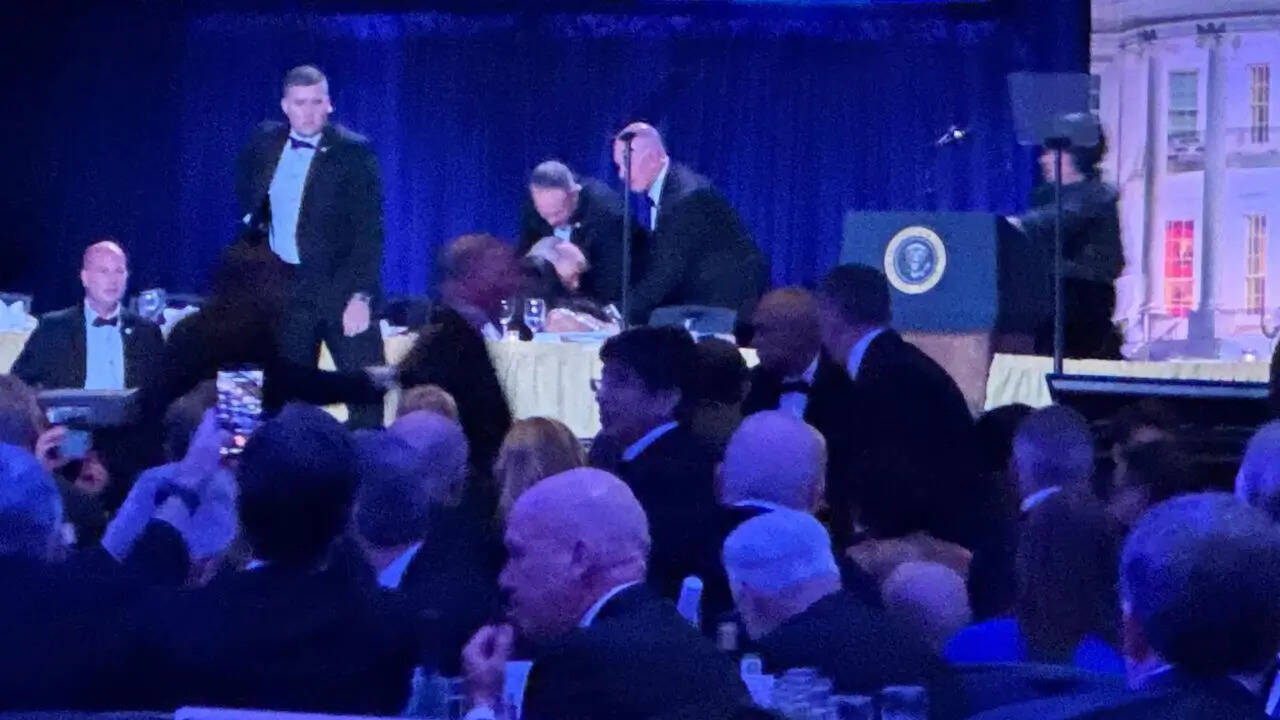
The air inside the Washington Hilton usually smells of expensive cologne, wilting lilies, and the distinct, metallic tang of ambition. On this particular Saturday, it was the epicenter of the American political machine—the White House Correspondents’ Dinner. Thousands of journalists, Hollywood stars, and power brokers were packed into the ballroom, safe behind layers of Secret Service checkpoints and the invisible shield of status.
Then came the sound.
It wasn't a bang. It was a ripple. It began as a murmur near the exits, a sudden hitch in the choreographed breathing of the room. Security details didn't walk; they surged. For those standing near the periphery, the shift in reality was instantaneous. The Washington elite, people who spend their lives projecting an image of total control, were suddenly vibrating with the raw, primal frequency of panic.
The Illusion of the Inner Circle
We like to believe that certain places are untouchable. We buy into the idea that power creates a vacuum where the chaos of the outside world cannot reach. But when the reports of "shots fired" began to tear through the crowd, that illusion dissolved like sugar in rain.
JD Vance was caught in the center of this sudden fracture. To the cameras, he is a figure of polarizing political consequence, a man defined by his rhetoric and his proximity to the highest office in the land. In that ballroom, however, he was simply a target requiring extraction.
The Secret Service does not ask for permission when the perimeter fails. They move with a violent efficiency that disregards social niceties. One moment, Vance was part of the gala’s glittering machinery. The next, he was being hauled through the guts of the hotel, surrounded by a phalanx of dark suits and adrenaline.
Imagine the sensation. The sudden grip on your arm. The shouted commands that override the polite hum of dinner conversation. The sight of men in formal wear—men who, minutes prior, were debating policy or gossiping about the latest polls—now hiking up their trousers to sprint toward the service elevators.
When the Narrative Breaks
The "gunfire" turned out to be a phantom. There was no shooter. There were no spent casings on the carpet. Initial reports suggest the panic may have been triggered by a loud noise—perhaps a falling equipment rack or a localized disturbance—that was misinterpreted by a crowd already primed for catastrophe.
This is the psychological core of the event. We live in an era where the expectation of violence is so pervasive that it functions as a secondary nervous system. We are always waiting for the floor to drop out.
Consider the "hypothetical attendee"—let’s call her Sarah, a junior staffer who spent three months' salary on a dress just to stand in the back of that room. When the surge started, she didn't think about the Second Amendment or the upcoming election. She thought about the distance between her chair and the nearest heavy door. She saw the most powerful people in the country looking over their shoulders with the wide-eyed stare of the hunted.
That collective trauma is real, even if the bullets weren't.
The evacuation of a high-profile figure like JD Vance is a mechanical process. It involves secure hallways, armored vehicles, and a pre-planned route that bypasses the public eye. But for the hundreds of others left in the ballroom, the experience was a chaotic scramble. People tripped over floor-length gowns. Wine glasses shattered on the floor, the red liquid looking uncomfortably like something else under the harsh emergency lights.
The Sound of Silence
The most haunting part of the footage isn't the shouting. It’s the silence that followed the initial rush. In the videos captured by trembling hands, you can see the empty chairs, the half-eaten plates of sea bass, and the abandoned clutches. It looks like a shipwreck.
In the aftermath, the headlines focused on the logistical failure. How could a noise cause such a breakdown? Why was the Vice Presidential candidate moved so aggressively? These are valid questions for a security audit, but they miss the human frequency.
The truth is that we are all living in a state of hyper-vigilance. The gala was a microcosm of a larger American anxiety. We gather in these fortresses of glass and stone, surrounding ourselves with guards and protocols, yet we remain deeply aware of how fragile the peace truly is.
Vance’s evacuation wasn't just a security maneuver; it was a reminder of the barrier that exists between the leaders and the led. While the crowd was left to navigate the confusion of the darkened hallways, the "assets" were whisked into the night. It highlights a recurring theme in our modern life: the unequal distribution of safety.
The Ghost in the Ballroom
By the time the "all clear" was given, the night was ruined. You can’t go back to laughing at a comedian’s monologue after you’ve prepared your mind for a mass casualty event. The adrenaline leaves a bitter aftertaste.
Critics will point to this event as an example of "panic culture," arguing that we have become too sensitive to noise, too quick to flee. But that critique ignores the reality of the last twenty years. People run because they have been taught, through a thousand headlines, that the sound of a falling rack is more likely to be a rifle than a mistake.
The Secret Service agents who grabbed Vance weren't acting on a whim. They were acting on a script written by a violent history. Their job is to assume the worst so that the worst doesn't happen. In this instance, the worst was a ghost, but the fear it conjured was flesh and blood.
As the limousines pulled away from the Hilton and the guests filtered out into the cool D.C. night, the conversation wasn't about the jokes or the fashion. It was about the moment the music stopped. It was about the sight of JD Vance disappearing into a shadow of security while the rest of the room stood frozen, waiting to see if the world was ending.
We returned to our homes, locked our doors, and checked the news to see what had actually happened. We found out it was nothing. Just a noise. Just a misunderstanding.
But the image remains: a room full of the world's most influential people, reduced to a panicked huddle, reminded in a single, terrifying heartbeat that no amount of power can truly silence the fear of the dark.
The tuxedo is a thin armor.