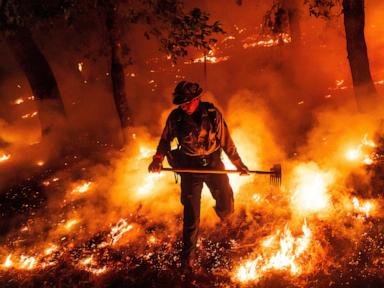
The media has a new favorite villain: the "zombie" wildfire that refuses to sleep. The narrative is predictably neat. We are told that rising global temperatures have stripped away the nighttime humidity recovery that once acted as a natural fire extinguisher. Because the air stays thirsty after dark, the flames keep eating. It sounds like a horror movie. It makes for a great headline. It also happens to be a dangerous oversimplification that ignores eighty years of catastrophic land management.
If you believe wildfires are burning 24/7 simply because it's a few degrees warmer at midnight, you have been sold a half-truth. Temperature is the spark. Fuel is the bomb. By obsessing over atmospheric moisture, we are ignoring the literal mountains of dry tinder we have stacked in our forests through a century of aggressive fire suppression.
We didn't just get "unlucky" with the weather. We engineered a landscape that is no longer capable of going to sleep, regardless of the humidity.
The Nighttime Humidity Myth
The conventional wisdom suggests that "vapor pressure deficit" (VPD) is the sole driver of the new overnight fire cycle. VPD is the difference between how much moisture the air can hold and how much it actually holds. When that gap widens, the air sucks moisture out of dead needles and fallen logs.
The "lazy consensus" argues that since nights are getting warmer, VPD remains high, and therefore fires don't die down.
Here is what they aren't telling you: A healthy, thinned forest can handle a high VPD night without turning into a firestorm. The reason these fires are "burning overtime" isn't just the air; it's the fuel continuity. We have spent decades putting out every small, natural fire that tried to clean up the forest floor. Consequently, our forests are now packed with 10 to 50 times the tree density they had in the 1800s.
When you have that much biomass packed into a tight space, the fire creates its own weather. It generates so much localized heat that it overrides the ambient humidity recovery. You could have a 90% humidity night, but if the fire is hot enough because it's devouring a century of unchecked undergrowth, that "cool night air" won't do a thing.
The Arrogance of Suppression
I have sat in rooms with land managers who have watched their budgets balloon into the billions while their success rates plummet. They are fighting a war against a biological necessity.
Fire is a janitor. It is supposed to clean the floor. By "protecting" our forests from every single flame for the last century, we have essentially refused to let the janitor into the building. Now, the trash is piled up to the ceiling, the wiring is frayed, and we are shocked—shocked!—that the building burns down when someone drops a match.
The media wants to blame the sun for staying up late. I blame the humans who thought they could stop a natural cycle indefinitely.
Stop Asking About Temperature Start Asking About Structure
Every time a major fire breaks out, the "People Also Ask" section of Google fills with queries like "How does climate change cause wildfires?" or "Why are fires worse at night now?"
The premise is flawed. Climate change doesn't cause the fire; it amplifies the conditions. But you cannot amplify a vacuum. If there were no fuel, the temperature wouldn't matter.
We need to talk about Forest Structure.
- Horizontal Continuity: Trees are now spaced so closely that a squirrel could travel for miles without touching the ground. This allows fire to jump from crown to crown with zero friction.
- Vertical Ladders: Small shrubs and mid-sized trees act as "ladders" that carry ground fires into the canopy.
- Fuel Loading: The sheer tonnage of dead wood per acre is at an all-time high.
When a fire hits a forest with this structure, the "nighttime recovery" becomes irrelevant. The thermal mass of the fire is so immense that it ignores the clock. We are seeing fires that burn through the night because we have provided them with a buffet that never ends.
The Fallacy of the Technological Fix
We love to think we can "innovation" our way out of this. We talk about satellite detection, AI-powered smoke sensors, and massive fleets of 747 Supertankers.
It's a waste of capital.
I’ve seen agencies dump millions into "predictive modeling" software that tells them exactly where a fire will go, only to realize they don't have the boots on the ground or the political will to do the one thing that actually works: Mechanical thinning and prescribed burns.
We are terrified of smoke. If a state agency plans a prescribed burn to clear out the undergrowth, the local community complains about the haze and the "risk." So, the agency cancels the burn. Then, three years later, a lightning strike hits that same patch of overgrown timber and creates a mega-fire that burns for three months, destroys 500 homes, and chokes the entire West Coast with toxic smoke.
The trade-off is simple: You either take a little bit of controlled smoke now, or you take a catastrophic amount of uncontrolled smoke later. There is no third option where the fire just goes away.
Why "Cooler Nights" Won't Save Us
Let's look at the physics. The energy release component (ERC) of a modern wildfire is significantly higher than it was forty years ago.
Imagine two campfires.
One is a small pile of twigs. When the sun goes down and the dew falls, that fire will likely smolder and die.
The second is a massive bonfire made of whole oak logs soaked in gasoline. Does that bonfire care if the temperature drops from 80°F to 60°F? No. The internal heat of the reaction is so great that the ambient environment becomes a secondary factor.
Our forests have become that second bonfire.
The "nighttime humidity" argument is a convenient scapegoat because it shifts the blame to a global phenomenon that feels out of our control. It absolves local governments and federal agencies of their failure to manage the land. If it’s "the climate," then it’s nobody’s fault. If it’s "fuel management," then someone has to lose an election or get fired for incompetence.
The Actionable Truth Nobody Wants to Hear
If we want fires to "go to sleep" again, we have to stop trying to put them all out.
- Managed Wildfire: We must allow natural, lightning-caused fires to burn in remote areas when conditions are right. This creates a mosaic on the landscape that acts as a natural fuel break.
- Hardened Communities: Stop building wood-frame houses in the Wildland-Urban Interface (WUI) and then demanding the Forest Service risk lives to save a deck made of cedar.
- Aggressive Thinning: We need to log. Not old-growth giants, but the "dog-hair" thickets of small, spindly trees that provide no habitat but infinite fuel.
This isn't a popular take. Environmental groups hate logging. Homeowners hate prescribed burns. Taxpayers hate the upfront cost of thinning.
But the alternative is the status quo: A world where the fire season never ends, the smoke never clears, and we keep blaming the "night air" for a disaster we built with our own hands.
The fire isn't burning overtime because it’s a workaholic. It's burning overtime because you gave it an infinite shift and a golden parachute.
Stop looking at the thermometer. Start looking at the ground.