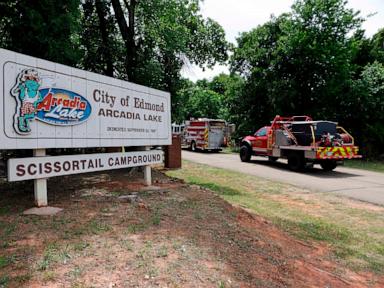
The chaos at a public park in Oklahoma, which resulted in 23 people wounded by gunfire, represents one of the most significant mass casualty shootings in the state's recent history. While initial reports focused on the immediate trigger—a verbal altercation between rival groups—the scale of the violence points to a much deeper systemic failure. This was not a random act of madness. It was the predictable outcome of escalating regional tensions and a catastrophic lapse in event security and preventative policing.
When nearly two dozen people are struck by bullets in a single location, the narrative shifts from a simple "fight gone wrong" to a question of how such an arsenal was allowed to congregate in a public space. Law enforcement officials have confirmed that the incident began as a dispute between two distinct parties before rapidly evolving into a multi-directional firefight. This event exposes the thinning line between local disputes and mass-casualty events in environments where high-capacity firearms are readily accessible and law enforcement presence is reactive rather than proactive.
The Anatomy of a Public Space Massacre
The violence did not occur in a vacuum. To understand why 23 people are now recovering from gunshot wounds, we have to look at the mechanics of the confrontation. Witnesses describe a festive atmosphere that soured within minutes. In these high-pressure environments, the transition from a verbal shouting match to a "hot" zone happens in seconds.
The sheer volume of shell casings recovered at the scene suggests that multiple shooters were involved, likely using semi-automatic handguns with extended magazines. This isn't just about one person with a grudge. It is about a culture where the immediate response to a physical threat is to spray lead into a crowded area, disregarding the presence of families, children, and bystanders. The ballistic evidence paints a picture of a "crossfire" scenario, where victims were caught between two or more shooters who had no regard for their surroundings.
The Security Gap
A gathering of this size requires more than just a permit. It requires a tactical understanding of the terrain. Oklahoma City police noted that while officers were in the general vicinity, they were not positioned to prevent the initial draw of weapons. This is the "security gap"—the space between a police presence that exists to "keep the peace" and a tactical presence that can actually deter a gunfight.
- Crowd Density: High-density gatherings in open-air parks make it nearly impossible for standard patrol units to identify concealed weapons.
- Response Time: Even a 30-second response time is too slow when a modern firearm can discharge 15 to 30 rounds in less than ten seconds.
- Perimeter Control: Without metal detectors or restricted entry points, public parks remain soft targets for individuals looking to settle scores with high-caliber tools.
The Failure of De-escalation in the Modern Era
We often hear the term "de-escalation" used by departments as a panacea for violence. However, de-escalation requires at least one party to be willing to talk. In the Oklahoma incident, the speed of the escalation suggests that both groups arrived at the park "pre-loaded." This means they were prepared for violence before the first word was ever exchanged.
Community leaders have long warned that the breakdown of local mediation programs has left a void. When young men believe that the only way to maintain "respect" or "safety" is through overwhelming force, the traditional methods of policing fail. You cannot de-escalate a bullet that has already left the barrel. The investigation now centers on whether these groups had a history of conflict that was known to local intelligence units but was not acted upon.
Intelligence vs. Patrol
Standard patrol shifts are designed to respond to 911 calls. They are not designed to monitor the simmering animosities of local factions. For years, specialized units focused on gang and group violence have seen their budgets shifted or their mandates restricted. The result is a blind spot in the heart of the community.
If the groups involved in the Oklahoma shooting had a documented history of beefs, the question must be asked: why was a high-risk gathering allowed to proceed without a visible, overwhelming police presence? This is not about infringing on the right to assemble. It is about the duty of the state to protect the lives of those who are assembling.
The Physical and Psychological Toll
Twenty-three victims. That number is staggering. It places this event in the same statistical tier as some of the most notorious mass shootings in the United States. Yet, because it is framed as a "fight" rather than a "mass shooting" by some outlets, the national outcry is often muted. This distinction is dangerous. A victim of a stray bullet feels the same pain whether the shooter was a "lone wolf" or a participant in a group brawl.
The medical response to the Oklahoma park shooting was a feat of modern trauma surgery. Local hospitals were flooded with patients, many arriving in private vehicles because the scene was too chaotic for ambulances to enter safely. This is "battlefield medicine" in the middle of a civilian park.
The Long-Term Impact on Public Spaces
When a park becomes a crime scene of this magnitude, it loses its status as a "common." It becomes a site of trauma. The long-term impact on the neighborhood is a decline in civic engagement. Parents stop bringing their kids to the playground. Local businesses see a drop in foot traffic. The "broken windows" theory suggests that small signs of disorder lead to bigger crimes, but a "23-person shooting" is not a broken window. It is a shattered foundation.
Gun Laws and the Reality of the Street
Oklahoma has some of the most permissive gun laws in the country. Proponents argue that a "good man with a gun" is the best defense against such violence. However, in the chaos of a 23-person shooting, the presence of more armed civilians often complicates the police response. Officers arriving on the scene cannot easily distinguish between a "defender" and an "aggressor."
The legal reality in Oklahoma also makes it difficult for police to conduct "stop and talk" interactions based solely on the presence of a firearm. This creates a environment where individuals can carry heavy firepower right up to the moment of the first shot. By the time a crime has been committed, the damage is already done.
The Myth of the "Clean" Shooting
There is no such thing as a clean gunfight in a crowded park. The physics of ballistics don't care about your intentions. A 9mm round can travel through a human target and continue for hundreds of yards, hitting someone who wasn't even involved in the original argument. This is exactly what happened in Oklahoma. The majority of the 23 wounded were likely not the intended targets. They were collateral damage in a war of egos.
The Investigatory Road Ahead
As the Oklahoma City Police Department sifts through video footage and forensic evidence, the pressure to produce "high-level" arrests is mounting. But arrests are a trailing indicator. They happen after the blood has been washed off the pavement.
The real investigation needs to focus on the chain of custody for the weapons involved. Were they straw purchases? Were they stolen? In many of these cases, the firearms are part of a local "pool" of weapons that move between different individuals. Breaking that supply chain is the only way to prevent the next Oklahoma City park incident.
The Role of Social Media in Real-Time Violence
We must also look at how digital platforms acted as an accelerant. It is common for these disputes to start on Instagram or "X" (formerly Twitter) and move into the physical world. If the police are not monitoring these digital spaces with the same intensity they monitor the streets, they are fighting a 21st-century war with 20th-century tools. The Oklahoma shooting was likely "broadcast" in parts before it ever began, through threats and posturing that went unflagged.
Moving Beyond the "Isolated Incident" Narrative
City officials often try to frame these tragedies as isolated incidents to prevent panic or damage to the city's reputation. This is a mistake. Calling a 23-person shooting an "isolated incident" is an insult to the victims and a dereliction of duty. It is a systemic event. It is the result of specific policy choices, budget allocations, and a failure to address the root causes of group violence.
The solution isn't just "more police." It is "smarter policing." This involves:
- Targeted Intervention: Using data to identify groups at high risk of violent confrontation and engaging them before the shooting starts.
- Event Tiering: Requiring a higher level of security presence for events that involve groups with known histories of conflict.
- Infrastructure Changes: Designing parks with better lighting, clear sightlines, and integrated camera systems that can provide real-time intelligence to responding officers.
The tragedy in Oklahoma is a warning shot for the rest of the country. As urban areas become more crowded and firearms become more powerful and prevalent, the potential for mass casualty events in public spaces only grows. We cannot afford to treat these as "fights" anymore. They are domestic security breaches.
The victims in Oklahoma face a long road to recovery, both physically and mentally. For the city, the recovery involves more than just hospital bills; it involves a total reassessment of how public safety is managed in an age of instant escalation. The blood on the grass at that park is a testament to the fact that our current strategies are failing. Change is not an option; it is a necessity for the survival of the American public square.
The immediate task is clear: find the shooters, recover the weapons, and provide for the victims. But the long-term task is far more difficult. It requires admitting that a fight leading to 23 people shot is not just a "crime"—it is a failure of the social contract. When people cannot gather in a park without the fear of being caught in a crossfire, the government has failed in its most basic duty to protect its citizens.
Oklahoma City must now decide if it will double down on the status quo or if it will lead the way in developing a new model of urban safety that accounts for the reality of modern firepower. The 23 wounded are waiting for an answer. Every resident who avoids the park this weekend is waiting for an answer. The time for "thoughts and prayers" has long since passed, replaced by a desperate need for tactical, legislative, and community-driven action. Stop treating the symptoms and start treating the rot.