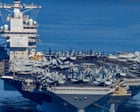
The USS Gerald R. Ford (CVN 78) represents a $13.3 billion bet on the future of power projection, yet its scheduled maintenance stop in Souda Bay, Crete, exposes the friction between theoretical capability and material reality. When a lead ship of a new class experiences simultaneous failures in basic habitation systems and advanced propulsion cooling, the issue is rarely isolated mechanical error. Instead, these symptoms point to a systemic failure in the "Design-for-Maintainability" loop. The transition from the Nimitz-class to the Ford-class involved 23 new technologies, a density of innovation that creates a fragile internal ecosystem where a failure in the Electromagnetic Aircraft Launch System (EMALS) or the Advanced Weapons Elevators (AWE) ripples through the ship’s operational tempo, ultimately degrading crew efficacy.
The Triple Constraint of Nuclear Surface Operations
To understand why a supercarrier requires unscheduled or accelerated pier-side intervention, one must analyze the intersection of three specific operational pillars. When these pillars lose alignment, the ship’s readiness enters a state of logarithmic decay.
- Systemic Complexity and Cascading Failure: The Ford-class utilizes an a-Zonal electrical distribution system. While this increases damage shocks resistance, it complicates localized repairs. A plumbing blockage or a fire in a galley isn't just a localized inconvenience; in a highly integrated hull, these events tax the Damage Control (DC) networks and the Advanced Waste Management System (AWMS).
- The Human-Machine Interface Gap: The Ford was designed for a significantly smaller crew than its predecessors—approximately 500 to 1,100 fewer personnel. This lean manning model assumes that automation will offset labor-intensive tasks. When automation fails (e.g., the plasma arc waste destruction system or automated valves), the remaining crew experiences an exponential increase in workload, leading to the "sinking morale" cited in recent reports.
- Material Readiness and Saltwater Degradation: Operating in the Eastern Mediterranean subjects the hull and internal cooling loops to specific salinity and temperature variables. Fire damage in high-voltage environments, such as those powering the Dual Band Radar (DBR), suggests that the thermal management systems are operating at the edge of their designed tolerances.
The Mechanics of Habitation Failure
The mention of "clogged toilets" in a multi-billion dollar asset sounds trivial to the layperson but represents a critical failure in the ship's Vacuum Waste System. Unlike gravity-fed systems on older ships, the Ford uses a vacuum-suction mechanism similar to those on commercial aircraft but scaled for thousands of users.
The bottleneck is not merely the diameter of the piping. The failure is a function of "Systemic Throughput." When the AWMS cannot process waste at the rate it is generated, the pressure differential in the lines fluctuates. This leads to frequent acid-flushing requirements—a maintenance procedure that costs roughly $400,000 per evolution. The operational cost of a "clogged toilet" on a CVN is not measured in plumber hours, but in the degradation of the "Quality of Life" (QoL) metric, which is the primary driver of sailor retention. In a lean-manned environment, every sailor performing manual waste extraction is a sailor not performing a mission-critical role in the Combat Direction Center or on the flight deck.
Thermal Dynamics and the Fire Damage Variable
Reports of fire damage during deployment typically stem from one of two sources: electrical arcing in new power distribution blocks or friction-based ignitions in the catapult machinery. The Ford’s move to an all-electric ship architecture means it carries significantly more cabling and high-output transformers than the Nimitz-class.
The heat signature of an all-electric carrier is massive. If the cooling loops—which rely on filtered seawater—suffer from bio-fouling or sediment intake in the shallower waters of the Mediterranean, the risk of electrical fires increases. A fire in a carrier is a "Class Alpha" or "Class Charlie" event that requires immediate isolation of the affected zone. Because the Ford’s systems are so tightly integrated, isolating one zone for fire repair often means powering down sensors or weapon systems in adjacent zones, effectively neutering the ship’s defensive posture.
The Crete Logistical Pivot
Choosing Crete for repairs is a strategic decision based on the infrastructure of Souda Bay. As the only deep-water pier in the Mediterranean capable of berthed maintenance for a carrier, it serves as a "Forward Operating Base" (FOB) for technical intervention.
The logistical flow for these repairs follows a rigid hierarchy:
- Priority 1: Specialized Technical Representatives (STRs). Because the Ford-class is proprietary in its many sub-systems, local Greek contractors cannot perform the work. Experts must be flown in from Newport News Shipbuilding or General Atomics.
- Priority 2: Parts Sourcing. The Ford-class does not yet benefit from the mature global supply chain of the Nimitz-class. Every specialized valve or circuit board must be pulled from the continental United States (CONUS) or scavenged from the CVN 79 (John F. Kennedy) currently under construction.
- Priority 3: Crew Restitution. The stop in Crete is as much about psychological repair as mechanical. The "morale" factor is a quantifiable metric in naval warfare, directly correlating to the "Mean Time To Repair" (MTTR). A fatigued crew makes more errors in standard operating procedures (SOPs), which in turn causes more mechanical failures.
The Illusion of Automation
The primary logic gap in the Ford's development was the over-estimation of autonomous system reliability. The "Pillars of Nimitz" were built on redundancy through labor; if a pump broke, there were fifty sailors available to man a manual bypass. On the Ford, the bypass is often a software-controlled solenoid. If the software glitches or the solenoid burns out, the "lean crew" lacks the manpower to sustain manual operations for extended periods.
This creates a "Fragility Loop":
- New technology fails due to high-cycle stress.
- Automated backups fail or are bypassed.
- The reduced crew is forced into 20-hour workdays to compensate.
- Exhaustion leads to "SOP Drift," where maintenance is deferred or rushed.
- Deferred maintenance causes a secondary, more severe system failure.
Quantifying the Strategic Cost of Deployment Delays
Every day the USS Gerald R. Ford spends at the pier in Souda Bay is a day the United States lacks a "Force Projection Multiplier" in a volatile theater. The opportunity cost is calculated in "Sortie Generation Rates" (SGR). The Ford is rated for a 33% higher SGR than previous carriers. However, an SGR of zero during a maintenance halt averages down the ship’s lifetime effectiveness.
The maintenance stop isn't just a repair window; it's a data-collection phase. The Navy is currently performing "Real-Time Engineering Analysis" to determine if the faults found in Crete are idiosyncratic to the CVN 78 or inherent to the class design. If the vacuum waste systems and electrical cooling loops are fundamentally undersized for Mediterranean thermals and high-capacity usage, the entire class—including the future Kennedy and Enterprise—will require massive, expensive mid-build redesigns.
The Operational Directive
To stabilize the Ford-class, the Department of the Navy must move away from the "Minimum Manning" philosophy and return to a "Redundancy-in-Personnel" model. The cost of additional berths and salaries is significantly lower than the $400,000 cost of a single system flush or the strategic cost of a carrier being sidelined during a regional crisis.
The immediate tactical move for the Ford's command is a "Deep-Cleaning and Calibration" cycle in Crete. This involves more than fixing the immediate clogs; it requires a full recalibration of the electrical bus controllers to prevent the surges that lead to fire damage. If the ship leaves Souda Bay without a fundamental adjustment to its power-load distribution software, the thermal issues will likely resurface before it reaches its next waypoint. The Mediterranean is an unforgiving testing ground for a ship that is essentially a floating prototype. Success is no longer measured by the number of planes launched, but by the ship's ability to remain at sea without its internal systems collapsing under the weight of their own complexity.