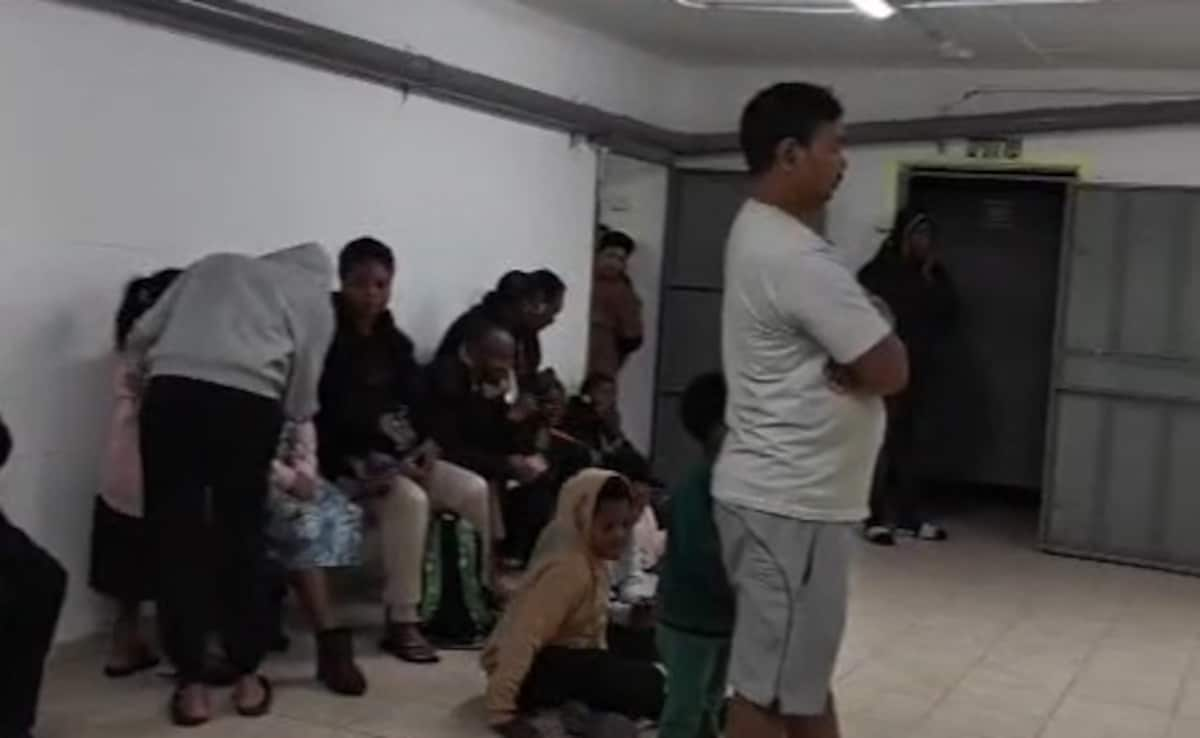
The survival of foreign nationals during a saturation-style ballistic missile engagement is not a matter of chance but a function of integrated urban engineering and psychological conditioning. When Iran launched a multi-wave missile attack against Israel, the safety of approximately 30,000 Indian nationals—primarily caregivers, students, and IT professionals—was secured by a three-tiered defensive architecture: kinetic interception (Active Defense), reinforced structural shelters (Passive Defense), and the Home Front Command’s digitized early warning system (Cognitive Defense). Understanding why this demographic remained largely unharmed requires deconstructing the mathematical reality of "Time-to-Impact" vs. "Time-to-Shelter."
The Physics of the Safe Room: Passive Defense Architecture
The primary reason Indian nationals survived in proximity to impact zones is the legal mandate of the Merkhav Mugan Di rati (Mamad), or Residential Secured Space. Unlike traditional basements used in Western storm-prone regions, the Mamad is a reinforced concrete cell integrated into the building's skeleton.
- Structural Integrity: A standard Mamad is constructed with 20–30 cm thick reinforced concrete walls designed to withstand blast overpressure and shrapnel from 122mm rockets or ballistic missile debris.
- Sealing Mechanisms: The heavy steel doors and airtight windows provide a barrier against chemical agents, though their primary utility in the current Iranian-Israeli context is mitigating the vacuum effect and secondary fires caused by kinetic impacts.
- Blast Deflection: The architectural placement of these rooms ensures that even if the surrounding apartment collapses, the reinforced core remains standing, creating a "survivable volume" within a destroyed structure.
Indian caregivers, who form a significant portion of the diaspora, operate under a specific protocol: the "Double-Vulnerable" protection model. They must manage their own transit to a Mamad while simultaneously moving elderly or immobile Israeli citizens. This creates a bottleneck in the Time-to-Shelter equation. In central Israel (Tel Aviv), the warning time is approximately 90 seconds. In the north (Haifa), it can be as low as 30 to 60 seconds.
The Mathematics of the Early Warning System
The Home Front Command (HFC) utilizes a localized alert system that segments the country into thousands of "polygons." When a missile trajectory is calculated by the "Green Pine" radar system, only the specific polygons in the predicted impact zone receive an alert. This prevents nationwide panic and economic paralysis.
For an Indian national in Israel, the alert arrives through three redundant channels:
- The Physical Layer: A network of high-decibel sirens using a rising and falling tone to indicate an incoming threat.
- The Digital Layer: Real-time push notifications via the HFC app, which uses GPS to determine the user's precise polygon.
- The Broadcast Layer: Interruptions on TV and radio, and increasingly, the use of Cell Broadcast technology which overrides phone silencers.
The efficiency of this system rests on the "False Alarm vs. Desensitization" ratio. If the system alerts too broadly, the population ignores it. If it alerts too narrowly, casualties rise. The Iranian attack, involving ballistic missiles with speeds exceeding $Mach 5$ during reentry, necessitated a high-precision calculation of the "Ellipse of Uncertainty"—the projected area where a missile might land after atmospheric friction and interception attempts.
Cognitive Load and the "Shelter Mentality"
The survival of Indian nationals is also a byproduct of rapid cultural assimilation into a high-threat environment. This is "Cognitive Defense." New arrivals from India, who may have no prior experience with missile warfare, undergo an informal but rigorous indoctrination into the "Rule of 10."
Standard HFC protocol dictates that individuals must remain in the shelter for 10 minutes after the last siren. This is not arbitrary. It accounts for two specific risks:
- Interception Debris: The Arrow-3 and David’s Sling systems intercept missiles at high altitudes. The kinetic energy of falling fragments can be as lethal as the original warhead.
- The Second Wave: Ballistic strategies often involve "clustering" or "staggering" launches to overwhelm the radar of the Iron Dome or to catch civilians as they exit their shelters.
The Indian Embassy in Tel Aviv acts as a secondary command node in this cognitive defense, translating HFC instructions into Hindi, Malayalam, and Telugu. This linguistic bridge is critical because stress inhibits the brain's ability to process a second language (Hebrew or English) during high-cortisol events.
The Geopolitical Risk Function
The Iranian-Israeli conflict introduces a variable that previous conflicts (such as those with Hamas or Hezbollah) lacked: the use of Medium-Range Ballistic Missiles (MRBMs) like the Kheibar Shekan or Fattah. These carry warheads ranging from 500kg to 1,500kg.
The kinetic energy $E_k = \frac{1}{2}mv^2$ of these payloads upon impact, even if partially intercepted, creates a cratering effect that can bypass standard basement shelters. Consequently, the reliance shifted from the "Iron Dome" (optimized for short-range rockets) to the "Arrow" system. For the Indian worker, this means the nature of the "bang" changes—interceptions are higher, louder, and create a wider debris field.
The "Safety Threshold" for a foreign national in this environment is determined by the proximity to "Sensitive Infrastructure." Many Indian workers are located in urban centers or near hospitals. While these areas are prioritized by active defense batteries, they are also "high-value targets" for an adversary attempting to saturate the defense grid.
Critical Vulnerabilities in the Diaspora Safety Net
Despite the sophistication of the Mamad and the HFC, three specific vulnerabilities remain for the Indian population:
- The "Pre-1991" Housing Gap: Buildings constructed before 1991 are not legally required to have Mamads. Indian students or low-wage workers living in older, cheaper apartments must rely on "Mamik" (communal floor shelters) or "Miklat" (public bomb shelters). The transit time to a Miklat often exceeds the missile flight time, forcing residents to shelter in stairwells—a suboptimal solution that provides only partial protection against lateral blasts.
- Psychological Attrition: Long-term exposure to siren cycles leads to "shelter fatigue," where individuals begin to calculate the statistical probability of a hit versus the inconvenience of moving.
- Communication Blackouts: In the event of a direct hit on cellular infrastructure or a deliberate GPS spoofing by the military (to confuse missile guidance), the digital layer of defense fails.
Strategic Protocol for Non-Combatants in Missile Corridors
For any foreign national operating within a high-intensity missile corridor, the following operational framework is the only viable path to mitigating risk:
- Audit the Structural Environment: Before signing a lease or employment contract, verify the presence of a Mamad. If unavailable, map the distance to the nearest Miklat. If the distance exceeds a 60-second walk, the location is statistically unsafe.
- Redundant Power and Comms: Maintain a dedicated battery-powered radio and a high-capacity power bank. In a saturation attack, the grid is the first secondary casualty.
- The Stairwell Protocol: In the absence of a reinforced room, the stairwell of a multi-story building is the safest "last resort." It serves as the building's structural spine and provides the most layers of concrete between the individual and the exterior atmosphere. Always stay at least two floors below the roof to avoid "top-down" penetration.
The survival of the Indian diaspora in Israel serves as a case study in the efficacy of civil hardening. It proves that a disciplined population, supported by rigorous engineering and clear communication, can survive a state-level ballistic assault with near-zero casualties. The strategic imperative for the Indian government moving forward is the formalization of "Civil Defense Literacy" for all citizens migrating to "Zone A" conflict regions.


