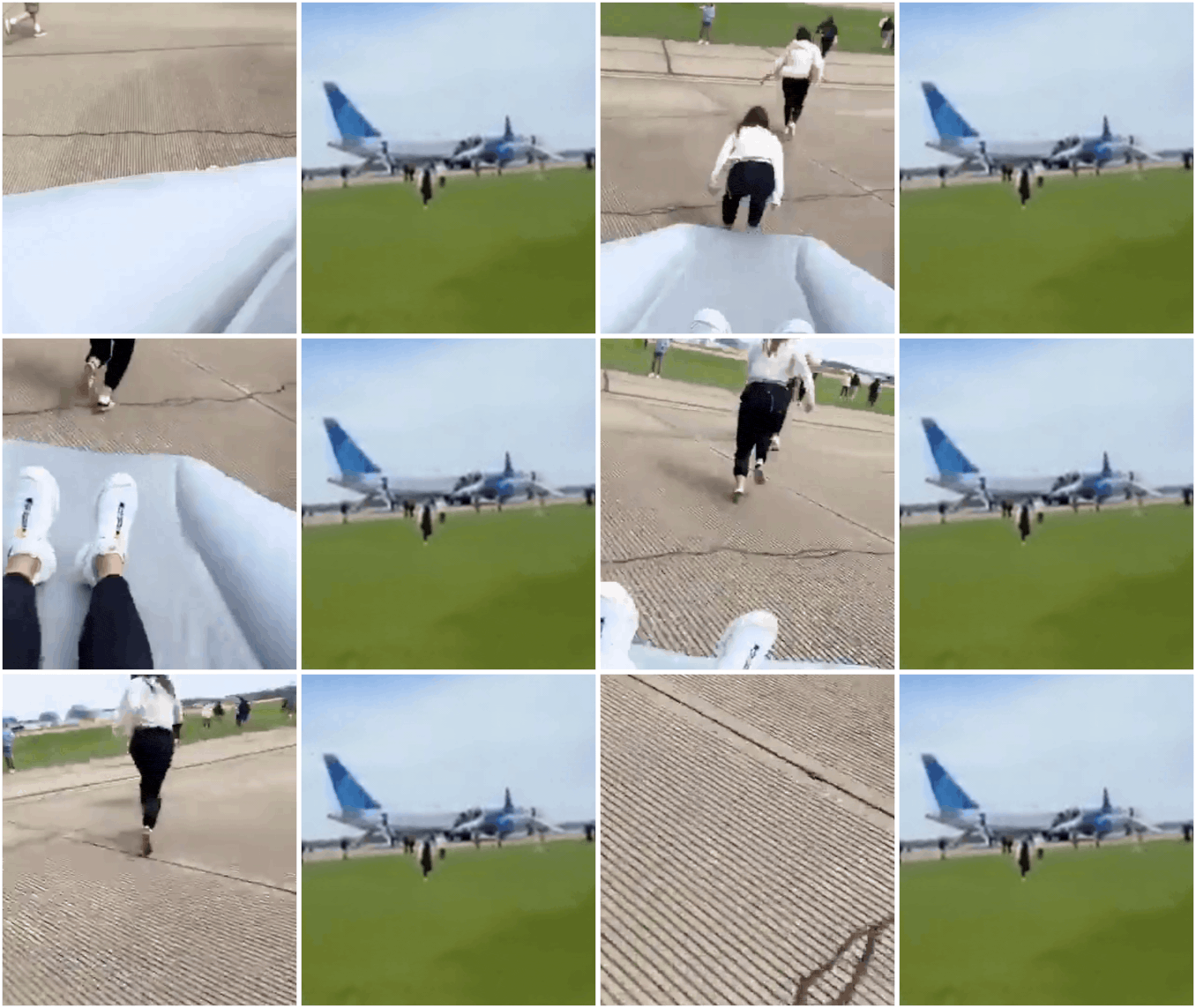
The diversion of United Flight 291 from Newark to Pittsburgh, culminating in a full-scale emergency slide evacuation, represents a critical breakdown in the aircraft’s primary life-support and propulsion systems. While media accounts focus on the spectacle of the yellow slides, a structural analysis reveals a complex intersection of pneumatic failure, risk-weighting by the flight crew, and the brutal economic reality of unplanned aircraft grounding. An emergency evacuation is not a precautionary measure; it is the final mitigation strategy in a failure chain where the risk of remaining on board—due to fire, smoke, or structural instability—outweighs the statistically significant injury rate associated with rapid deplaning via inflatable chutes.
The Anatomy of the Failure Chain
Aviation safety is built on the principle of redundant systems. When an aircraft diverts, it indicates that a primary system has entered a state of "Unacceptable Risk" or "Inoperative Status" under the Minimum Equipment List (MEL). In this specific incident involving a Boeing 737, reports of smoke in the cockpit or cabin signify a breach in the environmental control systems (ECS) or an electrical thermal event. In other developments, read about: The Blood and Iron Origins of the Peak District National Park.
The decision-making matrix for the pilot follows a rigid hierarchy:
- Aviate: Maintain aerodynamic control.
- Navigate: Divert to the nearest suitable airfield (Pittsburgh International, in this instance, provides the requisite runway length and emergency response infrastructure).
- Communicate: Declare an "Emergency" (Mayday) or "Urgency" (Pan-Pan) to prioritize air traffic flow.
The transition from a safe landing to an emergency evacuation occurs the moment the "Command" signal is given. This is triggered by a localized threat—specifically, the detection of fire or the inability to verify the integrity of the airframe. Remaining at a gate is the preference; evacuating on a taxiway indicates that the threat was perceived as immediate and life-threatening. The Points Guy has analyzed this important subject in extensive detail.
The Physics and Mechanics of Slide Deployment
Emergency evacuation slides are engineering marvels designed to function in less than six seconds. They are powered by high-pressure gas aspirators.
The system operates on a dual-gas inflation principle. A compressed gas cylinder (typically nitrogen and carbon dioxide) provides the initial pressure, but the volume of the slide is too great for a single tank to fill quickly without adding prohibitive weight to the aircraft. Instead, the high-pressure stream passes through an aspirator—a Venturi-effect device—that pulls in ambient air at a ratio of approximately 500:1. This allows the slide to reach the necessary rigidity to support the weight of sequential human impacts in seconds.
The risk profile of these devices is non-zero. Injuries during slide evacuations are frequent, occurring due to:
- Friction Burns: High-speed descent against synthetic materials.
- Impact Trauma: Improper landing posture at the base of the slide.
- Deceleration Force: The transition from a 40-degree incline to a horizontal stop.
By ordering an evacuation, the pilot is effectively trading a high probability of minor injuries (sprains, abrasions) for the mitigation of a low-probability, high-severity event (smoke inhalation or hull fire).
The Logistics of Ground Disruption
When an aircraft terminates its flight on a taxiway rather than a gate, it creates a "logistical bottleneck" that ripples through the airport’s operational efficiency. Pittsburgh International, while equipped for such events, must immediately freeze ground movements in the vicinity of the incident.
The recovery process involves three distinct phases:
- The Triage Phase: Passengers are moved from the taxiway to the terminal via busing. This bypasses traditional security and customs flows, requiring immediate coordination between the airline, the TSA, and local airport authorities to maintain the "sterile" status of the terminal.
- The Forensic Phase: The National Transportation Safety Board (NTSB) and the Federal Aviation Administration (FAA) assume jurisdiction. The aircraft cannot be moved until the cockpit voice recorder (CVR) and flight data recorder (FDR) data are secured and initial physical evidence is documented.
- The Extraction Phase: Removing an aircraft with deployed slides is a slow process. The slides must be detached or deflated and stowed, and if the brakes have seized due to high-energy emergency braking, the aircraft must be towed using specialized heavy-lift equipment.
The Economic Cost Function of a Diversion
The financial impact on United Airlines extends far beyond the immediate repair of the aircraft. The "Cost of Failure" for an emergency evacuation can be modeled by the following variables:
Total Cost = (Fuel Burn + Landing Fees) + (Passenger Re-accommodation) + (Slide Repacking/Replacement) + (Opportunity Cost of Grounded Hull)
- Slide Replacement: Once deployed, an emergency slide cannot simply be folded back into the door. It must be sent to a certified repair station for a full overhaul and pressure test. The cost for a single slide deployment—including labor and certification—often exceeds $30,000. With multiple doors deployed, the hardware cost alone enters the six-figure range.
- Hull Downtime: A Boeing 737 generates revenue only when in flight. Every hour the aircraft sits in Pittsburgh for inspection is an hour it is not fulfilling its scheduled rotations across the network. For a major carrier, the daily revenue loss for a narrow-body aircraft can range from $50,000 to $100,000.
- Reputational Hedging: Airlines manage the "social cost" of these events through rapid re-accommodation. Providing vouchers, hotel stays, and alternative flights is a defensive expenditure designed to prevent long-term customer churn.
Operational Vulnerabilities in Modern Fleet Management
The incident raises questions regarding the aging cycles of narrow-body fleets. While the 737 is a workhorse, the frequency of "fumes in the cockpit" incidents across the industry points to a specific mechanical vulnerability: the "Bleed Air" system.
Most commercial aircraft (excluding the Boeing 787) use air bled off the engines to pressurize the cabin. If a seal fails in the engine's bearing chamber, turbine oil can enter the air stream, flash-boil, and enter the cabin as toxic smoke or "dirty air." This creates a binary choice for the crew: continue to breathe compromised air or execute a high-risk emergency descent and evacuation. The failure of a component worth a few hundred dollars—a carbon seal—can thus trigger an operational loss of half a million dollars and endanger hundreds of lives.
Human Factors and the Failure of Passenger Compliance
A recurring bottleneck in emergency evacuations is the "Luggage Variable." FAA regulations require passengers to leave all belongings behind to ensure a 90-second evacuation time. However, data from recent evacuations shows a persistent trend of passengers attempting to retrieve overhead bags.
This behavior creates a "flow impedance" that can be lethal. In a smoke-filled cabin, the difference between a 90-second exit and a 120-second exit is the difference between life and death due to carbon monoxide poisoning. The Pittsburgh incident, while successful, highlights the ongoing struggle for flight crews to maintain "Command and Control" over a panicked civilian population.
Tactical Recommendations for Fleet Operators
To mitigate the recurrence and cost of such diversions, carriers must move beyond reactive maintenance into high-fidelity predictive analytics.
- Sensor Integration: Implementing real-time air quality sensors within the ECS ducts can distinguish between "nuisance smoke" (dust on a heater) and "thermal events" (oil or electrical fires). This provides the cockpit with better data to decide between a standard deplaning and a slide evacuation.
- Dynamic Rerouting: Using AI-driven dispatch tools to identify diversion airports that have not just the longest runways, but the highest density of maintenance personnel for that specific airframe type.
- Passenger Education Overhaul: Replacing the standard safety briefing with high-impact, data-driven explanations of why luggage must be left behind. Fear of property loss must be countered with a clearer understanding of the physics of fire spread in a pressurized aluminum tube.
The Pittsburgh evacuation is a testament to the efficacy of current safety protocols, but it also serves as a warning. The margin between a controlled emergency and a catastrophe is thin, held together by the rapid inflation of a nylon slide and the split-second decision-making of a flight crew operating under extreme cognitive load. Continuous improvement in the reliability of bleed air systems and stricter enforcement of evacuation protocols are the only paths to reducing the frequency of these high-cost, high-risk events.